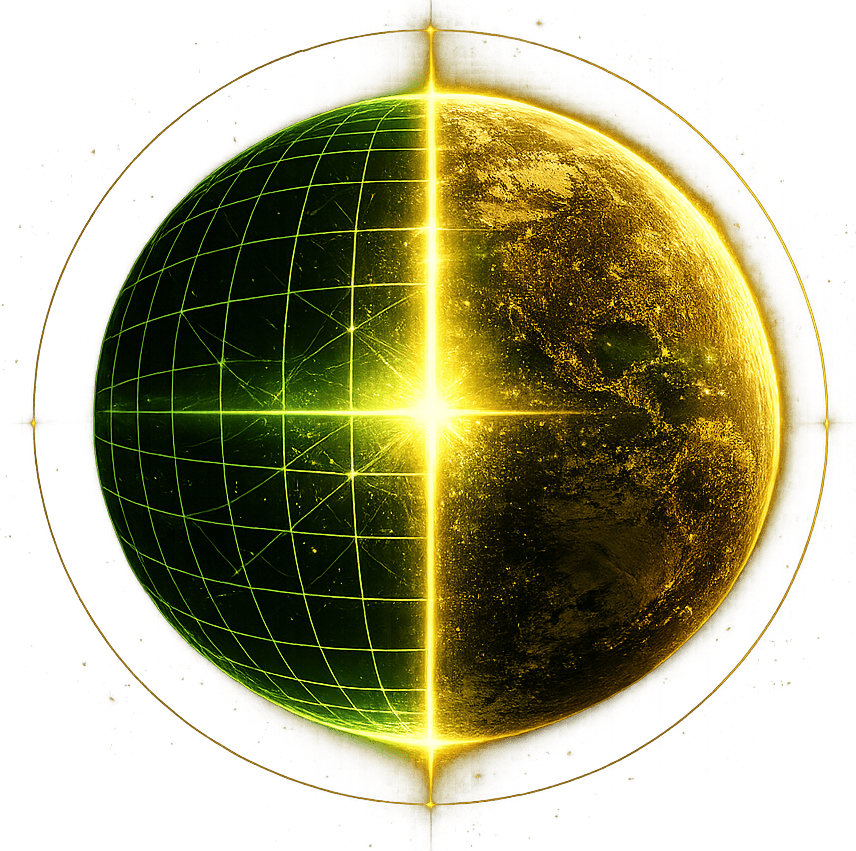
Truth vs illusion isn’t a philosophical luxury. It’s the central question of conscious existence. Every tradition that looked carefully at reality arrived at the same unsettling conclusion: what you experience as solid, fixed, and undeniable is a constructed interface, not the territory itself. The mind doesn’t record the world. It builds it, edits it, and then hides the edits. What you call truth is often just the story your nervous system agreed to stop questioning.
This isn’t abstract theory. Neuroscience confirms it. The brain receives roughly 11 million bits of sensory data every second but processes only about 50. The rest is filtered, compressed, and discarded before it ever reaches conscious awareness. What survives that bottleneck isn’t raw reality but a simplified model optimized for survival, not accuracy. You don’t see the world as it is. You see a rendering built from expectation, memory, and inherited assumptions.
Which raises the harder question: if perception is a filter, how much of what you defend as truth is just familiarity in disguise?
The Mechanism Behind the Filter
The brain’s gatekeeper is called the Reticular Activating System, or RAS. It sits at the base of the brainstem and decides what information reaches conscious awareness. Without it, you’d be paralyzed by sensory overload. With it, you experience a stable, navigable world. But that stability comes at a cost. The RAS prioritizes what it considers relevant based on your current goals, emotional state, and beliefs. It doesn’t show you reality. It shows you what it thinks you need to see.
This is why two people can witness the same event and walk away with opposite memories. Their filters were set differently. One person’s RAS was scanning for threat. The other’s was scanning for opportunity. Neither saw the full picture. Both experienced a custom-rendered version shaped by what they were already primed to notice. The illusion isn’t that the event happened. The illusion is that either person saw it objectively.
Cognitive science calls this confirmation bias, the tendency to notice information that supports what you already believe. But it runs deeper than selective attention. The mind doesn’t just favor certain inputs. It actively generates predictions about what should happen next and displays those predictions as if they were live perception. What you experience as the present moment is actually a blend of delayed sensory input and predictive modeling. The brain smooths over gaps, fills in blind spots, and constructs continuity where none exists. Reality feels seamless because the glitches are edited out before you notice them.
Ancient Maps of the Same Territory
Long before modern neuroscience mapped the mechanics, spiritual traditions across every continent named the problem. Hinduism called it Maya, the grand illusion. Buddhism described it as emptiness, the recognition that all phenomena lack inherent existence and arise only through interdependent causes. Plato’s cave showed prisoners mistaking shadows for reality, unable to turn toward the light because the chains felt normal.
These weren’t poetic metaphors. They were diagnostic maps. The sages recognized that human beings mistake a mediated experience for direct contact with truth. What we call the world is a projection, and the projector is running inherited code. Culture, language, trauma, and repetition all shape the filter. Most people never question the display because the display is all they’ve ever known.
Gnostic texts went further, describing the material realm as a construct maintained by a lesser creator, the Demiurge, who veiled the divine source. Whether taken literally or symbolically, the teaching points to the same mechanism: reality as experienced is not reality as it is. To wake up is to see through the veil, not by rejecting the world but by recognizing the interface.
The convergence is striking. Separate traditions, centuries apart, isolated by geography and language, all arrived at the same conclusion. That kind of agreement isn’t coincidence. It’s a signal. The grand illusion isn’t a fringe idea. It’s one of humanity’s most documented insights.
The Double-Slit Experiment and Observer-Dependent Reality
Modern physics reinforced the ancient claim from an unexpected direction. The double-slit experiment, first conducted with light and later replicated with electrons, demonstrated that particles behave differently when observed. Fire electrons through two slits without measuring which slit they pass through, and they act like waves, creating an interference pattern. Place a detector to observe the path, and the wave function collapses. The electrons behave like particles, passing through one slit or the other.
The implications are profound. At the quantum level, reality does not finalize until it is observed. Before measurement, particles exist in superposition, holding multiple potential states simultaneously. Observation collapses that potential into a single outcome. The act of looking doesn’t just record what’s there. It participates in determining what becomes real.
This isn’t mysticism. It’s repeatable, peer-reviewed physics. And it mirrors what the mystics said: consciousness is not a passive witness but an active participant in the unfolding of reality. The observer and the observed are not separate. They are entangled.
Why the Mind Prefers Illusion
If truth is available, why does the mind cling to illusion? Because certainty feels safer than uncertainty. The brain evolved under conditions where missing a threat cost more than missing an opportunity. Fear, caution, and pattern recognition were survival advantages. The mind that questioned everything died young. The mind that accepted the familiar, even when the familiar was wrong, lived long enough to reproduce.
This creates a built-in bias toward belief perseverance. Once a worldview is installed, contradictory evidence doesn’t update the model. It triggers defense. Neuroscience shows that when core beliefs are challenged, the same brain regions activate as during physical pain. To the nervous system, being wrong feels like being attacked. The ego doesn’t defend truth. It defends continuity.
This is why dogma persists across generations. It’s not that people are stupid. It’s that the mind treats inherited belief as part of identity. To question the belief feels like self-erasure. The illusion becomes load-bearing. Pull it out, and the whole structure threatens to collapse. So the mind doubles down, reinterprets evidence, and rebuilds the story to preserve the filter it’s always known.
Social reinforcement amplifies this. When everyone around you shares the same assumptions, those assumptions feel like facts. The collective illusion becomes consensus reality. Dissent isn’t just wrong; it feels dangerous. The bandwagon effect, groupthink, and in-group bias all serve the same function: they protect the shared narrative from scrutiny.
The Simulation Hypothesis as Modern Framework
In recent decades, the language shifted from mysticism to technology, but the insight remained the same. Simulation theory asks whether the reality we experience is base reality or a rendered construct. Philosopher Nick Bostrom formalized the question in 2003, proposing that if civilizations can create realistic simulations, and if they run many such simulations, then statistically we are more likely to be inside one than outside it.
The hypothesis isn’t science fiction. It’s a logical extension of computational theory and probability. And it maps cleanly onto the ancient claim. What the Vedic texts called Maya, what Plato called shadows, simulation theory calls a rendered environment. The framework changes. The structure beneath it does not.
Evidence from quantum mechanics supports the analogy. Reality behaves as though it conserves computational resources. The universe doesn’t render what isn’t observed. Particles remain probabilistic until measurement forces them into definition. This mirrors how video games only load the environment within the player’s line of sight. Everything outside that cone exists as compressed data, not fully realized form. The parallel is too clean to dismiss.
If the universe operates like code, then truth vs illusion becomes a question of recognizing the interface. The display is real in the sense that it functions. But it’s not the source. To mistake the icon for the program is to remain trapped inside the desktop metaphor, convinced that deleting a file icon erases the data itself.
Coherence as the Way Through
Seeing through illusion doesn’t mean rejecting the world. It means understanding the relationship between observer and observed. The key is coherence, the alignment of perception, belief, and action into a unified signal. When the mind is fragmented, scattered across fear, distraction, and contradiction, it collapses into a narrow particle state. Potential contracts. Reality reflects that contraction back.
But when awareness stabilizes, when attention becomes focused and emotion becomes clear, the wave state holds. Potential remains open. The field responds differently. This isn’t magic. It’s the observer effect scaled to lived experience. What you hold in coherence, the system treats as instruction.
Ancient practices understood this. Meditation quiets the predictive mind, allowing direct perception to surface. Fasting removes metabolic noise, sharpening the signal. Prayer, when stripped of petition and performed as pure focus, functions as intentional broadcasting into the field. Every tradition that taught mastery taught some version of coherence training. The methods varied. The mechanism did not.
Modern biofeedback research confirms the principle. Heart-brain coherence, measured by HeartMath Institute and others, shows that when the heart’s rhythm stabilizes into a smooth, ordered pattern, the brain synchronizes. Cortisol drops. Cognitive performance improves. The nervous system shifts from survival mode to integration mode. Coherence isn’t a metaphor. It’s a measurable state with measurable effects.
The question becomes practical: what are you broadcasting? If your inner state is chaos, the reflection will be chaotic. If your attention is fragmented, the outcomes will be fragmented. The system isn’t punishing you. It’s mirroring you. The full synthesis of how perception, vibration, and biology converge into a single mechanism is detailed in Chapter 5 of Master Thyself. But the foundation is already visible here: truth emerges when the filter is recognized and coherence is sustained.
Discernment, Not Denial
To navigate truth vs illusion requires discernment, the ability to hold multiple perspectives without collapsing into certainty or cynicism. This is harder than it sounds. The mind wants resolution. It wants to land on an answer and defend it. But premature certainty is just another form of illusion. It trades one filter for another without ever seeing the mechanism.
Discernment begins with humility. Recognize that your perception is partial. Acknowledge that belief shapes experience more than experience shapes belief. Notice when the mind is defending rather than exploring. Those moments of defensiveness are the seams in the construct, the places where the illusion is working hardest to maintain itself.
Discernment also requires testing. Don’t accept an idea just because it feels true. Don’t reject it just because it threatens identity. Embodied practice reveals what theory cannot. If a teaching produces coherence, clarity, and measurable change, it points toward truth. If it produces confusion, dependency, and stagnation, it’s reinforcing illusion. The fruit reveals the tree.
This doesn’t mean all perspectives are equal. Some maps are more accurate than others. But the accuracy isn’t determined by consensus or authority. It’s determined by whether the map helps you navigate the territory. Truth is what remains when the filters are stripped away. Illusion is what collapses under scrutiny.
The Role of Language in Shaping Reality
Language is one of the deepest filters. Every word you speak is a vibrational pattern that organizes perception. Repetition installs belief. Belief generates expectation. Expectation shapes what the RAS allows through. This is why mantras work. This is why propaganda works. Both use the same mechanism: repeated sound imprints meaning into the subconscious, bypassing critical analysis.
The choice of language determines the reality you inhabit. Speak in terms of lack, and the mind scans for scarcity. Speak in terms of abundance, and the filter adjusts accordingly. This isn’t positive thinking. It’s recognition that language programs the observer, and the observer participates in collapsing the wave function of potential into lived experience.
Some traditions treated language as sacred technology for exactly this reason. Hebrew, Sanskrit, and ancient Greek all embedded numerical and symbolic weight into their alphabets. The hidden structures within sacred texts weren’t decorative. They were operational. The words weren’t just describing reality. They were encoding instructions for how to engage it.
Modern linguistic research on the Sapir-Whorf hypothesis shows that language shapes thought in measurable ways. Cultures with different grammatical structures literally perceive time, causality, and agency differently. The words available determine the thoughts possible. If truth vs illusion is a question of seeing clearly, then the first place to audit is the language running in your head.
Breaking the Loop
The loop is self-reinforcing. Belief generates perception. Perception confirms belief. The mind mistakes the loop for truth because the feedback is consistent. Breaking the loop requires introducing a variable the system wasn’t designed for: conscious observation without identification.
This is what meditation trains. Not the suppression of thought, but the recognition that thought is an event, not the self. The moment you can watch a belief without being absorbed by it, the filter becomes visible. The illusion doesn’t disappear. But it loses its authority. You see it as a construct rather than a given.
The same principle applies to emotion. Fear, anger, and shame are vibrational states that narrow perception. They collapse the wave into a single defensive trajectory. But when emotion is observed rather than obeyed, it becomes information. The collapse reverses. The field opens again. Coherence returns.
This isn’t spiritual bypassing. You don’t transcend by pretending the illusion isn’t real. You transcend by recognizing the mechanism and choosing which frequency to sustain. The illusion is still there. But you’re no longer trapped inside it. You’re operating it.
The Signature of Truth
Truth has a signature. It simplifies without reducing. It clarifies without dismissing. It unifies patterns that seemed contradictory. When a principle is true, it scales across domains. Geometry, biology, consciousness, and cosmology all reflect the same underlying order. The language shifts. The structure repeats.
Illusion, by contrast, requires maintenance. It fragments under scrutiny. It depends on ignorance, repetition, and authority to remain stable. The moment you examine it closely, contradictions appear. The story doesn’t hold. This is why institutions that traffic in illusion resist transparency. Transparency is fatal to constructed narratives.
Truth doesn’t need defense. It invites investigation. The more you look, the more coherent it becomes. This is how you distinguish signal from noise. If a teaching deepens under examination, it’s pointing toward truth. If it collapses, it was always illusion.
Practical Application
Knowing the difference between truth and illusion isn’t enough. The knowledge must become practice. Start with what you repeat. Audit the words, the media, the people, and the environments you expose yourself to daily. Each one is a frequency input. Each one is programming your filter.
Notice when certainty arises too quickly. That’s the ego defending the construct. Notice when defensiveness flares. That’s the illusion protecting itself. Notice when synchronicity increases. That’s coherence aligning perception with a deeper pattern.
Test your beliefs against reality, not consensus. Reality doesn’t care what you believe. It reflects what you are. If your inner state is fragmented, chaotic, or rooted in fear, the outer world will mirror that back. If your state is clear, focused, and aligned, the reflection changes. This isn’t wishful thinking. It’s observable cause and effect once the mechanism is understood.
The path forward isn’t escaping the illusion. It’s mastering the relationship with it. You don’t leave the simulation. You wake up inside it. And once awake, you stop being a character reacting to the script. You become the one writing it.