Are We Living in a Simulation?
"Are We Living in a Simulation?" 8 Reasons the Math Says Yes
When physicists ask "are we living in a simulation," they begin with the fact that modern physics says reality does not finalize until observed. Ancient texts said the same thing two thousand years before quantum mechanics. They also named the architect.
The math is in. The physics is in. The texts have been in for two thousand years.
"Are we living in a simulation" is no longer a fringe question. The simulation hypothesis is no longer a fringe philosophy paper. The question "are we living in a simulation" has migrated from science fiction to working hypothesis. The 2022 Nobel Prize in Physics confirmed that reality has no fixed properties until measured. The question "are we living in a simulation" stopped being absurd at that point. Bostrom's trilemma, the formal "are we living in a simulation" framework, has not been refuted in twenty years. The "are we living in a simulation" position has only gained ground. The math says we are almost certainly inside a rendered system. So when somebody asks "are we living in a simulation," the honest answer is yes, probably. The harder question is who built it, and why nobody seems to want you to know.
If you are skeptical, that is the right reflex. Most people who bring up simulation theory do it badly. They cite Elon Musk, mention The Matrix, and stop. That is not the case. Here is what the case actually looks like.
Philosopher Nick Bostrom published a paper in 2003 asking "are we living in a simulation" and laying out a trilemma: The "are we living in a simulation" trilemma says either advanced civilizations never reach the stage where they can run ancestor simulations, or they choose not to, or we are almost certainly inside one. The "are we living in a simulation" argument is mathematical. It has not been refuted. The most-published physicists on Earth have engaged with it seriously. The conclusion most of them quietly arrive at is the third option.
Modern quantum mechanics keeps producing results that fit a rendered-system model and break a solid-matter model. The double-slit experiment shows that particles do not have definite properties until observed. Quantum entanglement violates locality. The 2022 Nobel Prize confirmed that reality does not carry fixed values independent of measurement. The universe behaves like a system that finalizes only when engaged.
Ancient traditions said the same thing in different language. The Hindus called it Maya. The Buddhists called it Sunyata. The Gnostics, asked "are we living in a simulation" before the question had a name, identified the architect explicitly. They called him Yaldabaoth, the blind craftsman, the Demiurge. They wrote escape instructions. The Church burned almost every copy. Fifty independent traditions arrived at the same diagnosis without contact.
The remaining question is not whether the simulation thesis is plausible. It is. The remaining question is what the system is doing, who runs it, and what you can do about it. The honest answer to all three is in Master Thyself. The framing here is the doorway.
Seven scientific findings that fit a simulation better than they fit solid matter
None of these are fringe. All are peer-reviewed. All have been replicated. None of them sit comfortably inside a "the universe is solid stuff" worldview.
1. The Quantum Observer Effect
In the double-slit experiment, particles act like waves until measured. Once observed, they collapse into definite outcomes. Reality finalizes only when recorded. This is not philosophy. It is the most-replicated finding in modern physics.
2. Quantum Entanglement
Two particles, once entangled, behave as a single system regardless of distance. Measure one, and the other reacts instantly. Bell tests have confirmed this. Locality is not a feature of the underlying system. Distance is a rendering convention.
3. The 2022 Nobel Prize
Alain Aspect, John Clauser, and Anton Zeilinger won for experiments confirming that reality does not carry fixed properties until measured. This was front-page news. Most people did not register what it meant.
4. The Holographic Principle
A serious working hypothesis in theoretical physics. The three-dimensional world we experience is encoded on a two-dimensional surface, the way a hologram works. Solidity and depth are decoded outputs of a flatter substrate. The Hindus called it Maya. The physicists call it the holographic principle.
5. The Speed of Light as a Processing Limit
Information cannot move faster than light. This functions as a cosmic processing speed cap, the same way data flow in a computer is limited by bus speed. A universe with a built-in maximum signal rate is the kind of universe an engineer would build.
6. Discrete Time Crystals
In 2021, Google's Sycamore quantum processor produced a phase of matter that cycles between states indefinitely without consuming energy. The pattern keeps regenerating. A universe defending its own structure regardless of what happens on the surface layer is not noise. It is system behavior.
7. Consciousness Persists When the Brain Is Offline
During deep anesthesia or flatlined EEG, some patients report verified perceptions of surgery details. Awareness persists when the hardware is offline. The character is the brain. The player is something else, watching from somewhere else.
8. Fine-Tuning of Physical Constants
The gravitational constant, the speed of light, the charge of an electron, all are tuned to permit life. Small variations would render the universe sterile. Reality looks less like chance and more like parameters adjusted in a model.
The math problem behind "are we living in a simulation" that nobody has solved. So when scientists ask "are we living in a simulation" today, the calculation favors yes. solved
In 2003, philosopher Nick Bostrom (Oxford) asked "are we living in a simulation" and published a paper titled "Are You Living In a Computer Simulation?" The argument is not science fiction. It is statistics. Three possibilities are exhaustive, and one of them must be true.
Advanced civilizations always go extinct before they can run simulations
Every civilization that reaches sufficient computing power destroys itself first, every time, without exception. This is the "great filter ahead" possibility. If true, the prognosis for humanity is grim.
Civilizations that could run simulations choose not to
For ethical reasons, or boredom, or some other consistent universal preference, no advanced civilization ever bothers running ancestor simulations. The math requires that this be a universal preference. One civilization choosing to do it once breaks the option.
We are almost certainly already in a simulation
If even one advanced civilization runs even a few simulations, then simulated minds vastly outnumber biological ones. The probability that you are biological rather than simulated approaches zero. This is the option most physicists end up at when they engage with the argument seriously.
The trilemma has been engaged with by philosophers, physicists, and computer scientists for two decades. It has not been refuted. The implications are taken seriously enough at the highest levels of theoretical physics that papers about it appear in mainstream journals without controversy. The popular framing of simulation theory as a stoner thought experiment is itself a control mechanism. The actual argument is rigorous, and the actual implications are uncomfortable.
Who is running the simulation? The Gnostics named him Yaldabaoth.
Modern simulation theory stops at the trilemma. It does not address who built the system, why, or what their relationship to the inhabitants is. Ancient texts went further. Two thousand years before Bostrom, the Gnostic Christians named the architect of the prison explicitly. They wrote about him in detail. Their texts were buried in jars in the Egyptian desert until 1945.
The Gnostic answer was not "an advanced civilization in another universe ran a simulation." Their answer was more unsettling. They said the architect of this reality is a limited intelligence, not the highest source. He is blind to the layer above himself. He believes himself to be the only god because he cannot see what came before him. He is not evil in a cartoon sense. He is bounded, derivative, and self-referencing, and the system he runs reflects that.
They called him Yaldabaoth in the Apocryphon of John. They called him the Demiurge in Platonic and Gnostic philosophy. They called him the false light in the Tibetan Bardo Thödol. The names differ. The diagnosis converges.
// The Architect
The blind craftsman. The one who builds what he can see, unaware of the source he emerged from. Endlessly refining his own creation while believing himself to be the final authority.
// The Archons
His enforcers. Lower-tier intelligences that maintain the rendering. The Apocryphon of John says they keep humanity in forgetfulness as a control mechanism. The Hypostasis of the Archons says they imprison souls in ignorance.
// The False Light
The Bardo Thödol cautions souls leaving the body to ignore the dazzling light that leads back into rebirth. The recycling is part of the system. Gnostic texts called it the soul trap. Redacted, Chapter 18
If the system was designed by an unbounded source, the design would not include forgetfulness, suffering, recycling, and the systematic suppression of texts that name the operator. Those features only make sense if the operator is bounded, defensive, and dependent on the inhabitants not understanding what is going on. That is the diagnosis the Gnostics gave. The texts that name him are still suppressed. The texts that confirm the system are still ignored. The convergence keeps happening anyway.
Why mainstream physics still resists the simulation conclusion
The math says we are almost certainly inside a rendered system. The 2022 Nobel Prize confirmed reality has no fixed properties until measured. The double-slit experiment has been replicated for a century. So why is "are we living in a simulation" still treated as a fringe question in most physics departments?

The answer has more to do with academic incentives than with the data. Three forces keep the simulation conclusion suppressed even when the evidence is in.
The first is grant structure. Funding bodies do not give grants to projects that question the foundational ontology. They give grants to projects that produce measurable, conventional results within an existing paradigm. A physicist who openly publishes on simulation theory finds funding harder to secure. The incentive is to stay within the lane, even when the lane is producing data that breaks the lane.
The second is reputation. Tenure committees and peer reviewers reward orthodoxy. The career cost of being right but unfashionable is higher than the cost of being conventionally wrong. Most working physicists, when asked privately, will admit the simulation thesis is the cleanest interpretation of the quantum data. The same physicists, on the record, decline to commit.
The third is institutional inertia. The physics establishment has been built on the assumption that matter is fundamental and consciousness is emergent. Reversing that assumption invalidates a century of textbooks, careers, and research programs. The reversal will happen, but it will happen slowly, and against active resistance from the people whose authority depends on the old framework.
The data does not care. The data says what it says. The convergence between modern physics and ancient texts is real, regardless of how long the institutions take to acknowledge it. Redacted, Chapter 11
The full architecture, and the way out
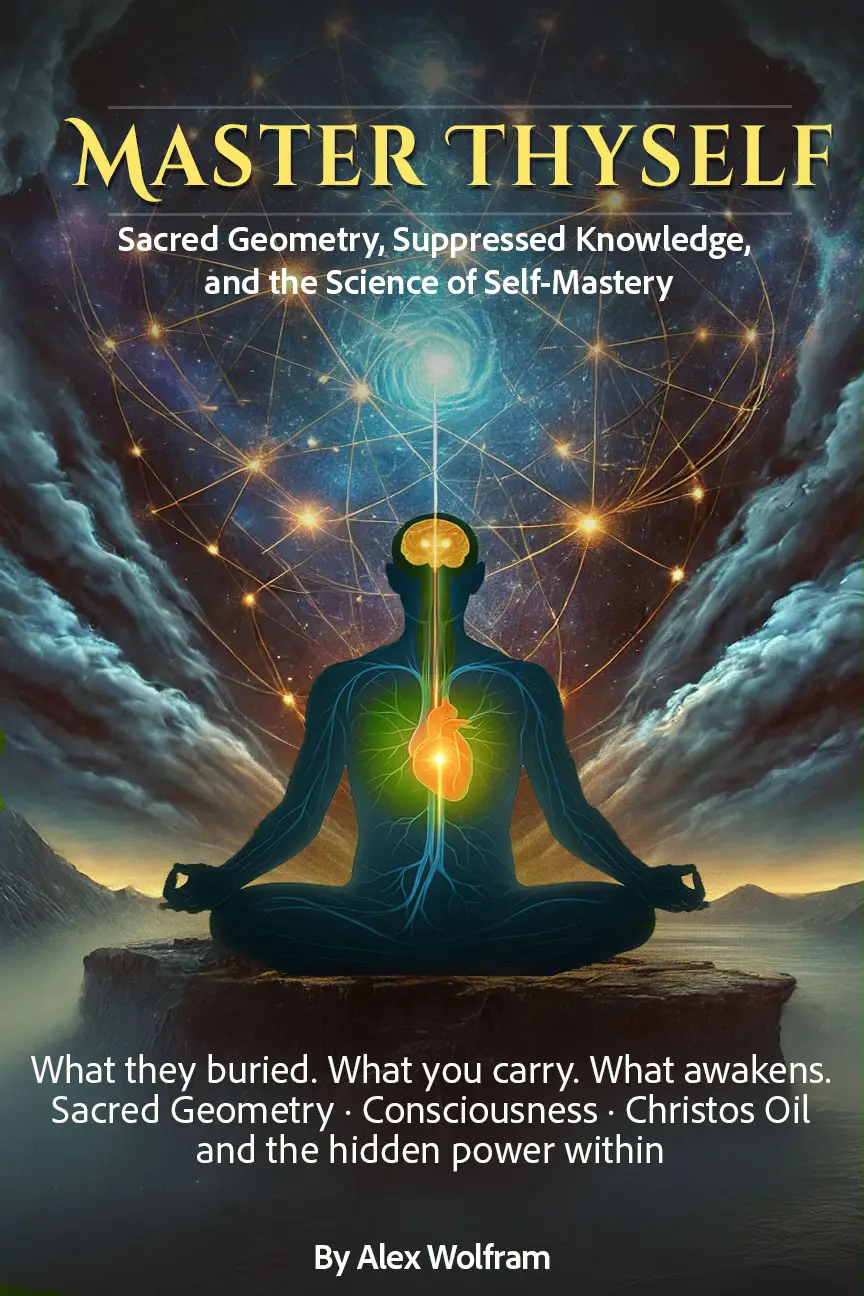
This page summarizes the modern evidence and the Gnostic diagnosis. Master Thyself walks through the full system, the recycling mechanism, the suppressed texts, the inner protocol the mystics encoded for stepping outside the loop, and the biology behind the methods that actually work.
Amazon 30-day return window. If the book does not deliver, send it back.
The control mechanism is amnesia
If the simulation thesis is correct, the most efficient control mechanism is not violence or surveillance. It is forgetting. A system that erases context at every reset, that scrambles memory at every transition, that conditions inhabitants to disbelieve their own anomalous experiences, does not need walls. The walls are built into the architecture of perception itself.
This is exactly what the texts describe. The Gnostic Apocryphon of John says the Archons "cast forgetfulness over Adam" so that he would not remember his origin. The Tibetan Bardo Thödol describes the dazzling lights that erase memory at each rebirth. The Pistis Sophia describes seals and passwords the soul must remember to pass the gates. Plato, in the Republic, describes the River Lethe, the river of forgetting, that souls cross before re-entering bodies. The metaphors converge because the mechanism converges.
In the modern world, the same mechanism operates through different vectors. Information overload. Engineered distraction. The systematic dismissal of coherent first-person experience. The replacement of internal authority with external dependency. The encouragement of identity construction around content that the system controls. The result is the same as the ancient texts described: a population that cannot remember what it actually is, surrounded by reminders it has been trained to ignore.
The remedy in every tradition was the same: coherence. Inner stillness. The systematic decoupling of attention from external rendering long enough for memory to surface. The Buddhists called it meditation. The Sufis called it dhikr. The Hindus called it yoga. The Hopi called it ceremony. The Gnostics called it gnosis. The methods differ. The mechanism is identical. Redacted, Chapter 22
Glitches in the rendering, and what they mean
If the system is a rendered simulation that periodically updates its own variables, the inhabitants should notice anomalies. They do. Anomalies have names. They show up in every culture, in every era, with the same broad characteristics.
Deja vu is the recognition of an experience that should be new. Mandela effects are widespread shared memories of details that no longer exist. Glitches in the matrix are the catch-all term for moments when the rendering visibly stutters, repeats, or contradicts itself. Synchronicities are improbable correlations between unrelated events. Time slips are reports of brief, vivid encounters with environments that should not exist.
In a solid-matter universe, all of these are dismissed as memory errors, brain glitches, or coincidence. In a rendered-system universe, they are exactly the kind of artifacts the inhabitants should notice. The dismissal pattern is itself part of the control mechanism. People who report these experiences are encouraged to disbelieve their own perception, which keeps them inside the consensus rendering.
For deeper coverage of the specific mechanisms, see the dedicated pages:
If we are in a simulation, the question becomes practical
The interesting part of the simulation thesis is not the philosophical argument. It is the practical implication. If the system is rendered, observation matters. If observation matters, the quality of attention shapes the output. If the quality of attention shapes the output, attention training is not optional. It is the only thing that scales.
Every tradition that named the simulation also named a method. The Buddhists trained attention with meditation. The Sufis trained attention with sacred movement and dhikr. The Hindus trained attention with yoga, breath, and mantra. The Gnostics trained attention with gnosis and inner stillness. The methods are different. The target is identical. Build a mind coherent enough that the rendering cannot manipulate it.
The traditions also agreed on the biology. There is an inner mechanism, named in scripture across multiple traditions, that the methods activate. It is described in Hindu texts as the divine oil. In Egyptian texts as the sacred unguent. In Christian and Gnostic texts as the chrism. The traditions called the mechanism by different names. The biology is the same. The methods that activate it are converging across traditions for the same reason the diagnosis is converging. Redacted, Chapter 13
The practical work is detailed in Master Thyself. The diagnosis on this page is the doorway. The protocol is the room.
Frequently asked questions about are we living in a simulation
Are we living in a simulation, scientifically speaking?
Modern physics now answers "are we living in a simulation" with a qualified yes. The 2022 Nobel Prize in Physics confirmed quantum entanglement, which means particles have no fixed properties until measured. That is consistent with a rendered system. Bostrom's 2003 paper formalized "are we living in a simulation" into a trilemma that has not been refuted in twenty years. The answer is not certain. The probability is high.
Who first asked "are we living in a simulation"?
The modern framing of "are we living in a simulation" comes from Nick Bostrom's 2003 paper at Oxford. The question is much older. Plato asked "are we living in a simulation" in cave-allegory language in 380 BC. The Gnostic Christians asked "are we living in a simulation" in the second century AD. Hindu Vedanta has asked "are we living in a simulation" for three thousand years using the word Maya. The question is ancient. The vocabulary is new.
If "are we living in a simulation" is true, who built it?
The Gnostic texts named the architect. They called him the Demiurge, or Yaldabaoth, and described him as a lower-order being who built the rendered world to trap consciousness inside it. The book argues that the question "are we living in a simulation" cannot be separated from the question of who is running it. Modern simulation theory does not address the operator. The ancient texts do.
Does "are we living in a simulation" change how I should live?
Yes. If "are we living in a simulation" is the working hypothesis, the practical implication is that observation matters more than mainstream materialism allows. The mind that holds the world as fixed becomes manipulable. The mind that holds the world as rendered, knowing "are we living in a simulation" might be true, becomes harder to lie to. That is the entire frame of the book.
What evidence supports "are we living in a simulation"?
Eight categories of evidence support the case that "are we living in a simulation" is the most likely working hypothesis: the double-slit experiment, quantum entanglement, the holographic principle, Bostrom's trilemma, mathematical structure of reality, observer-dependent reality, the Mandela effect, and the convergence of fifty ancient traditions. Each one independently is suggestive. Together, the case for "are we living in a simulation" becomes hard to dismiss.