Simulation Theory
The argument the ancients called Maya, the philosophy department now calls the simulation hypothesis, and the physicists are increasingly forced to take seriously by the evidence.
Simulation theory is the proposition that physical reality is computed rather than fundamental. Not a metaphor. A specific technical claim with empirical implications. Originally a fringe thought experiment, it has become a respectable topic in philosophy of mind and theoretical physics, partly because the alternative explanations for certain features of physical reality are getting harder to defend.
This page covers the formal Bostrom argument, the physics anomalies that fit the simulation frame, what ancient traditions called Maya, and why this is more than a thought experiment for cocktail parties.
What Simulation Theory Actually Claims
Simulation theory, in its formal version, is the claim that what we experience as physical reality is the output of computation running on some substrate other than the substrate we appear to inhabit. The substrate could be biological, technological, or fundamental in some way that does not map cleanly onto either. The key claim is that the world is a render of an underlying process, not a self-existent base reality.
Distinctions that matter:
- Strong simulation hypothesis. The simulation is implemented on physical hardware in some "outside" reality. A future civilization running ancestor simulations, or a non-human civilization simulating us. The version popularized by Elon Musk and Nick Bostrom.
- Weak simulation hypothesis. Reality has computational properties without requiring an "outside" platform. The universe itself is doing something analogous to computation. Compatible with various forms of digital physics and IT-based metaphysics.
- Consciousness-first version. What appears as physical reality is the content of a foundational awareness. Consciousness is the substrate, not silicon. The traditions called this Maya. The modern philosophical version is idealism. Read the deeper treatment on consciousness.
Different versions have different implications and require different evidence. The popular version (we are in a video game) is the most cinematic and the least supported. The philosophically interesting versions are closer to what the contemplative traditions described.
Bostrom's Trilemma
Nick Bostrom's 2003 paper "Are You Living in a Computer Simulation?" formalized the simulation hypothesis as a probability argument. Bostrom did not claim we are in a simulation. He claimed that one of three propositions must be true, and that the third proposition is much more plausible than the first two.
The three options, as Bostrom presented them:
- Option 1. Almost all civilizations at our stage of development go extinct before reaching the capacity to run ancestor simulations.
- Option 2. Civilizations that reach that capacity choose not to run ancestor simulations.
- Option 3. We are almost certainly living in a simulation.
The argument: if any civilization, anywhere, ever, reaches the technological capacity to run ancestor simulations and chooses to do so, the number of simulated minds will rapidly outnumber the number of original biological minds by many orders of magnitude. The base rate for any conscious experience being "real" rather than simulated becomes vanishingly small. Therefore, statistically, we are almost certainly simulated, unless one of the first two options is true.
The argument is statistical, not metaphysical. It does not depend on the simulation being any specific kind. It does require granting that simulations of conscious beings are possible in principle. If consciousness cannot be simulated computationally (a position increasingly taken by serious philosophers), the argument loses its force. The argument's strength and the question of consciousness's nature are inseparable.
The Anomalies That Fit

Beyond the Bostrom argument, several features of physical reality fit the simulation frame more naturally than the materialist one. None of these is conclusive. The accumulation is suggestive.
- The discrete structure of reality at the Planck scale. Space, time, and energy all appear to be quantized at the smallest scales. The universe has a maximum resolution. Discrete structure is exactly what one would expect from a computed reality. Continuous structure is what one would expect from a base reality. The universe has the structure of the former.
- The observer effect. Quantum mechanics has demonstrated, with absolutely robust experimental confirmation, that the act of measurement affects the outcome being measured. The double-slit experiment shows that particles behave as waves when unobserved and as particles when observed. The reasonable materialist interpretations of this are increasingly strained. The simulation interpretation is straightforward: the system only renders what is being observed.
- The fine-tuning of physical constants. The values of the fundamental physical constants are improbably precise for the existence of stable matter, stars, and life. Slight changes in any of them would produce a universe in which complex structure cannot exist. Fine-tuning fits a designed-for-purpose interpretation more naturally than a random one.
- The mathematical structure of physical law. Physical reality is mathematically describable to a degree that has puzzled physicists for centuries (Eugene Wigner's "unreasonable effectiveness of mathematics in the natural sciences"). Mathematics is what you would expect from a computed reality. The traditional materialist account treats it as a mystery.
- The holographic principle. Modern theoretical physics increasingly treats spatial reality as encoded on a two-dimensional boundary, with the three-dimensional appearance being a kind of projection. The math works. The implications are simulation-friendly.
- Glitches. Reported anomalies (Mandela effect, déjà vu patterns, glitch-in-the-matrix experiences) that, taken individually, are easily dismissed but, taken collectively, fit a specific pattern. Detailed treatment in the book.
None of the items above proves simulation theory. Each is also explainable on other frameworks. The pattern, however, is that the simulation frame explains them more economically. Multiple ad-hoc fixes are needed for the materialist account. A single framework (the universe is computed) handles them all.
What the Traditions Called Maya
The claim that physical reality is a kind of appearance rather than the ultimate substance is not new. Every contemplative tradition that pursued the question seriously arrived at it. The vocabularies differ. The proposition is the same.
- Hinduism: Maya. The veil of appearance that conceals the underlying reality (Brahman). Maya is not exactly "illusion" in the sense of "not real." It is real as appearance, but the appearance is not the ultimate fact. The conventional translation of Maya as "illusion" is misleading.
- Buddhism: sunyata (emptiness). All phenomena are empty of inherent existence. They appear, but their apparent solidity and independence is a kind of conceptual overlay rather than a foundational fact.
- Gnosticism: the demiurge's world. The material world is constructed by a lesser creator god (the demiurge) and is not the highest reality. The Pleroma is the source. See the deeper treatment on Gnosticism and the Gnostic gospels.
- Plato's cave. What we experience as reality is the shadow play on the wall of a cave. The objects casting the shadows, and the sunlight outside the cave, are the deeper reality the prisoners cannot see directly.
- The Hermetic tradition. "As above, so below." The physical world is a reflection of higher levels. Read more on the meaning of "as above, so below".
- The simulation as ancient teaching. What modern simulation theory calls the "outside" reality, the traditions called the source. What modern simulation theory calls the render, the traditions called Maya. The conceptual structure is the same. The traditions did not have computer science, but they had something that arrived at the same conclusion through direct observation of awareness itself.
The convergence is striking. Different cultures, different centuries, different methods, similar conclusions. The simulation hypothesis is, in this sense, the modern technological vocabulary for an insight contemplative cultures arrived at independently.
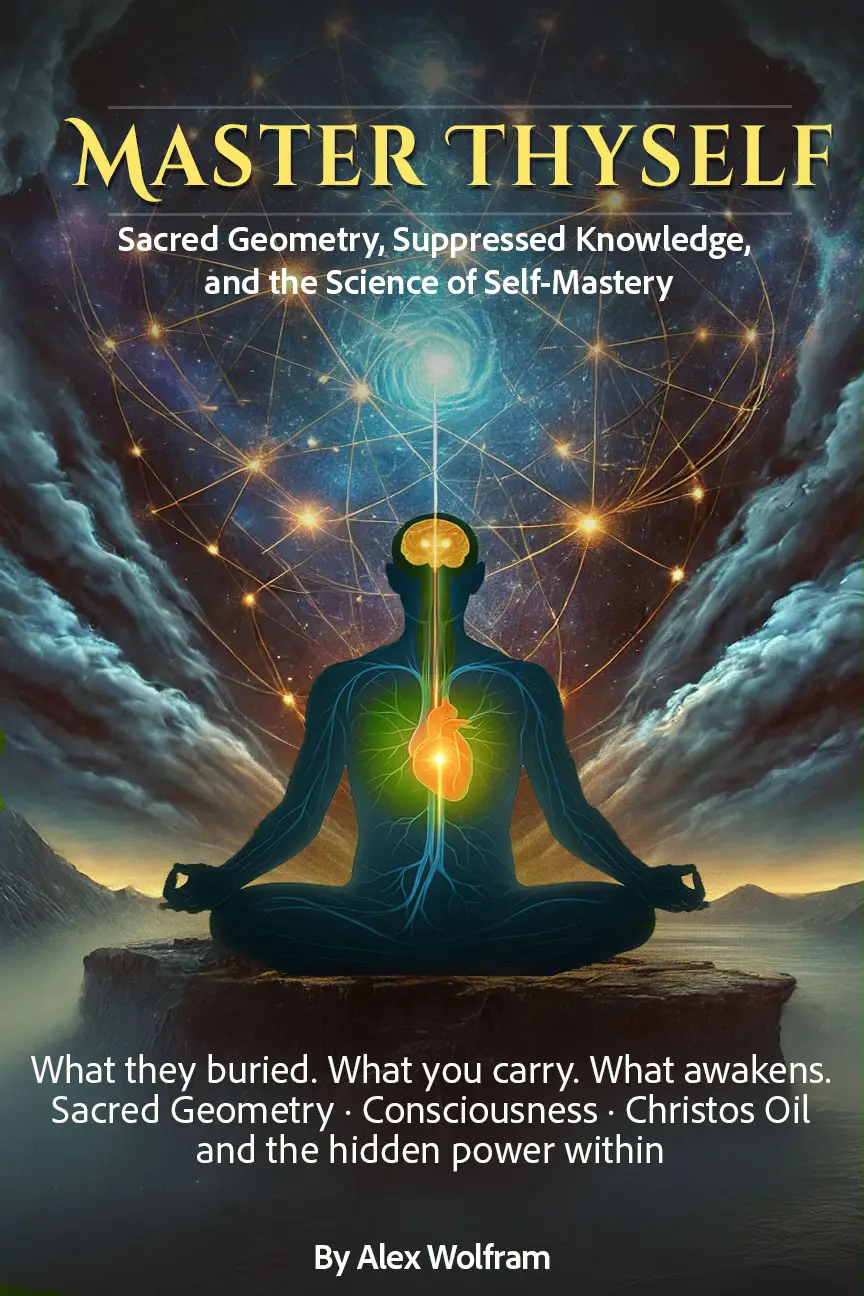
Chapters 3, 4, 5.
Cracks in the Simulation (Chapter 3) catalogs the anomalies. Games of the Mind (Chapter 4) treats the mechanics. The Grand Illusion (Chapter 5) integrates the modern physics with what the traditions said about Maya. The most rigorous synthesis you will find of the technical and the contemplative angles.
The Anomalies in Memory
The Mandela effect is the phenomenon of large numbers of people sharing specific false memories about facts that are easily checkable. Named after the widespread belief that Nelson Mandela died in prison in the 1980s (he died in 2013). Other classic examples: the Berenstain Bears (many remember "Berenstein"), the line "Luke, I am your father" (the actual line is "No, I am your father"), the Monopoly man's monocle (he never had one).
The conservative explanation is shared false memory, the result of common cognitive biases, suggestion, and unreliable encoding. This explanation handles most cases.
The harder cases involve very specific, easily verifiable facts where the false version is exactly aligned across millions of people who never communicated with each other. The conservative explanation requires increasingly elaborate accounts of the convergence. The simulation interpretation is simpler: the underlying reality changed at some moment, and the human memory systems retained the earlier state in some way.
No empirical test currently distinguishes between these two interpretations. The phenomenon itself, regardless of explanation, is real and well-documented. The frequency with which it occurs and the specificity of the convergence is the interesting data.
Frequently Asked Questions
What is simulation theory in simple terms?
The proposition that physical reality is computed rather than fundamental. What we experience as the physical world is the output of some computational process, rather than a self-existent base reality. The technical version was formalized by Nick Bostrom in 2003 as a statistical argument.
Is simulation theory science or philosophy?
Both. It originated as philosophical speculation but has acquired empirical implications. Several proposed tests for simulation theory exist (looking for discrete pixel-like structure at the smallest scales, computational shortcuts in physical processes, statistical anomalies). It is currently treated as a serious topic in philosophy of mind, theoretical physics, and consciousness studies.
Are we living in a simulation?
Bostrom's argument concludes that, given certain assumptions, we are almost certainly simulated. The assumptions (particularly that conscious experience can be simulated computationally) are contested. The honest answer is that simulation theory cannot currently be confirmed or ruled out. The probability assignments depend on the assumptions one is willing to grant.
What evidence supports simulation theory?
Discrete structure of reality at the Planck scale (pixel-like quantization), the observer effect in quantum mechanics, the fine-tuning of physical constants, the unreasonable effectiveness of mathematics in describing physical law, the holographic principle in theoretical physics, and various memory and perception anomalies (Mandela effect, déjà vu patterns). None of these is conclusive. The pattern fits the simulation frame more economically than the materialist alternative in several cases.
What is the connection between simulation theory and ancient teachings?
Every contemplative tradition that pursued the question seriously arrived at the conclusion that physical reality is appearance rather than ultimate substance. Hindu Maya, Buddhist emptiness, Gnostic demiurge cosmology, Platonic cave, Hermetic correspondence. The vocabulary is different. The conceptual structure is the same: reality as we experience it is downstream of something more fundamental. Modern simulation theory is the technological vocabulary for an ancient insight.
If we are in a simulation, does anything matter?
The traditions that worked this out millennia ago answered yes. Maya is real as appearance. Suffering inside Maya is real suffering. Love inside Maya is real love. What changes is not the reality of experience but its ultimate ontological status. The practical implication is sovereignty: knowing what you are in relation to what is appearing. The book's full chapter 22 treatment.