Sacred Geometry
Why the same shapes appear on every continent, in every age, in every spiritual tradition, and what they actually encode.
The proportions of the Egyptian pyramids match the proportions of the Parthenon match the proportions of Gothic cathedrals match the proportions of Hindu temples match the proportions of the human body. Different millennia, different cultures, different gods, identical numbers. This is not coincidence. Sacred geometry is the vocabulary the universe uses to build itself.
This page covers what sacred geometry actually is, the five foundation shapes every tradition uses, the cross-cultural convergence on the same constants, the golden ratio, and why modern biology and cymatics keep producing the same numbers. The foundation of Master Thyself, Chapter 1.
What Sacred Geometry Actually Is
Sacred geometry is the study of geometric proportions, shapes, and patterns that appear repeatedly in nature, art, architecture, and spiritual symbolism, and that traditional cultures considered to encode information about the structure of reality itself. It is not occult and it is not mysticism in the negative sense. It is the observation that certain numbers, certain shapes, and certain proportions are not arbitrary, that they recur in independent contexts, and that humans across cultures noticed.
The hard claim is not metaphysical. It is geometric. There are only five regular three-dimensional shapes (the platonic solids). There is only one ratio (phi, the golden ratio) that produces self-similar division at every scale. There is only one way to pack circles in a plane at maximum efficiency (hexagonal). When these constraints meet, they produce the patterns sacred geometry studies. The patterns are not invented by the cultures that use them. They are discovered, the way a mathematician discovers a theorem.
The "sacred" in sacred geometry refers to the historical observation that cultures that took the patterns seriously also tended to use them for their most important buildings, their most refined art, and their initiatic teachings. The geometry was not sacred because someone decided it was. It was treated as sacred because, used skillfully, it produced cathedrals, temples, and contemplative diagrams that aimed the mind at something the mind kept reporting was real.
The Five Foundation Shapes
Across every tradition that takes sacred geometry seriously, the same handful of forms appear as foundational. Different cultures emphasized different ones. The convergence on this short list is itself the evidence for the deeper claim.
- Vesica Piscis. The lens shape formed by two overlapping circles of equal radius, each centered on the other's perimeter. The height-to-width ratio is the square root of 3. Christian iconography frames Christ and Mary inside it (the mandorla). The basis of medieval cathedral floor plans.
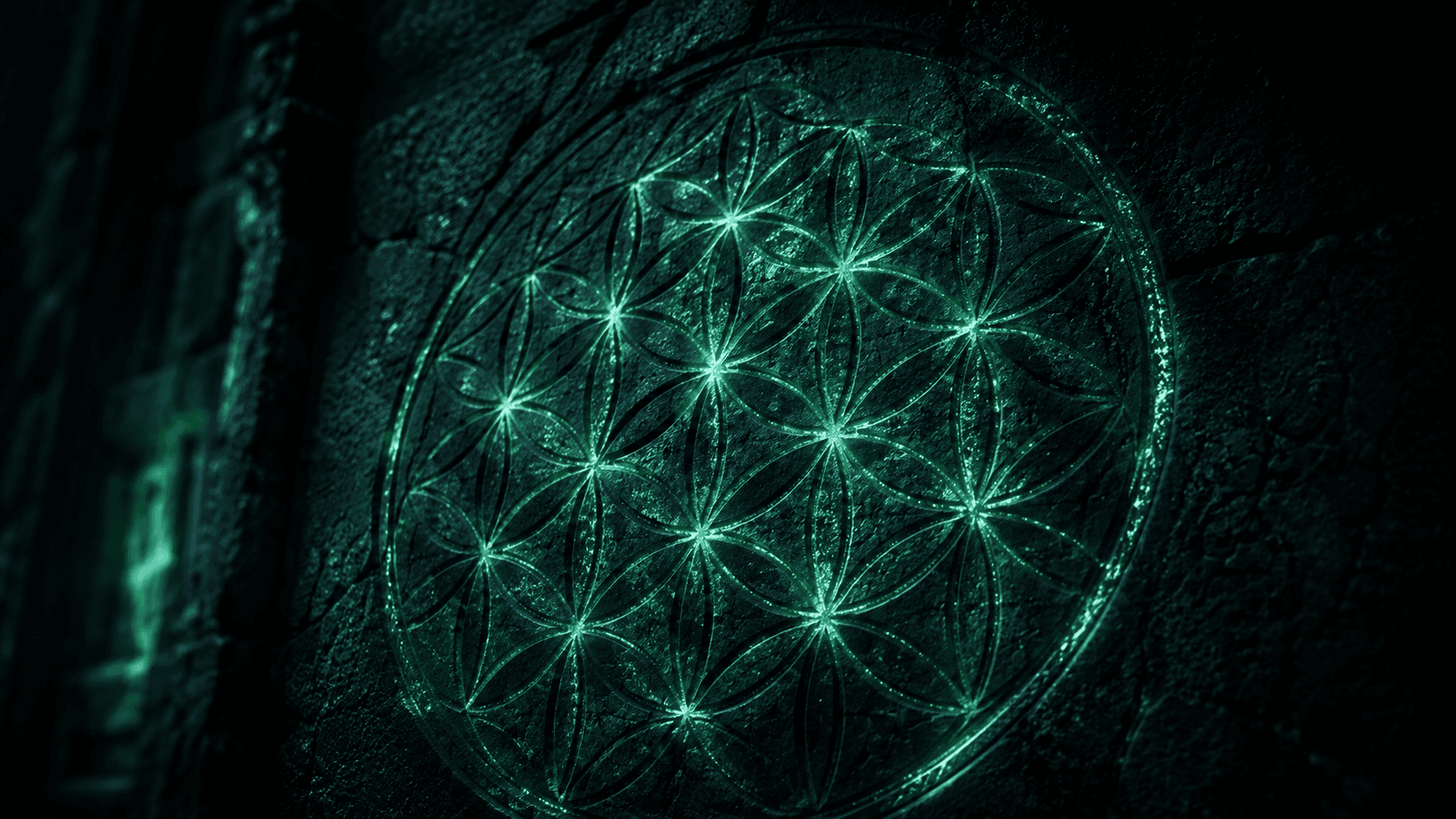
- Seed of Life. Seven circles in hexagonal symmetry. Six circles around a central seventh. Said to represent the seven days of creation in multiple traditions. The geometric core from which the Flower of Life grows.
- Flower of Life. Nineteen overlapping circles in hexagonal tessellation. Found on every inhabited continent in independent ancient cultures. The master pattern from which the other sacred shapes are derived. See the full Flower of Life treatment.
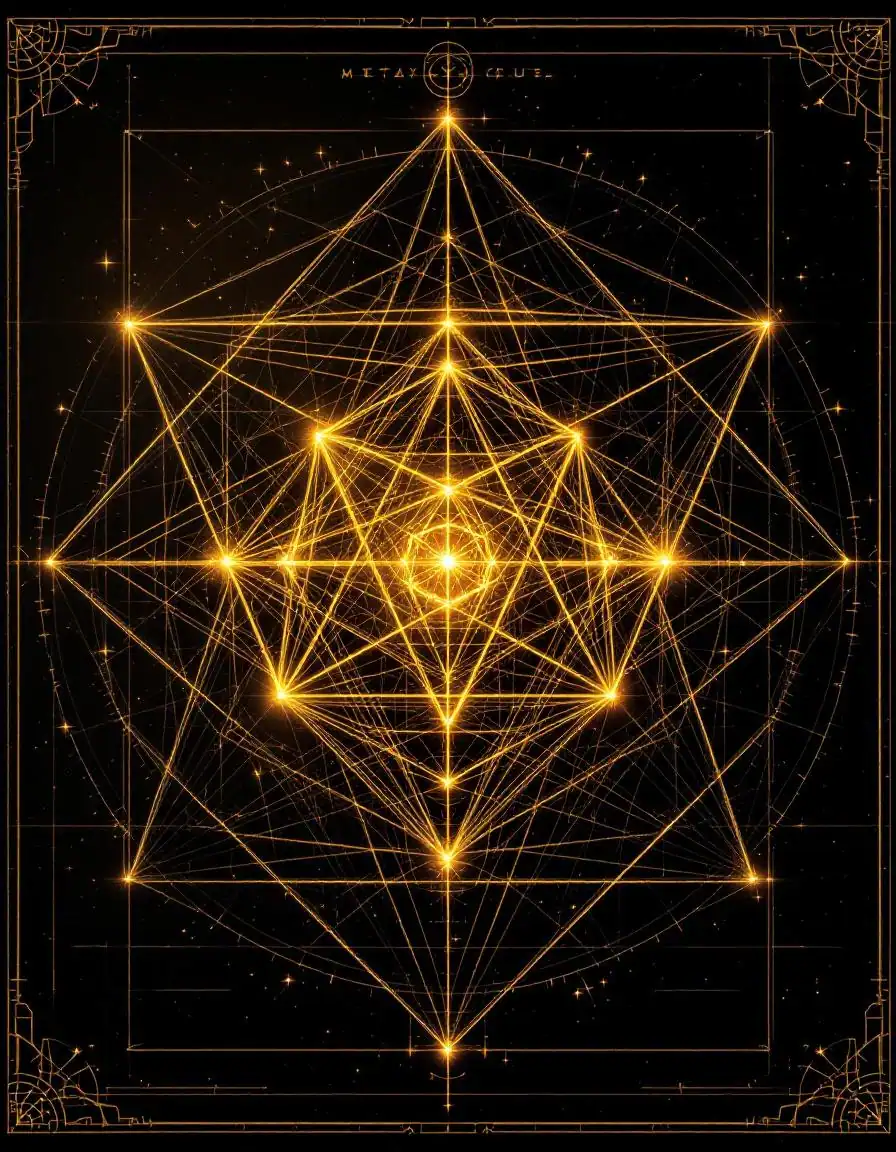
- Metatron's Cube. Connect the centers of thirteen circles in a specific arrangement and you generate a figure that contains all five platonic solids. Named in Jewish mystical tradition after the archangel Metatron. The geometric link between two-dimensional and three-dimensional sacred geometry.
- Sri Yantra. Nine interlocking triangles forming forty-three smaller triangles around a central point. The most refined Hindu yantra (geometric mandala). Used as a focus for contemplative practice. Geometrically related to the same proportions found in Vesica Piscis.
These five forms recur in independent traditions. They are not the same because the traditions copied each other. They are the same because they are the geometric vocabulary that emerges when humans pay sustained attention to form.
Cross-Cultural Convergence
If sacred geometry were a cultural invention, you would expect it to look different in each culture. It does not. The shapes show up everywhere with strikingly similar uses.
- Egypt: The Great Pyramid's proportions encode pi and phi to several decimal places. The Temple of Osiris at Abydos carries the Flower of Life burned into its granite.
- Greece: The Parthenon was built around the golden ratio. Pythagoras founded an entire school on the premise that "all is number." Plato's Timaeus uses the five platonic solids to describe the elements.
- India: Hindu temple architecture and yantra design are mathematical. The Sri Yantra has been studied by modern geometers and contains constructions that were not formally proven in mathematics until the 20th century.
- China: The I Ching's eight trigrams and sixty-four hexagrams form a binary system that Leibniz, who studied it, used as one inspiration for binary mathematics. The pattern is geometric.
- Mesoamerica: Mayan and Aztec pyramid proportions match the same ratios used in Egypt. The two cultures had no contact. The numbers are the same.
- Europe: Gothic cathedrals were built by guilds that preserved a working knowledge of sacred geometry through the medieval period. Chartres Cathedral's floor plan is a study in Vesica Piscis derivation.
- Islam: Islamic geometric art, especially Moorish tilework in Spain and Iran, uses sacred geometry as the basis for an entire visual tradition. The proportions are the same proportions.
Independent invention is the lowest-effort explanation. Cultural transmission through the mystery schools is the second. The third explanation is that humans, when they look carefully, all find the same patterns because the patterns are actually there.
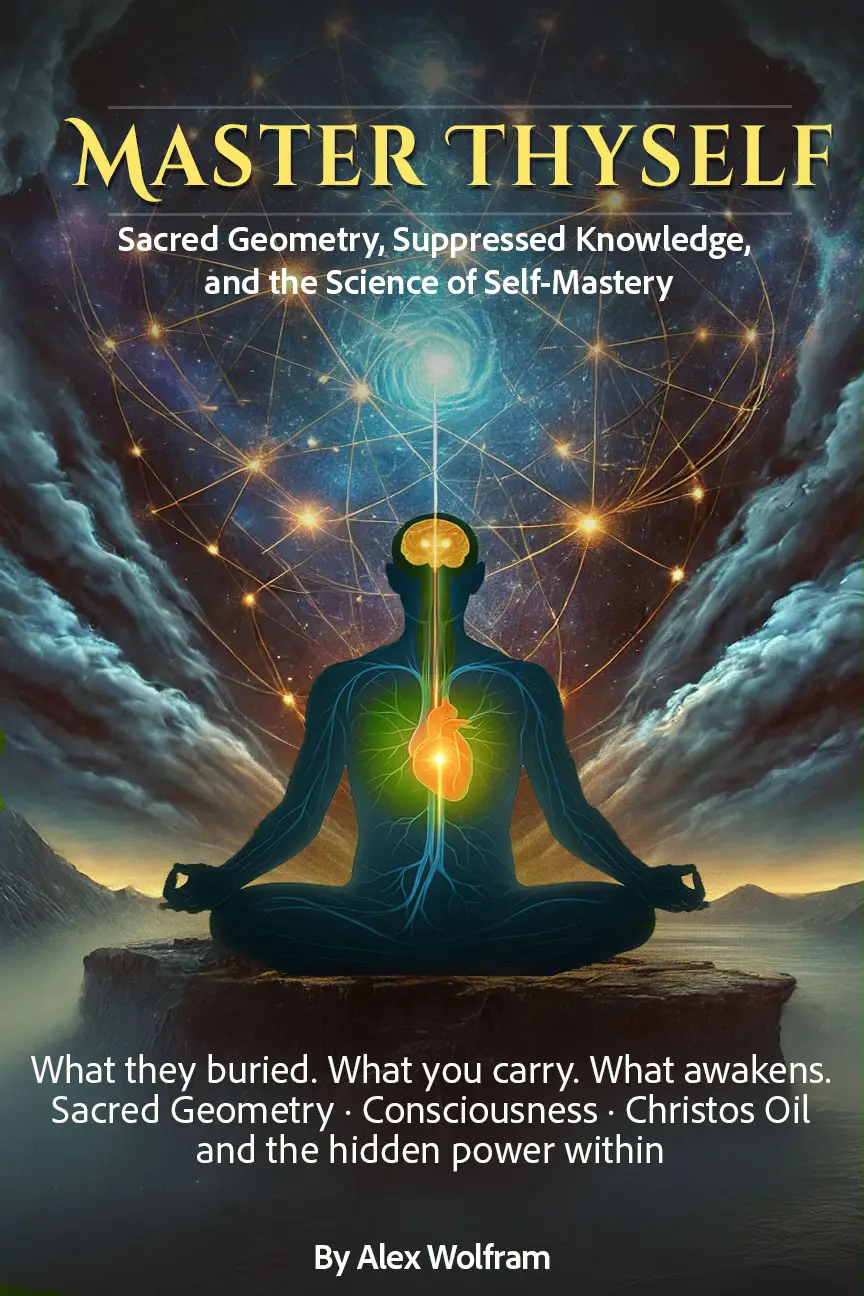
Chapter 1. The Foundation.
Sacred geometry is the foundation the rest of Master Thyself is built on. The cross-cultural record, the geometric derivations, the cymatics, the biology, the link to the Tree of Life and the Christos Oil tradition. The book then follows the geometry through 23 more chapters across six traditions.
Phi, the Ratio Nature Uses
The single most recurrent number in sacred geometry is phi (Φ), approximately 1.618. It is the ratio that satisfies a unique property: when a line is divided so that the whole is to the larger part as the larger part is to the smaller, the ratio is phi. It is also the limit of the Fibonacci sequence. Each new Fibonacci number divided by the previous one approaches phi forever.
Phi shows up in places it has no reason to be unless nature is using it deliberately:
- Plant growth. Sunflower seed spirals, pine cone scales, pineapple skin patterns, fern fronds, all use phi-based spiral angles. The angle (approximately 137.5 degrees) optimizes light capture and packing density.
- Human anatomy. The ratio of the human navel-to-foot distance to total height is approximately phi. The proportions of finger bones to each other, the proportions of the face, the spiral of the ear all hover near the same number.
- DNA. The DNA double helix has a 34 to 21 angstrom ratio. 34 and 21 are consecutive Fibonacci numbers. Their ratio is phi.
- Galactic spirals. Spiral galaxies, including the Milky Way, follow phi-based logarithmic spiral curves. The same ratio that governs sunflower seeds governs the arms of galaxies.
- Art and architecture. The Parthenon, the Great Pyramid, Renaissance painting composition, even modern logo design, all return to phi for proportions humans find pleasing.
The Greeks called phi the divine proportion. The medievals called it the same thing in Latin (divina proportione). Modern biology calls it the most efficient packing solution. They are describing the same fact: that one specific irrational number is woven into the architecture of nature at every scale.
Geometry as the Architecture of Awareness
The use of sacred geometry that the contemplative traditions cared most about was not architectural. It was contemplative. The shapes were used as objects of sustained attention. A Tibetan monk gazing at a mandala. A Hindu practitioner focused on a Sri Yantra. A Christian mystic absorbed in the rose window of a Gothic cathedral. A Sufi tracing the geometric tilework of a mosque. The geometry was a tool to organize the mind.
Why geometry, not story? The traditions' answer was consistent. The conceptual mind, the part that does language and narrative, is what generates the sense of being a separate self. Geometry bypasses it. Looking at a perfectly proportioned figure does not require thinking about it. The mind can rest its language-machinery and simply absorb the pattern. After enough absorption, something shifts. The traditions called the shift recognition, awakening, satori, fana. Ego death in one of its slower forms.
Modern cognitive science is starting to catch up. Sustained attention on geometric form correlates with measurable changes in brain-wave coherence, in the activity of the default mode network, and in subjective reports of altered states. The Sri Yantra has been studied specifically for this. The geometry is not magic. It is a precisely engineered piece of attention-technology, refined over centuries by people who understood what they were building.
Frequently Asked Questions
What is sacred geometry?
The study of geometric proportions, shapes, and patterns that recur in nature, art, architecture, and spiritual symbolism across independent cultures. The patterns include the platonic solids, the Vesica Piscis, the Seed and Flower of Life, Metatron's Cube, the Sri Yantra, and the golden ratio. Traditional cultures treated these forms as encoding information about the structure of reality.
Is sacred geometry real or pseudoscience?
The geometric facts are real. The platonic solids are the only five regular three-dimensional shapes. The golden ratio is a real number with provable mathematical properties. These appear in nature with measurable frequency. What is debated is the interpretation, specifically whether the recurrence of these forms implies anything about consciousness or design. The geometry itself is not in dispute.
What religion is sacred geometry from?
Every religion. Christianity, Judaism, Islam, Hinduism, Buddhism, ancient Egyptian religion, Greek philosophy, and indigenous spiritual traditions all use the same geometric vocabulary. The shapes predate any single religion. They are observed in nature and adopted by traditions that pay attention to nature.
What is the most important shape in sacred geometry?
The Flower of Life is the most commonly cited master pattern, because every other sacred shape can be derived from it. The Vesica Piscis is the most basic generative form. The golden ratio is the most pervasive number. Different traditions emphasize different starting points.
How is sacred geometry used in meditation?
As an object of sustained attention. The practitioner gazes at a geometric figure (mandala, yantra, rose window) without analyzing it, allowing the mind to organize itself around the pattern. The traditions report that prolonged absorption in well-constructed geometric forms produces measurable shifts in consciousness.
What is the golden ratio?
A specific irrational number, approximately 1.618, that satisfies the property of self-similar division. It is the limit of the Fibonacci sequence and appears throughout nature in plant growth, animal anatomy, galactic spirals, and DNA structure. Used in art and architecture since antiquity for its perceived aesthetic harmony.