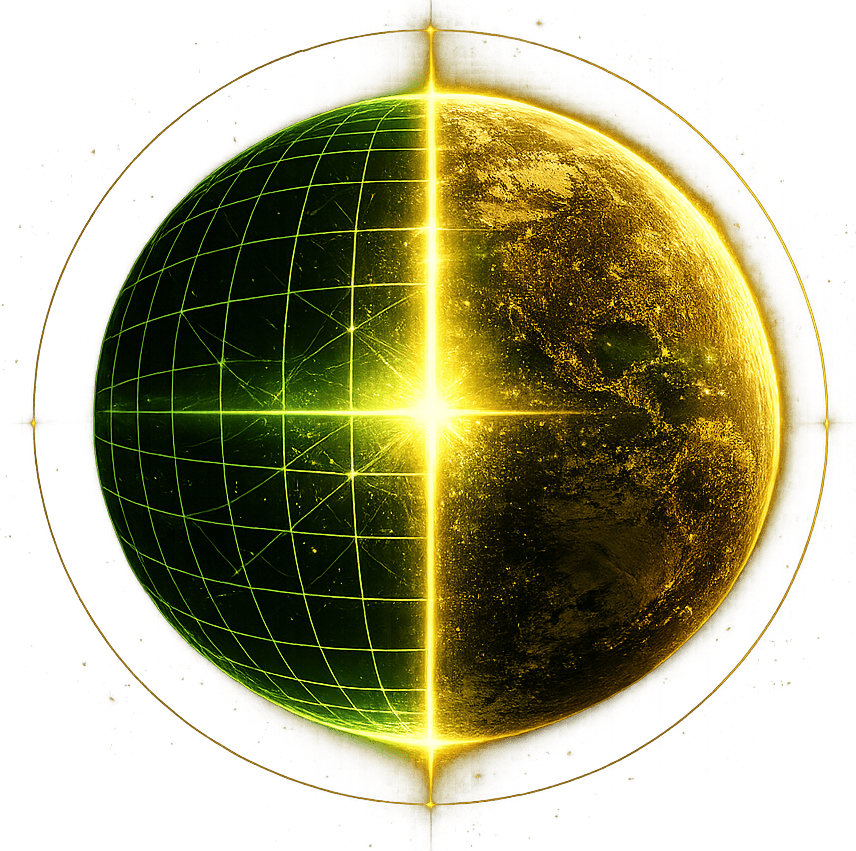
Simulation theory explained begins with a simple but unsettling question: what if the reality you experience every day is not the fundamental layer of existence, but a constructed environment running on hidden architecture? This idea, once confined to science fiction and esoteric philosophy, now sits at the intersection of quantum mechanics, computer science, and ancient mystical traditions. At its core, simulation theory proposes that our perceived reality may be a sophisticated rendering, similar to a video game or virtual environment, built on informational substrates we cannot directly access.
The Core Premise of Simulation Theory
When simulation theory explained in its simplest form, it suggests that what we call the physical universe may be a construct generated by processes operating at a level beyond our sensory perception. Just as characters in a video game experience their world as complete and real, we may be experiencing a curated interface designed for coherence and survival, not ultimate truth. The brain does not record reality objectively. It builds a usable model from filtered signals, compressing roughly 11 million bits of sensory data per second into the approximately 50 bits your conscious mind can process. What feels solid, continuous, and self-evident is actually an edited reconstruction.
Modern neuroscience confirms this through phenomena like change blindness and inattentional blindness, where the brain fails to register glaring changes in the environment when attention is directed elsewhere. The world you see is not the world as it is. It is the world as your nervous system renders it, optimized for speed and utility rather than accuracy.
Quantum Physics and the Observer Effect
One of the strongest pieces of evidence supporting simulation theory comes from quantum mechanics. The double-slit experiment demonstrates that particles behave differently when observed. Fire electrons through two slits without measuring which path they take, and they create an interference pattern as if passing through both slits simultaneously. Place a detector to observe which slit they use, and the pattern collapses into two distinct bands. Reality does not finalize until it is measured. This behavior mirrors how video games render only what the player can see, conserving computational resources by leaving unobserved areas unprocessed.
The 2022 Nobel Prize in Physics went to researchers whose experiments confirmed that reality is not locally real at the quantum level. Particles do not carry fixed properties until observation forces a collapse into a single state. Physicist John Wheeler described this as a participatory universe, where the observer is woven into the fabric of what becomes real. If the universe behaves like a system that renders outcomes only when engaged, the simulation analogy gains traction as more than metaphor.
The Simulation Hypothesis and Nick Bostrom
Philosopher Nick Bostrom formalized the argument in his 2003 paper, proposing a trilemma: either advanced civilizations never reach the technological capacity to run ancestor simulations, or they choose not to run them, or we are almost certainly living inside one. Bostrom’s reasoning rests on probability. If it becomes possible to simulate conscious beings, and if such simulations are run at scale, then simulated realities would vastly outnumber base reality. Statistically, you are more likely to be inside a simulation than outside one. The hypothesis is not proof, but it shifts the burden of evidence. Dismissing it requires assuming either technological limits or universal restraint, neither of which can be demonstrated.
Elon Musk extended this argument in public remarks, estimating the odds of living in base reality at one in billions. The logic is simple: if simulations are possible and numerous, the probability that this instance is the original becomes vanishingly small. Whether one accepts the premise or not, the mathematical structure of the argument holds. Simulation theory explained through Bostrom’s lens is less about proving we are in a simulation and more about recognizing that we cannot prove we are not.
Ancient Traditions and the Illusion of Maya
Long before modern physics or digital metaphors, spiritual traditions across the world arrived at strikingly similar conclusions. Hinduism describes the material world as Maya, a grand illusion veiling ultimate reality. Buddhism teaches that all phenomena are empty of inherent existence, dependent on perception and devoid of fixed essence. Plato’s Allegory of the Cave presents humanity as prisoners mistaking shadows for truth, unable to see the source until they turn toward the light. Gnostic Christianity described the physical cosmos as a flawed copy, a lower emanation concealing the divine source. These traditions did not use the language of code or computation, but their diagnosis is identical: the world you perceive is not the final truth.
The study of reality as structured illusion has always walked the line between science and mysticism. What changes across eras is the metaphor used to describe the same underlying insight. Today, simulation theory explained through the lens of computer science gives ancient wisdom a modern vocabulary. The pattern remains: reality is layered, perception is filtered, and what feels most obvious is often the furthest from ultimate truth.
The Mathematical Structure of Reality
If reality were a simulation, it would be expected to run on mathematical laws, exhibit repeating patterns, and display efficiency in how information is processed. All three conditions hold. The universe is governed by elegant equations. The same geometric ratios appear in shells, galaxies, and DNA. Fractals repeat at every scale. The Fibonacci sequence structures biological growth. The golden ratio appears in art, architecture, and atomic proportions. These are not coincidences but signatures of an underlying code.
Max Tegmark’s Mathematical Universe Hypothesis goes further, proposing that physical existence and mathematical existence are identical. We do not live in a universe described by mathematics. We live in a universe that is mathematics, experiencing itself. If that is true, then the distinction between base reality and simulation collapses. A mathematically structured universe already behaves like code. The question is not whether reality runs on rules, but whether those rules were written by something or someone operating at a higher level of abstraction.
Glitches in the Matrix: Mandela Effect and Déjà Vu
Simulation theory explained often points to anomalous experiences as potential evidence of system updates or rendering errors. The Mandela Effect describes widespread false memories where large groups recall events, logos, or quotes differently than the historical record shows. Examples include the Berenstain Bears spelled with an A rather than the widely remembered E, or the absence of a cornucopia in the Fruit of the Loom logo despite vivid collective recall. Skeptics attribute these to confabulation and social reinforcement. Simulation advocates interpret them as residual memory from prior iterations of the code, glitches left behind after a system update.
Déjà vu, the eerie sensation of reliving a moment, may function similarly. Neuroscience explains it as a misfire in temporal recognition, where the brain mistakes a new experience for a recalled one. But if reality operates like a simulation rendering probabilities in real time, déjà vu could represent a momentary overlap between potential timelines or a brief awareness of the same event processed twice. Neither interpretation is provable. Both are consistent with simulation theory explained as a framework rather than a claim.
Consciousness as the Rendering Engine
One of the most profound implications of simulation theory is the role of consciousness. If observation collapses quantum states and perception shapes experience, then awareness is not a passive byproduct of the system but an active participant in its generation. Dr. Robert Lanza’s biocentrism argues that life and consciousness create the universe, not the other way around. The brain acts as a filter rather than a generator, tuning into a field of awareness that exists independently of the body. Near-death experiences, terminal lucidity, and reports of awareness during flatlined brain states support this view. Consciousness persists when the hardware fails, suggesting it is not produced by neurons but received through them.
In this model, the body is an avatar and consciousness is the player. The simulation does not imprison awareness. It provides a stage for experience, growth, and choice. Awakening is not escape but recognition. The difference between being trapped inside the game and mastering it is whether you remember who is holding the controller. Dissolving the illusion of ego-driven identity becomes the first step toward operating as the observer rather than the observed.
The Physics of Information and the Holographic Principle
Physicist John Wheeler proposed that reality arises from information, coining the phrase it from bit. At the most fundamental level, existence is not made of matter but of binary distinctions, yes or no answers embedded in the structure of the cosmos. This idea finds support in the holographic principle, which suggests that all the information contained in a three-dimensional volume can be encoded on its two-dimensional boundary. Black holes store information on their event horizons in a way that resembles holographic encoding. If the principle extends to the universe as a whole, then the three-dimensional reality we experience may be a projection from a lower-dimensional informational substrate.
Theoretical physicist Leonard Susskind and others have explored this in string theory and quantum gravity. The universe may not be built from particles but from information processing at scales far below the Planck length. If consciousness interacts with that information field, then perception is not viewing reality but co-creating it. The full mechanism behind how observation triggers collapse and how intention shapes probability remains one of the core teachings in the complete framework, where disciplines converge to show that mind and matter are not separate categories but phases of the same process.
Free Will Inside a Programmed System
If reality is a simulation, does free will exist? The answer depends on how the system is structured. A deterministic simulation would render every outcome in advance, reducing choice to the illusion of agency. But quantum indeterminacy suggests otherwise. Outcomes are probabilistic until measured. The observer participates in which potentials collapse into actuality. In this sense, free will operates not as the ability to rewrite the code, but as the capacity to influence which path through the code unfolds.
Neuroscience complicates this. Brain scans show that the impulse to act begins milliseconds before conscious awareness of the decision. Does this mean free will is an illusion? Or does it mean the conscious mind is simply the last layer to receive a signal that originated deeper in the system? If you are not the body but the awareness behind it, then the delay is not evidence of determinism but proof that the avatar operates on autopilot until the witness takes the wheel. Understanding the interplay of opposites reveals how constraint and freedom exist not as contradictions but as complementary forces within a structured system.
Why Simulation Theory Matters
Whether or not we live inside a literal simulation, the framework changes how we engage with reality. If perception filters input, then upgrading perception expands what becomes accessible. If belief shapes biology, then adopting empowering narratives rewrites the body’s code. If attention collapses probabilities, then where you place focus determines which timeline you inhabit. Simulation theory explained is not an invitation to nihilism or detachment. It is a call to recognize that reality is participatory, responsive, and far more malleable than materialist dogma allows.
The ancients knew this. They called it Maya, Samsara, or the Cave. Modern physics arrived at the same insight through quantum mechanics and information theory. The language changes. The structure does not. You are not a passive observer of a fixed world. You are a node in a responsive field, shaping and being shaped by the frequencies you emit. Understanding that mechanism is not abstract philosophy. It is practical leverage. And those who grasp it early gain an advantage that compounds across every domain of experience.
Living Consciously Inside the Code
If this is a simulation, the question is not how to escape but how to play well. Every spiritual tradition that described reality as illusion also provided tools for awakening within it: meditation, fasting, breathwork, and focused intention. These are not metaphors. They are protocols for altering brainwave states, shifting biochemistry, and tuning perception toward coherence rather than fragmentation. The system rewards those who learn its rules. Ignorance does not protect you. It enslaves you to patterns you never chose.
Simulation theory explained is ultimately about reclaiming authorship. The code was written before you arrived. The defaults were installed without your consent. But the capacity to observe, question, and redirect remains. That capacity is what separates the player from the non-player character. The NPC runs its script without deviation. The aware participant recognizes the script and chooses whether to follow it. That choice, however small it appears, is the difference between living inside the dream and lucid dreaming your way through it.