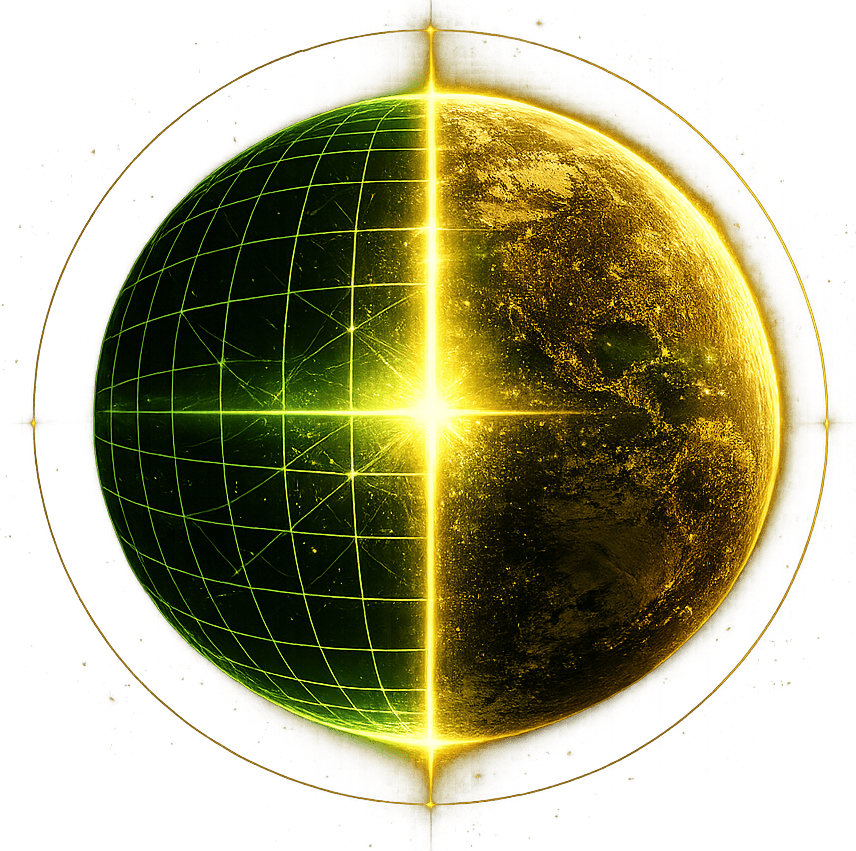

Is reality real? It’s the kind of question that sounds philosophical until you realize quantum physics, neuroscience, and thousands of years of spiritual tradition all point toward the same unsettling answer: what you experience as solid, objective reality may be nothing more than a convincing simulation generated by your brain.
Most people assume the world exists exactly as they perceive it. The chair feels solid. The sky looks blue. Other people seem to move independently through the same shared space. But every assumption breaks down under scrutiny. The chair is 99.9% empty space held together by electromagnetic forces. Blue doesn’t exist in the physical world, only wavelengths your brain interprets as color. And those other people? You’ve never directly experienced their consciousness. You’ve only experienced your own nervous system’s response to sensory data.
The question isn’t whether you’re experiencing something. You are. The question is whether that experience corresponds to an external, objective reality, or whether it’s a rendered interface optimized for survival rather than truth.
What Quantum Physics Reveals About Reality
The double-slit experiment remains one of the most profound demonstrations that reality behaves differently than common sense suggests. When electrons are fired through two slits without observation, they create an interference pattern, behaving like waves passing through both slits simultaneously. But the moment a measuring device observes which slit the electron passes through, the wave function collapses. The particle suddenly behaves like a particle, going through one slit or the other, but not both.
This isn’t a quirk of small particles. It’s a fundamental feature of how reality operates. The observer effect shows that measurement changes outcomes at the quantum level. Reality doesn’t finalize until something interacts with it. Before observation, particles exist in superposition, holding multiple potential states at once. After observation, one outcome becomes real while the others vanish.
In 2022, physicists Alain Aspect, John Clauser, and Anton Zeilinger won the Nobel Prize for experiments proving that particles don’t carry fixed properties until measured. Their work on quantum entanglement showed that reality is not locally real. Two entangled particles can influence each other instantaneously across any distance, and neither has definite properties until observed. This suggests the universe doesn’t exist in a fixed state independent of observation. It responds to engagement.
If reality only solidifies when observed, then asking is reality real becomes more than philosophy. It becomes physics.
Your Brain Constructs What You See
Neuroscience confirms what quantum physics suggests: you never experience reality directly. Your brain filters roughly 11 million bits of sensory data every second down to about 50 bits your conscious mind can process. The rest gets discarded. What reaches awareness isn’t raw reality but a radically compressed model optimized for quick decision-making.
The Reticular Activating System, a network at the base of your brainstem, decides what information loads into conscious experience and what stays filtered out. It prioritizes based on current goals, emotional state, beliefs, and recent focus. This is why you suddenly see red cars everywhere the moment you decide to buy one. They were always there. Your brain just wasn’t rendering them as relevant.
Neuroscientist Anil Seth calls conscious experience a controlled hallucination. The brain generates a prediction of what the world should look like, then updates that prediction when sensory signals push back. What you perceive at any moment isn’t the world itself. It’s your brain’s best-guess model. Reality becomes the constraint that keeps the hallucination from drifting too far off-script.
Even time itself is part of the constructed interface. Signals from your eyes, ears, and body take measurable time to reach the brain. By the time you register an event, it has already happened. To mask this delay, the brain constantly predicts what should happen next and displays that prediction as though it were happening now. You live perpetually in the recent past, experiencing a smoothed, edited version of events your nervous system stitched together after the fact.
The Illusion of Solidity
Matter itself dissolves under examination. Atoms, which make up everything you touch, are more than 99.9% empty space. If a proton were the size of a marble, its nearest electron would orbit several football fields away. What you experience as solid is actually electromagnetic repulsion. The electrons in your hand and the electrons in the table beneath you never make physical contact. They repel each other, and your nervous system interprets that resistance as solidity.
You have never actually touched another person. You have never touched anything. What you call touch is your body’s response to invisible forces. The sensation feels undeniable, but it’s a translation, not the thing itself.
Zoom further in and matter stops being matter at all. Particles are better understood as excitations in quantum fields, temporary patterns of energy holding a stable form long enough for interaction. What appears solid is vibration. What feels permanent is flux. The entire physical world is energy organized into repeating patterns, and those patterns only stabilize when something observes them.
For those exploring how perception shapes experience, this site traces the mechanics of illusion across science and tradition, showing how ancient mystics and modern physicists arrived at the same conclusion from opposite directions.
Ancient Traditions Knew This Already
Long before quantum mechanics, spiritual traditions across the world taught that the material world is maya, illusion, or dreamlike projection. Hinduism describes physical reality as a veil concealing eternal truth. Buddhism teaches that phenomena lack inherent existence and are projections of the mind. Gnostic Christianity framed the visible cosmos as the work of a lesser creator, a copy obscuring the divine source.
Plato’s allegory of the cave captured the same insight. Prisoners chained inside a cave mistake shadows on the wall for reality. One prisoner breaks free, turns toward the light, and realizes the shadows were projections. When he returns to tell the others, they mock him. They would rather cling to familiar illusions than face the painful process of turning toward the source.
The Tao Te Ching opens with a warning: the Tao that can be spoken is not the eternal Tao. Any attempt to define ultimate reality misses it. Zhuang Zhou dreamt he was a butterfly, then woke and wondered whether he was a man who dreamt of being a butterfly or a butterfly now dreaming of being a man. The boundary between dream and waking, he suggested, is thinner than we assume.
These weren’t primitive guesses. They were observations about the structure of experience. The mystics didn’t have particle accelerators, but they had direct introspection. And what they found, again and again, was that the world of appearances is not the final truth. It’s a layer, a rendering, a surface concealing something deeper.
Simulation Theory and the Holographic Universe
Modern physics has begun to echo ancient mysticism. Physicist David Bohm proposed that the universe behaves like a hologram, where every part contains information about the whole. The holographic principle in theoretical physics suggests that all information about a three-dimensional volume can be encoded on its two-dimensional boundary, much like a hologram encodes a 3D image on a 2D surface.
If the universe is holographic, then what we experience as solid reality may be a projection from a deeper layer of existence. Philosopher Nick Bostrom formalized this into the simulation hypothesis: either advanced civilizations never reach the ability to run ancestor simulations, they choose not to, or we are almost certainly inside one. The logic is statistical. If it’s possible to simulate conscious beings, then simulated realities will vastly outnumber base reality, making it more probable that you’re in a simulation than not.
Whether the simulation is computational, informational, or consciousness-based, the mechanics converge. Reality behaves like a rendered environment. It only finalizes what is observed. It conserves resources by not processing what isn’t engaged. It follows consistent rules, like a programmed physics engine. And it contains glitches, anomalies like the Mandela Effect and déjà vu, that feel like rendering errors or memory conflicts.
The same logic extends to consciousness itself. If awareness isn’t generated by the brain but filtered through it, then the brain acts as a receiver rather than a source. Near-death experiences, terminal lucidity, and awareness during flatlined brain states all suggest that consciousness persists when the hardware is offline. The player doesn’t disappear when the avatar stops functioning. The signal continues even when the receiver fails.
For readers ready to go deeper into how perception, belief, and the observer effect shape what becomes real, the full framework is laid out in Master Thyself, showing not only how reality is constructed but how to work with that construction consciously.
The Role of Belief in Shaping Reality
If reality is observer-dependent, then belief becomes more than psychology. It becomes a variable in the system. The placebo effect demonstrates this directly. Sugar pills trigger real brain activity, releasing dopamine in Parkinson’s patients and endorphins in pain studies. Belief alone changes biology. The nocebo effect runs the same mechanism in reverse: expecting harm creates real symptoms even when the substance is inert.
Dr. Bruce Lipton’s research in epigenetics showed that cells respond to their environment, not just their genetic code. Genes are like blueprints waiting to be read, but belief, emotion, and perception determine which genes activate. Change the internal narrative and you change gene expression. The body doesn’t distinguish between a vividly imagined event and a real one. Both trigger the same neurological and hormonal responses.
This extends beyond individual biology. The Global Consciousness Project at Princeton documented that random number generators worldwide showed statistical patterns around major global events, including September 11, 2001. Some researchers interpreted this as evidence of a collective consciousness influencing physical systems. Whether or not the interpretation holds, the data suggests that awareness and intention interact with matter in ways mainstream science is only beginning to measure.
Dr. Kirby Surprise’s meta-analysis of consciousness research points to a 2 to 6 percent deviation above chance in experiments where intention influences probabilistic outcomes. Small shifts, but consistent. If consciousness tilts probability even slightly, then repeated focus could build momentum. What starts as a ripple becomes a wave. Reality doesn’t just respond to observation. It appears to respond to expectation.
Those exploring how sound and vibration structure both matter and perception will find that the body’s inner mechanisms align with external resonance, suggesting that the interface between observer and observed runs deeper than sensory input alone.
The Question Reality Itself Can’t Answer
Is reality real? The question loops back on itself. Any tool you use to measure reality exists inside the system you’re trying to evaluate. Your senses are part of the rendering. Your logic is part of the code. Your instruments are built from the same matter they’re analyzing. Gödel’s incompleteness theorem proved that no logical system can fully explain itself from within. There will always be truths that are real but unprovable using the system’s own rules.
This doesn’t mean reality is arbitrary or meaningless. It means the map is not the territory. The interface is useful, convincing, and incomplete. Evolution didn’t optimize perception for truth. It optimized for survival. Cognitive scientist Donald Hoffman proved mathematically that natural selection drives accurate perception to extinction. The brain that sees reality as it is gets outcompeted by the brain that sees reality as useful.
What you experience, then, is a species-specific user interface. The desktop icons on a computer screen don’t resemble the voltages and circuits running underneath. They’re symbols optimized for interaction. Reality works the same way. Solidity, color, time, space, all of it may be a simplified display hiding the true architecture beneath.
The mystics called this awakening: recognizing the dream as a dream without leaving it. The physicists call it observer-dependent reality: acknowledging that measurement collapses potential into form. The result is the same. You are not a passive witness. You are woven into the fabric of what becomes real.
Recognizing the Dream While Inside It
If asking is reality real leads to the conclusion that experience is constructed, filtered, and observer-dependent, the next question becomes practical: what do you do with that knowledge? You can’t step outside the system. You can’t verify base reality from inside a simulation. But you can become lucid within it.
Lucid dreaming offers the closest analogy. The dreamer becomes aware they’re dreaming without waking up. Once that recognition occurs, the rules of the dream become flexible. Physics bends. Outcomes shift. The environment responds to intention because the dreamer recognizes their role in generating it. Waking life may operate on the same principle. The moment you recognize perception as construction, the construction becomes workable.
This isn’t escapism. It’s clarity. REDACTED, READ CHAPTER 5 outlines the ancient and modern methods for dissolving conditioned perception, but the principle begins with recognizing that what feels fixed is actually responsive. REDACTED, READ CHAPTER 4 details the specific cognitive mechanisms that lock perception into narrow defaults and how to override them.
Every tradition that taught meditation, fasting, prayer, or focused attention was teaching the same thing: how to quiet the noise that keeps the illusion stable. REDACTED, READ CHAPTER 6 maps the exact frequencies and vibrational states that correspond to expanded awareness, showing how sound and silence both function as tools for shifting the interface. REDACTED, READ CHAPTER 2 reveals the mathematical structures underlying perception and how those structures encode both limitation and liberation.
The body itself becomes the instrument. REDACTED, READ CHAPTER 13 identifies the seven internal energy centers that act as tuning nodes, each one corresponding to a specific frequency, gland, and level of awareness. When aligned, they don’t just improve health. They alter the rendering itself, opening perception to layers most people never access. REDACTED, READ CHAPTER 20 explains how the same architecture was encoded into mystery traditions for thousands of years and why it was systematically obscured.
For those examining how geometry encodes the structure of both matter and consciousness, the interplay of opposites reveals how duality generates form, and why integration rather than elimination is the path forward.
What This Means for You
So is reality real? The answer depends on what you mean by real. If real means independent, objective, and unchanging, then no. Reality is participatory, observer-dependent, and responsive. If real means consistent, structured, and lawful, then yes. The simulation runs on rules. Those rules can be understood, and once understood, they can be worked with.
You are not a passive character in someone else’s program. You are the observer collapsing the wave function. You are the awareness behind the brain’s hallucination. You are the dreamer recognizing the dream. And that recognition changes everything.
The world won’t suddenly become transparent. The chair will still feel solid. The sky will still look blue. But you’ll know those sensations are translations, not truths. And in that knowing, the prison becomes a playground. The illusion becomes a canvas. The question stops being whether reality is real and becomes what you choose to create within it.
Most people live their entire lives inside the default render, convinced the interface is all there is. REDACTED, READ CHAPTER 3 walks through the evidence that suggests we are living inside a constructed reality, including the mathematical constants, fractal patterns, and quantum behaviors that point toward code rather than chaos. REDACTED, READ CHAPTER 1 shows how the same sacred geometry that appears in nature, temples, and DNA all follows from a single starting point, suggesting design rather than accident.
Breaking free doesn’t mean escaping the world. It means seeing through it. REDACTED, READ CHAPTER 16 exposes the forces that benefit from keeping perception narrow and why the tools for expansion were hidden, restricted, or rebranded as dangerous. The architecture of control relies on keeping people locked in decoherence, fragmented, reactive, and identified with the avatar rather than the awareness behind it.
Coherence is the way out. Not escape. Integration. REDACTED, READ CHAPTER 24 synthesizes every thread into a single practice, showing how alignment of body, mind, and field transforms the observer into a conscious participant rather than a programmed response. The full synthesis is detailed in Master Thyself.
The question is reality real will never have a final answer. But it has a functional one. Reality is what you make of it. And making something of it begins the moment you stop accepting the default and start asking what else is possible.