
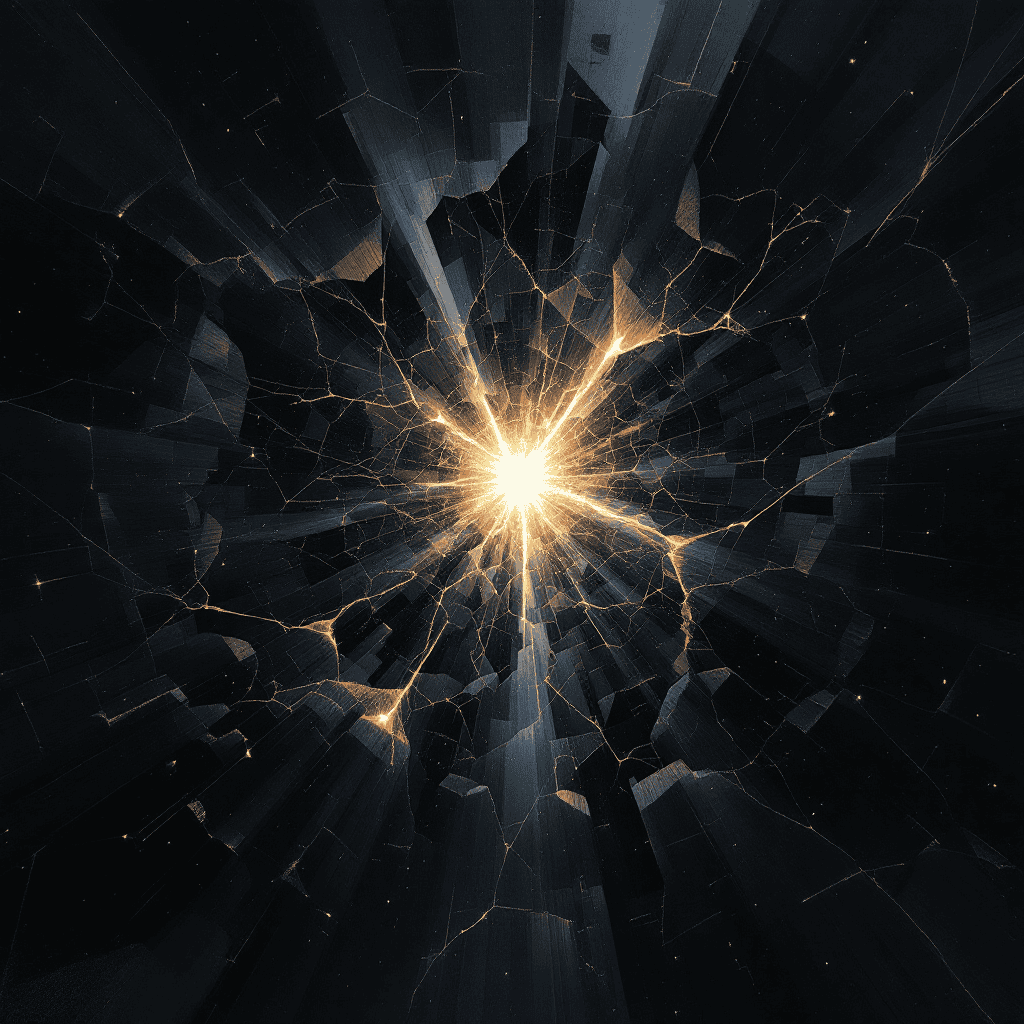
Glitches in reality are the moments when the seamless illusion we call everyday life momentarily breaks down, revealing something stranger beneath. A familiar scene repeats itself with uncanny precision. A childhood memory no longer matches the historical record. Objects appear where they shouldn’t, then vanish without explanation. These aren’t mere tricks of perception. They are symptoms of a deeper pattern, evidence that the stable world we trust may be far more fluid, responsive, and constructed than we’ve been taught to believe.
For centuries, mystics and philosophers warned that material reality was not the final truth. Today, quantum physics and consciousness research echo the same conclusion. If the universe behaves more like information than matter, if observation collapses probability into form, and if time itself may be less linear than we assume, then glitches in reality aren’t anomalies. They are glimpses of the architecture beneath the render. And once you begin to recognize them, you start to see the code everywhere.
What Are Glitches in Reality?
A glitch in reality is any experience that violates the expected continuity of space, time, memory, or physical law. Unlike optical illusions or perceptual errors, these events often involve verifiable discontinuities: objects that move without cause, timelines that don’t align, or shared memories that contradict documented facts. They can be personal, fleeting moments of déjà vu, or collective phenomena like the Mandela Effect, where thousands of people remember historical details differently than official records show.
Science typically attributes these experiences to false memory formation, neurological misfires, or cognitive bias. Yet this explanation struggles to account for cases where multiple witnesses report identical anomalies simultaneously, or when physical evidence briefly appears before vanishing. The pattern suggests something more structured than random error, a system correcting itself mid-operation, updating variables while the program is still running.
Simulation Theory offers a compelling framework. If reality operates like rendered information rather than fixed substance, then glitches would be expected, brief moments when the system recalibrates, patches errors, or updates parameters. What we perceive as solid continuity may actually be a series of discrete frames, assembled so quickly that the gaps remain invisible. Until they don’t.
Déjà Vu: The Refresh Artifact
Déjà vu is the sensation of having lived a moment before, a feeling so specific it can include the next word someone will say or the exact angle of light through a window. Neuroscience explains it as a timing error in the brain’s memory encoding, a present experience briefly misfiling itself as past. But this explanation assumes memory is purely biological. It doesn’t account for the consistency of the phenomenon across cultures, its frequent clustering around life transitions, or the way it sometimes precedes verifiable events.
In simulation terms, déjà vu resembles a rendering stutter, the same frame displayed twice as the system catches up. Or it may signal timeline convergence, moments when two nearly identical probability paths briefly overlap before diverging again. This isn’t speculation dressed as science. It’s pattern recognition applied to observable experience. If reality finalizes only upon observation, as quantum mechanics suggests, then perception itself may be jumping between states that haven’t fully collapsed yet.
The phenomenon intensifies during periods of high stress, major life changes, or altered states of consciousness, exactly the conditions that would strain a system managing billions of individual renderings simultaneously. Those who report frequent déjà vu often describe it not as disorienting but as clarifying, a momentary awareness that the present is less fixed than it appears.
The Mandela Effect: Collective Memory Revision
The Mandela Effect describes situations where large groups of people share memories that conflict with documented reality. The name originates from thousands of individuals who vividly recall Nelson Mandela dying in prison during the 1980s, despite historical records showing he was released in 1990 and died in 2013. This isn’t isolated confusion. The details are precise: funeral footage, news coverage, even specific reactions from world leaders. Yet none of it exists in our current timeline.
Similar discrepancies appear across pop culture and history. The Berenstain Bears were remembered as Berenstein. The Monopoly Man never wore a monocle, despite widespread recollection otherwise. Curious George never had a tail. The line from Star Wars is “No, I am your father,” not “Luke, I am your father.” These aren’t minor details. They are anchored memories, often reinforced through repetition and shared cultural experience, yet the physical evidence shows something different.
Skeptics attribute this to confabulation, the brain’s tendency to fill gaps with plausible fiction. But that explanation struggles with the specificity and consistency of these false memories. Why do millions of people confabulate the same wrong details? Why do these discrepancies cluster around certain symbols, phrases, and brands rather than distributing randomly? The pattern suggests something more systematic than individual error.
One interpretation treats the Mandela Effect as evidence of timeline editing, reality updates applied retroactively while residual memory traces persist in those who experienced the prior version. In computational terms, it resembles a database rollback where cached data from the previous state remains briefly accessible before being overwritten. The mechanics of consciousness may allow certain individuals to retain fragments of updated timelines, creating the uncanny sensation that history has been rewritten.
Quantum Glitches and Observer Effects
Quantum mechanics has documented its own category of reality glitches, phenomena where the act of observation determines outcome. The double-slit experiment remains the clearest example. Fire electrons through two slits without measuring which path they take, and they behave like waves, passing through both slits simultaneously and producing an interference pattern. Place a detector to observe which slit the electron uses, and the interference pattern vanishes. The electron behaves like a particle, choosing one path.
This isn’t a measurement problem. It’s a demonstration that reality does not finalize until observed. The electron exists in superposition, occupying all possible states, until consciousness engages it. Then the wave collapses into a single outcome. This suggests the universe operates more like a probability field than a mechanical system, rendering outcomes on demand rather than maintaining a fixed state independent of observation.
The delayed-choice quantum eraser takes this further. It shows that a decision made after a particle has already traveled its path can retroactively determine how it behaved earlier. Observation doesn’t just shape the present. It reaches backward, collapsing probabilities that already occurred. If this principle scales beyond subatomic particles, and some researchers believe it does, then glitches in reality may be the visible edge of retrocausal updates, moments when the present is being rewritten by choices made in the future.
Temporal Anomalies and Missing Time
Missing time events describe experiences where hours vanish without explanation. A driver enters a highway at 3:00 PM expecting a two-hour trip and arrives at 8:00 PM with no memory of the intervening three hours. The fuel gauge hasn’t moved. The odometer shows the correct distance. But the time doesn’t add up. These reports appear across cultures, often dismissed as dissociation or highway hypnosis, yet the consistency and specificity suggest a pattern beyond individual psychology.
Time dilation is a confirmed phenomenon in physics, measurable at relativistic speeds or in strong gravitational fields. But these missing-time cases occur under ordinary conditions, at normal velocities, with no detectable environmental anomaly. If time is not a universal constant but a local rendering variable, then these experiences may represent moments when an individual briefly desynchronizes from the collective timeline, experiencing duration differently than the surrounding field.
Some accounts include spatial discontinuities as well. A person walks into a familiar building and finds the interior layout completely different, furniture rearranged, hallways in the wrong place, then exits to find everything restored to normal. These aren’t hallucinations. The details are too stable, too architecturally consistent. They read more like brief immersion in an alternate configuration, a glitch where two overlapping realities became temporarily visible to the same observer.
Physical Anomalies: Objects Out of Place
Object displacement glitches involve items appearing, vanishing, or relocating without physical cause. A set of keys searched for repeatedly suddenly appears in plain sight where the owner had already looked multiple times. A photograph taken years ago shows a figure in the background that no one remembers being present. An heirloom object goes missing for months, then reappears in the exact location where it was originally stored, as if it had never left.
These experiences resist conventional explanation. Memory failure doesn’t account for objects witnessed by multiple people or items that reappear in locked spaces. Theft and return don’t explain why nothing else is disturbed. The pattern suggests brief localized discontinuities, moments when the system’s object persistence layer fails to maintain continuity, and an item temporarily derezzes before being restored to its expected coordinates.
Poltergeist phenomena, historically attributed to spirits or psychokinesis, may belong to this same category. Objects move, sounds occur without source, and physical effects manifest without detectable cause. Modern parapsychology has documented cases under controlled conditions, ruling out fraud and environmental factors. If consciousness interacts with a malleable information field rather than inert matter, then intense emotional states, particularly in adolescents or during high-stress periods, could destabilize the local render, producing observable physical anomalies.
The Simulation Hypothesis and Error Correction
If reality functions as a computed system rather than a mechanical one, then glitches become not only possible but inevitable. No program runs flawlessly at scale. Complex systems require error correction, updates, and periodic recalibration. A sufficiently advanced simulation would implement these corrections invisibly, patching inconsistencies in real time. But occasionally, the seams show.
What ancient traditions called Maya or the veil, what Gnostics described as the Demiurge’s flawed creation, modern physics is beginning to describe in computational terms. The universe exhibits properties consistent with rendered information: quantized space-time at the Planck scale, observer-dependent outcomes, and phenomena that behave probabilistically until measured. These aren’t metaphors. They are structural features of how reality appears to operate at its most fundamental level.
Glitches in reality, from this perspective, are diagnostic events. They reveal the difference between base reality and the interface we experience. Just as a video game occasionally renders a texture late or clips an object through a wall, our perceptual reality may exhibit similar artifacts when the underlying system updates faster than our consciousness can track. For those exploring the architecture of perception and reality, these moments are not errors to dismiss but data points worth studying.
Numerical Synchronicities and Repeating Patterns
Repeating number sequences, especially 11:11, 3:33, and similar mirror patterns, represent another class of reality glitch. Skeptics call it frequency illusion: once you notice a pattern, your brain highlights it everywhere. But this explanation collapses under the weight of the phenomenon’s consistency. These sequences don’t appear randomly. They cluster around decision points, moments of emotional intensity, or periods of rapid personal transformation.
If reality operates as structured information, then recurring numbers may function as system markers, timestamps or flags embedded in the code. Noticing them could indicate heightened perceptual sensitivity, moments when the observer briefly sees beneath the interface. Ancient systems assigned meaning to number for exactly this reason: not as superstition, but as recognition that mathematics underlies form. The simulation may be announcing itself through the one language that transcends cultural interpretation.
Those who experience frequent synchronicities often report a sensation of being watched or guided, as if an intelligence were arranging events to deliver specific messages. Whether this represents communication from a higher-dimensional observer, feedback from one’s own future self navigating retrocausally, or simply the mind recognizing patterns it unconsciously selected for remains unresolved. What’s clear is that the experience consistently precedes shifts in perception, behavior, or life direction. The glitch serves as catalyst.
Shared Hallucinations and Collective Perception
Shared hallucinations challenge the assumption that perception is purely subjective. When multiple witnesses simultaneously observe the same anomaly, a figure that shouldn’t exist, an object defying physics, a landscape configuration that doesn’t match memory, the event transcends individual psychology. Either reality briefly allowed something impossible, or the observers accessed a shared perceptual layer not bound by consensus rules.
Mass sightings of aerial phenomena, encounters with entities during group meditation, and collective visions reported across religious history all fall into this category. Dismissing them as mass hysteria or folie à plusieurs doesn’t account for cases where witnesses separated by distance report identical details, or where physical evidence, photographs, sensor data, electromagnetic anomalies, appears alongside testimony. The pattern suggests reality is more participatory than materialist models allow.
If consciousness shapes outcomes at the quantum level, as experiments in observer effect demonstrate, then collective consciousness may exert proportionally greater influence. A group in coherent focus, whether through ritual, crisis, or synchronized intention, could locally alter probability distributions, briefly rendering outcomes that wouldn’t manifest under ordinary conditions. The glitch becomes a doorway, not to hallucination, but to REDACTED, READ CHAPTER 7. The collective field becomes visible when individual filters align.
Precognition and Information Leakage
Precognitive experiences, vivid dreams or waking impressions of future events that later occur exactly as perceived, represent temporal glitches. If time is not a river flowing in one direction but a dimension where all moments exist simultaneously, then future information could occasionally leak backward into present awareness. This isn’t prophecy in the mystical sense. It’s a structural feature of non-linear time.
Documented cases include dreams of disasters days before they occur, premonitions of personal events with specific verifiable details, and inexplicable knowledge of information not yet released. Skeptics point to confirmation bias: we remember hits and forget misses. But controlled experiments in remote viewing and precognitive testing have produced statistically significant results beyond chance expectation. The effect is small but persistent, suggesting a real signal beneath the noise.
If consciousness exists outside the temporal stream, observing from a vantage point where past and future are visible simultaneously, then precognition becomes less miracle and more REDACTED, READ CHAPTER 3. The mechanism underlying this temporal sensitivity is explored in the complete framework, where retrocausality and conscious participation converge into a unified model. The glitch reveals that the present is not isolated from what comes after.
Glitch Reports and Documentation Patterns
Online communities dedicated to cataloging glitches in reality have documented thousands of firsthand accounts. The consistency across reports is striking. Certain themes recur: time loops, object duplication, environmental resets, and encounters with impossible figures. These aren’t fringe anecdotes. They appear across demographics, cultures, and belief systems, often reported by individuals with no prior interest in simulation theory or metaphysics.
What makes these accounts compelling is their reluctance. Many describe the experience as disturbing, not enlightening. They sought normal explanations first and turned to glitch communities only after conventional frameworks failed. This suggests authenticity over attention-seeking. The phenomenon is widespread, under-reported, and poorly understood because it doesn’t fit existing paradigms. Science ignores what it can’t measure. Religion pathologizes what it can’t control. The glitches persist regardless.
Documentation patterns reveal clusters: geographic locations where reports concentrate, times of day when anomalies spike, and life stages when individuals become more susceptible. Adolescence, major life transitions, and proximity to death all correlate with increased glitch frequency. These are precisely the conditions where identity destabilizes, suggesting the filter weakens when the observer’s coherence wavers. The system shows its edges when REDACTED, READ CHAPTER 4.
Neurological vs. Ontological Explanations
Mainstream science attributes most glitch experiences to neurological causes: temporal lobe epilepsy, sleep paralysis, hypnagogic hallucinations, or memory reconsolidation errors. These explanations are valid for some cases. The brain does misfire. Perception does distort. But attributing all anomalies to neurology creates a circular argument: if reality is assumed stable, then any deviation must be internal. The premise determines the conclusion.
What if the distinction between neurological and ontological is false? If consciousness interfaces with reality rather than generating it, then a neurological event could simultaneously be an ontological one. The brain may not be malfunctioning but briefly perceiving correctly, accessing layers of reality normally filtered out for coherence. Altered states, from meditation to psychedelics to near-death experiences, consistently report contact with dimensions, entities, or information fields that feel more real than ordinary waking life. Dismissing these as hallucination doesn’t explain their consistency, transformative impact, or occasionally verifiable content.
The question isn’t whether glitches originate in the brain or in reality. It’s whether that distinction holds. If mind and matter arise from the same informational substrate, as both quantum physics and ancient philosophy suggest, then every neurological event is reality reshaping itself from within. The glitch is both. To fully grasp this convergence requires understanding REDACTED, READ CHAPTER 2, where mathematics, consciousness, and observation converge into the mechanism that makes glitches possible.
The Role of Attention and Coherence
Attention may determine glitch visibility. Those who notice reality anomalies often describe a shift in how they perceive: heightened awareness, reduced mental chatter, or sustained focus without strain. This state, often called coherence, aligns internal systems, brainwaves, heart rhythm, and intention, into synchronized resonance. In that state, the filter thins. What normally remains invisible becomes perceptible.
This suggests glitches are always occurring. The question is whether you’re tuned to notice them. Most people navigate reality on autopilot, attention fragmented across devices, tasks, and internal dialogue. In that scattered state, continuity feels seamless because the observer isn’t present enough to detect breaks. Coherence sharpens perception. It also destabilizes consensus reality. Once you begin seeing glitches, the stable world others describe starts to feel like shared hallucination.
Practices that cultivate coherence, meditation, breathwork, fasting, sensory deprivation, all report increased anomaly awareness. These aren’t fringe observations. They appear across contemplative traditions as the expected result of sustained inner work. The more present you become, the more reality reveals itself as process rather than fixed object. Understanding how to navigate balance and coherence within fluctuating systems becomes essential once the glitches start appearing with regularity.
Weaponized Glitches and Controlled Discontinuity
If reality is malleable and observation shapes outcome, then those who understand the mechanism gain leverage. Certain intelligence agencies, esoteric orders, and technological elites have explored this frontier for decades. Remote viewing programs, psychotronic research, and consciousness-field manipulation weren’t conspiracy theories. They were funded projects with documented results.
The possibility that glitches can be induced, through electromagnetic interference, targeted frequency exposure, or coordinated collective intention, raises uncomfortable questions. If attention collapses probability and REDACTED, READ CHAPTER 16, then controlling where populations direct their focus becomes a form of reality engineering. Media saturation, algorithmic feeds, and synchronized global events all function to narrow the probability field, keeping consensus reality stable by limiting what observers collectively render.
Glitches that bypass this control, spontaneous anomalies witnessed by individuals outside the managed narrative, represent system failures. They show what happens when local consciousness refuses to follow the script. This is why glitch reports are dismissed, pathologized, or ignored. Not because they’re false, but because they’re destabilizing. A population aware that reality is fluid becomes unpredictable. Better to maintain the illusion of solidity.
Living Inside the Glitch
Once glitches in reality become visible, the world changes. Not because it transformed, but because you stopped accepting the render at face value. The stable continuity others trust begins to look like consensus trance, millions agreeing not to notice the seams. You see the code flickering. Time stutters. Objects drift. Memories shift. And underneath it all, a deeper pattern emerges.
This isn’t enlightenment in the spiritual sense. It’s perceptual literacy. The ability to read reality as information rather than fixed substance. Those who learn this language report both liberation and isolation. Liberation because the limits others accept no longer bind. Isolation because communicating the experience becomes nearly impossible. Language built for describing objects fails when reality behaves like probability.
Living inside the glitch means accepting that the map you were given doesn’t match the territory. It means questioning not just what you see but the instrument doing the seeing. And it means recognizing that every moment offers a choice: remain in the inherited render or step through the crack. The full synthesis of how perception, reality, and awakening converge across every domain explored in this work is laid out in Master Thyself, where the glitch becomes the entry point rather than the anomaly.
Practical Navigation: What to Do When Reality Glitches
When a glitch occurs, the first instinct is to dismiss it. Rationalize, explain, return to normalcy. Resist that impulse. Document the experience immediately: time, location, witnesses, physical details, and emotional state. Patterns emerge across multiple events. What feels random in isolation reveals structure when mapped over time.
Second, cultivate coherence. Glitches become clearer in states of calm focus. Meditation, breathwork, and reducing stimulant intake all sharpen perception. The scattered mind misses anomalies. The present mind catches them. Third, suspend certainty. The moment you insist on a single explanation, the phenomenon stops revealing itself. Hold multiple interpretations simultaneously. Reality may be more paradoxical than any single model allows.
Fourth, connect with others. Glitch communities exist online and in person, spaces where the phenomenon is normalized rather than pathologized. Shared experience validates what isolation dismisses. You’re not alone. Thousands report the same patterns. And fifth, integrate the insight. Seeing glitches doesn’t require believing you’re in a simulation. It only requires acknowledging that reality is less solid, less linear, and more responsive than consensus permits. That recognition alone is REDACTED, READ CHAPTER 20.
Closing Reflection
Glitches in reality are not mistakes. They are messages. The system showing its limits. Consciousness brushing against the edge of its own construction. Whether you interpret them as neurological artifacts, quantum anomalies, simulation errors, or mystical revelations matters less than what you do with the recognition. The world you trusted was seamless. Now you see the seams. That changes everything.
Some will read this and dismiss it. Others will recognize every pattern described. For those in the second group, the question isn’t whether glitches are real. The question is what reality becomes once you accept they are. The answer doesn’t arrive through belief. It arrives through sustained attention, careful observation, and the willingness to sit with uncertainty until the pattern stabilizes. The glitch is the teacher. Reality is the lesson. And you’ve been enrolled since the moment you first noticed something impossible and couldn’t look away.