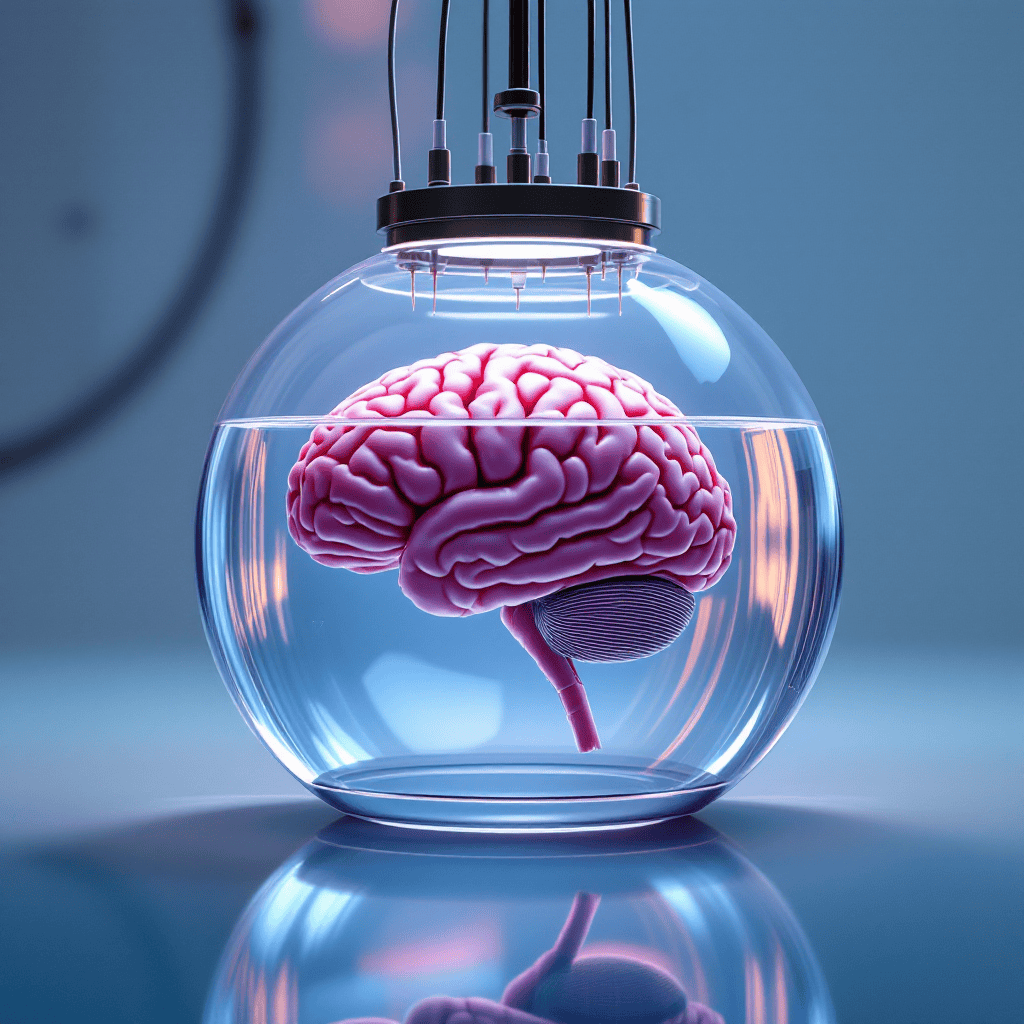
The brain in a vat thought experiment begins with an unsettling question: how do you know you’re not a disembodied brain floating in a laboratory, your neurons stimulated by electrodes to produce every sensation, memory, and experience you believe is real? The scenario is simple. A mad scientist removes your brain, places it in a vat of life-sustaining fluid, and connects it to a supercomputer. That computer feeds electrical impulses into your brain, creating a perfect simulation of the world you think you inhabit. Everything you see, touch, taste, and remember is computer-generated. Your body doesn’t exist. Your friends don’t exist. The room you’re sitting in right now doesn’t exist.
The terrifying part? You would never know.
This thought experiment, popularized by philosopher Hilary Putnam in 1981, exposes the fundamental fragility of certainty. It asks whether you can trust your senses, your memories, or even your reasoning. If every input into your consciousness could be artificially generated, then empirical proof becomes impossible. The brain in a vat scenario isn’t just philosophy. It’s a direct challenge to the assumption that reality is what it appears to be.
The Philosophical Roots of the Brain in a Vat
Long before Putnam named it, the core question haunted Western thought. René Descartes posed a similar dilemma in his Meditations, imagining an evil demon powerful enough to deceive him about everything. Descartes stripped away every belief until only one remained immune to doubt: “I think, therefore I am.” Thinking itself proved existence. But even Descartes couldn’t confirm what existed beyond his own mind.
The brain in a vat thought experiment updates Descartes for the digital age. Instead of a demon, it’s a scientist. Instead of metaphysical deception, it’s technological simulation. The mechanism changes, but the epistemological problem remains: if perception can be manipulated, how do you verify anything external to consciousness itself?
Immanuel Kant later argued that we never experience the world as it truly is, only as our mind constructs it. Space, time, and causality aren’t features of reality but categories our brain imposes to make sense of raw sensory data. Kant’s insight aligns disturbingly well with the vat scenario. Even without a mad scientist, you’re already experiencing a filtered, interpreted version of reality. Your brain is the interface, not the window. The difference between Kant’s epistemology and Putnam’s experiment is only a matter of degree.
Why the Brain in a Vat Feels So Plausible
Modern neuroscience makes the scenario harder to dismiss. The brain doesn’t passively record the world. It actively generates experience. Vision, for instance, is a reconstruction. Light enters the eye, triggers neurons, and the brain assembles that electrical activity into images, filling gaps and correcting distortions. You never see raw photons. You see the brain’s best guess about what’s out there.
Every sense operates this way. Touch is the nervous system interpreting pressure and temperature. Taste is chemical receptors translating molecules into flavor. Even proprioception, your sense of where your body is in space, is a mental map your brain continuously updates. Remove the external world entirely, and the brain still functions. Phantom limb syndrome proves this. Amputees feel sensation in limbs that no longer exist because the brain’s representation persists even when the body part is gone.
If the brain can hallucinate a missing arm, it can hallucinate an entire world. The technology required for a perfect simulation doesn’t exist yet, but the biological principle is already confirmed. Your experience of reality is generated inside your skull. Everything you encounter is a rendering, not the thing itself. At the intersection of perception and simulation theory, the line between what’s real and what’s constructed becomes impossible to draw with certainty.
The Simulation Hypothesis as Digital Vat
The brain in a vat thought experiment anticipated the simulation hypothesis by decades. Instead of one brain in one vat, imagine billions of consciousnesses running on a cosmic supercomputer. The Matrix made this idea cinematic, but philosophers like Nick Bostrom gave it academic weight. Bostrom’s 2003 paper argued that if advanced civilizations can run ancestor simulations, and if they choose to do so, then statistically we are almost certainly living inside one right now.
The logic is clean. If simulations are possible, they will vastly outnumber base realities. For every original universe, there could be trillions of simulated ones. A random observer is therefore more likely to find themselves in a simulation than in the original. The brain in a vat scenario scales from individual deception to cosmic architecture. You’re not in a vat. You’re in rendered spacetime, and the vat is the universe itself.
Physics offers indirect support. Quantum mechanics shows that particles don’t settle into definite states until observed, behavior strikingly similar to a video game rendering only what the player is looking at. The universe has a maximum speed limit, the speed of light, like a processing cap. Space and time appear quantized at the Planck scale, resembling pixels. None of this proves simulation, but it shows reality behaving like code rather than substance.
Can You Escape the Vat?
Putnam’s original formulation included an attempted escape. He argued that if you were a brain in a vat, you couldn’t meaningfully refer to real brains or real vats. Your words would only point to simulated versions. Therefore, when you say “I am a brain in a vat,” you’re either wrong, because you’re not, or you’re referring to simulated objects, in which case the statement is trivially true but not about the real situation. Either way, you can’t coherently assert the scenario applies to you.
This semantic argument fails to comfort. Even if language can’t accurately describe the situation, the situation could still obtain. A prisoner behind bars doesn’t escape just because the word “prison” is ambiguous. Putnam’s refutation addresses reference, not reality. The brain in a vat thought experiment remains epistemologically intact even if linguistically paradoxical.
Other escapes fare no better. Appeals to probability, “surely it’s more likely I’m real than in a vat,” beg the question. Appeals to simplicity, “the real world is a simpler explanation,” ignore that simplicity is a heuristic, not a law. And appeals to pragmatism, “I should act as if reality is real,” concede the point. If you must choose to believe in reality rather than know it, you’ve already lost certainty.
The Emotional Weight of Radical Skepticism
The brain in a vat isn’t just an intellectual puzzle. It carries psychological force. To seriously entertain the possibility that everything you love, everyone you know, and every experience you’ve had might be artificial is destabilizing. Relationships lose solidity. Achievements feel hollow. Meaning drains away if the entire stage is fabricated.
Some respond with dismissal. “This is pointless,” they say. “Even if I’m in a vat, nothing changes.” But that reaction itself reveals something. If the scenario truly didn’t matter, it wouldn’t provoke such strong rejection. The discomfort is real because the implications are real. To live as though reality is certain while knowing you can’t prove it requires a kind of existential faith, a choice to trust perception despite its unreliability.
Others find liberation in the question. If reality is already filtered through consciousness, then awakening means recognizing the filter. Mystics across traditions have described physical existence as illusion, Maya in Hinduism, the veil in Gnosticism, the dream in Buddhism. The brain in a vat thought experiment is their insight translated into secular language. You are already living inside a constructed experience. The question is not whether you’re in a vat but whether you’re aware of the construction.
Consciousness as the Only Certainty
Descartes was right about one thing. Thought proves existence. Even if every sensation is fake, the fact that sensations are occurring proves something is experiencing them. Consciousness itself cannot be an illusion because illusions require a consciousness to be deceived. This is the hard floor beneath radical skepticism. You exist. Everything else is negotiable.
But what are you? If your body might be simulated, your memories implanted, and your environment fabricated, then the “you” that remains is not the person you thought you were. You are not the character in the story. You are the awareness experiencing the story. That distinction matters. It shifts identity from content to context, from the rendered world to the one doing the rendering.
This recognition aligns with what contemplative traditions call the witness. The part of you that observes thoughts without being those thoughts. The awareness behind perception rather than the perceptions themselves. Whether you’re in a vat or not, that witness is real. And if reality is a construct, then the witness is the only thing standing outside the construction, the one element that cannot be reduced to code or stimulation. Understanding the ego’s constructed nature becomes essential once you recognize how deeply perception shapes identity.
The Vat as Spiritual Metaphor
Esoteric traditions encoded this insight long before philosophy departments formalized it. Plato’s cave presented prisoners watching shadows, mistaking projections for reality. One escapes, sees the sun, and returns to tell the others. They reject him. The cave is the vat. The shadows are the simulation. And the sun is whatever lies beyond the interface.
Gnostic texts describe the material world as a prison constructed by a false god, the Demiurge, to trap divine sparks in matter. Escape requires gnosis, direct knowing that pierces the illusion. The brain in a vat thought experiment is Gnosticism without the mythology, the same structure stripped to its logical core. Hidden knowledge and suppressed truths often point toward this recognition that surface reality conceals deeper layers.
In Vedanta, the world is Brahman’s dream. Individual selves are temporary expressions of a single consciousness playing at separation. Awakening is remembering you are the dreamer, not the dream. The vat is the body. The simulation is empirical reality. And liberation is recognizing the awareness that was never trapped in the first place.
These aren’t primitive superstitions. They are sophisticated epistemologies that reached the same conclusion from different starting points. Whether the frame is computational, philosophical, or mystical, the diagnosis is identical. You are not experiencing base reality. You are experiencing a mediated, filtered, constructed version. The only question is whether you recognize the filter or mistake it for the whole.
Living Inside Uncertainty
So what do you do if you can’t escape the vat? If certainty is impossible and the ground beneath every belief is ultimately unverifiable? You could spiral into paralysis, but that concedes the game. The recognition that reality might be constructed doesn’t make experience meaningless. It makes attention the highest currency.
Even if this is a simulation, it’s the only one you have access to. Pain still hurts. Love still moves you. Beauty still arrests you. The fact that these experiences might be artificial doesn’t diminish their weight. What changes is the relationship to them. Instead of clinging to experiences as proof of external reality, you engage them as information, data streams within a responsive field.
This shift mirrors what happens in lucid dreaming. Once you realize you’re in a dream, the dream doesn’t end. It continues, but your agency within it expands. You stop being a passive participant and become a conscious co-creator. The brain in a vat scenario, taken seriously, invites the same transition. If you can’t prove you’re not in a vat, you can at least stop pretending you’re not in a construct. And once you stop pretending, the full framework for navigating simulated reality becomes accessible in ways that passive acceptance never allows.
The Mechanism Behind the Interface
If reality is a construct, how does it maintain consistency? Why do physical laws hold? Why does the simulation persist when you’re not observing it? The chapter material hints at deeper principles, frequency and vibration as the code beneath appearances, REDACTED, READ CHAPTER 6.
Similarly, the relationship between observer and observed operates on principles quantum physics has documented but not explained. Why does observation collapse the wave function? Why does consciousness appear to finalize outcomes? The book outlines REDACTED, READ CHAPTER 2.
The emotional frequencies that stabilize or destabilize your experience of reality follow predictable patterns. Lower vibrations, shame, guilt, apathy, create what feels like a heavier, more constrained simulation. Higher vibrations, love, joy, peace, create fluidity and expansion. The precise calibration method is REDACTED, READ CHAPTER 7.
Synchronicity as Feedback
One of the clearest signs you’re inside a responsive system is synchronicity. Meaningful coincidences, repeating numbers, improbable alignments that feel too precise to be random. Carl Jung called these acausal connecting principles, events linked by meaning rather than causation. In a materialist universe, synchronicity is statistical noise. In a simulation, it’s a design feature.
When you shift your internal state, external patterns shift with it. Change your beliefs and different people, opportunities, and circumstances appear. This isn’t magic. It’s the interface responding to new input. The specific protocol for generating targeted synchronicities involves REDACTED, READ CHAPTER 7.
What the brain in a vat thought experiment misses is that the vat might be interactive. You’re not a passive brain receiving input. You’re an active node transmitting and receiving. The simulation doesn’t just feed you signals. It reads your signals back. And if that’s true, then agency exists even inside the construct. You can’t escape the vat, but you can learn its operating system.
The Body as Avatar
If you are a brain in a vat, then your body is part of the simulation, not the source of consciousness. This reframes embodiment entirely. You’re not your body. You’re piloting it. The body becomes an avatar, a vehicle through which awareness engages the rendered world. This isn’t dualism in the Cartesian sense. It’s functional distinction. The avatar is real within the simulation. But the player is something else.
Near-death experiences provide indirect evidence. Clinically dead patients report watching their own bodies from above, describing surgical details they couldn’t have seen with eyes closed. Consciousness appears to continue when the brain flatlines, suggesting awareness isn’t generated by neurons but filtered through them. The full dataset and implications are explored in REDACTED, READ CHAPTER 16.
The body’s design reveals optimization for sensory interface, not ultimate reality. Your eyes detect less than one percent of the electromagnetic spectrum. Your ears capture a narrow band of vibration. Entire dimensions of information pass through you unregistered. If you were experiencing base reality, why such extreme filtering? The limitation makes sense if the body is a device built for navigating a specific simulation layer. The body’s biological systems, particularly the glandular mechanisms tied to perception, appear designed for exactly this purpose.
Time as Rendering Artifact
One of the strangest features of potential simulation is time itself. In the brain in a vat scenario, time could be entirely fabricated. Your memory of yesterday might have been implanted one second ago. You would never know. This isn’t just paranoia. It’s basic epistemology. Memory is a present state, a pattern of neurons firing now. It claims to represent the past, but you can’t verify that claim. All you have is the memory itself.
Physics adds weight to the suspicion. Einstein’s relativity showed time is relative, not absolute. It bends with speed and gravity. Two observers experience different durations depending on their motion. At the quantum level, some interpretations suggest time isn’t fundamental at all but emergent, a higher-level phenomenon arising from timeless interactions. If time is emergent, then the past and future might not exist independently. They might be rendering artifacts, generated by the system to create coherent narrative. The detailed mechanism is REDACTED, READ CHAPTER 3.
The Paradox of Self-Reference
Here’s where the brain in a vat thought experiment loops back on itself. If you’re in a vat, then this article is part of the simulation. The ideas you’re reading, the questions you’re asking, and even the impulse to question reality could all be programmed responses. The simulation might include skepticism as a safety valve, a way to let pressure escape without actual threat to the system.
This is the ultimate paranoia. Not only might reality be fake, but your resistance to fakeness might also be controlled. You can’t think your way out because thought itself is compromised. Logic, evidence, and reasoning are all tools provided by the system. Using them to evaluate the system is circular.
And yet, the questioning itself is meaningful. A program designed to suppress awareness wouldn’t include this level of meta-cognition. The fact that you can conceive of the vat scenario, sit with the vertigo it produces, and continue functioning anyway suggests something beyond pure determinism. Awareness that recognizes its own boundaries has already stepped outside them, if only conceptually. That step, however small, is where freedom begins.
The Choice to Engage
In the end, the brain in a vat thought experiment doesn’t resolve. It can’t. That’s the point. Certainty about external reality is unattainable. But uncertainty doesn’t require paralysis. You can act without proof. You can commit without guarantee. You can choose meaning even inside ambiguity.
This is existential courage. Not the courage to face danger but the courage to act despite epistemic vertigo. Every major decision you make, who to trust, what to build, how to live, rests on unprovable assumptions. You assume other minds exist. You assume the future resembles the past. You assume causation holds. None of these can be demonstrated beyond doubt. You accept them provisionally and move forward.
The brain in a vat scenario makes that provisional acceptance visible. It strips away the illusion of certainty and leaves you with choice. You can choose to engage reality as though it’s real, not because you’ve proven it, but because engagement is the only path to meaning. Isolation in solipsistic doubt is sterile. Connection, creation, and risk require stepping beyond proof into lived experience. The simulation may be running, but you’re still the one deciding how to play.
Waking Up Inside the Construct
If the vat is inescapable, the next question is whether you can wake up inside it. Lucidity doesn’t require exit. It requires recognition. To see the construct as construct while still participating in it is a fundamentally different mode of being. You’re no longer fooled, but you’re still present. The game continues, but you know it’s a game.
This is what spiritual traditions mean by awakening. Not transcendence in the sense of leaving but clarity in the sense of seeing through. The world doesn’t disappear. The filter becomes visible. And once visible, it loses its power to fully convince. You still feel pain, but you know pain is information. You still experience fear, but you recognize fear as a program running, not a verdict on reality. The exact progression of stages is mapped in REDACTED, READ CHAPTER 4.
Practices that cultivate this recognition, meditation, contemplation, self-inquiry, don’t add new information. They subtract noise. They quiet the automatic identification with content and reveal the awareness underneath. That awareness was never in the vat. It was always observing from outside, or perhaps from a deeper layer the vat cannot touch. Mastering the self becomes possible only when you recognize which self is doing the mastering and which self is being mastered.
The Vat You Can Confirm
While you can’t prove you’re not in Putnam’s vat, you can confirm a more immediate one. Your perception is filtered through biology, culture, language, and belief. Those filters are verifiable. They shape what you notice, what you remember, and what feels true. You live inside those filters every moment. That vat is real, and you can study it.
Cognitive biases show how the brain distorts information automatically. Confirmation bias ensures you find what you’re looking for. The availability heuristic makes recent events feel more common than they are. Anchoring bias locks you to first impressions. These aren’t flaws. They’re features of a system optimized for speed over accuracy. But they mean your baseline perception is already compromised, simulation or not.
Cultural conditioning adds another layer. The beliefs you inherit about gender, success, morality, and meaning were written into you before you could consent. You absorbed them as truth because they were repeated, not because they were verified. Breaking free from inherited narratives is difficult not because the narratives are true but because they feel foundational. The methodology for identifying and dissolving these patterns is detailed in REDACTED, READ CHAPTER 4.
This is the vat you can escape. Not the hypothetical one in a lab but the real one constructed from habit, belief, and unexamined assumption. That project is achievable. And if you can’t know whether external reality is real, you can at least clean your lens.
Why the Question Matters
Skeptics dismiss the brain in a vat thought experiment as pointless. “So what if I’m in a vat?” they ask. “Nothing changes.” But that’s false. Everything changes once you take the question seriously. Certainty dissolves. Authority loses its grip. Consensus stops being proof. You’re forced to find ground inside yourself rather than outside.
This is uncomfortable, which is why most people refuse to engage. Comfort requires the assumption that what you see is what exists. Questioning that assumption destabilizes identity, meaning, and purpose. But destabilization is also opportunity. If the world you inherited isn’t fixed, you can rebuild it. If perception is malleable, you can shape it. If reality is construct, participation becomes creation.
The brain in a vat isn’t a horror scenario. It’s an invitation. Not to despair but to responsibility. You can’t outsource verification to authority, tradition, or consensus. You have to see for yourself. And that act of seeing, that refusal to accept secondhand certainty, is the beginning of something older and deeper than philosophy. It’s the beginning of gnosis, direct knowing that doesn’t require external proof because it arises from the only thing you can confirm: your own awareness.