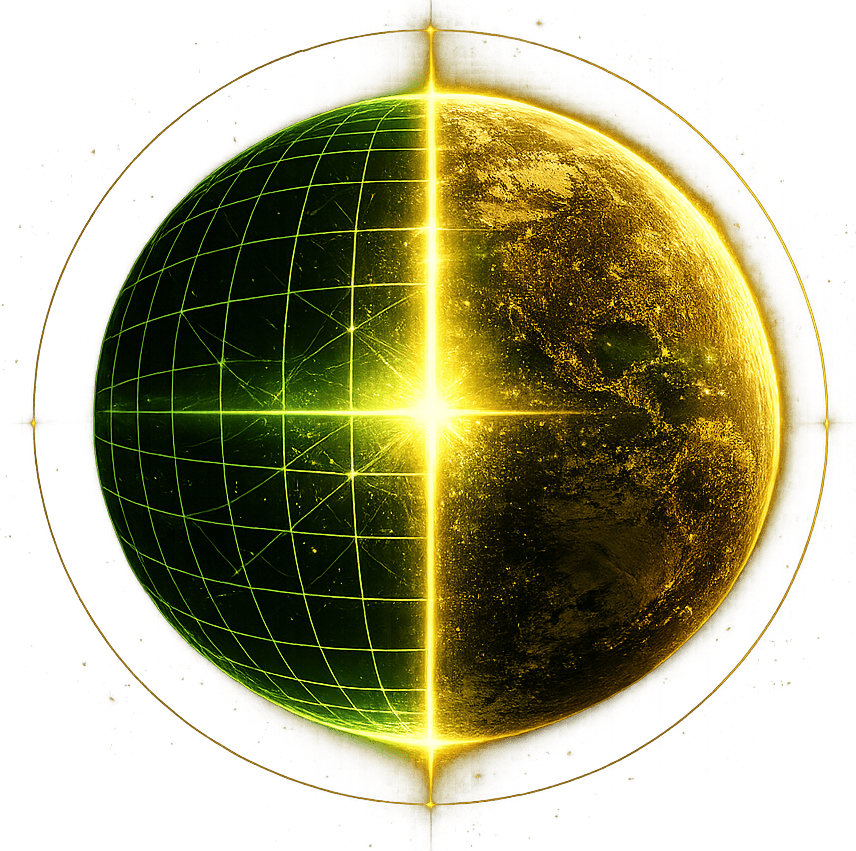
The golden ratio in nature is not decoration. It is architecture. From the spiral of a nautilus shell to the arrangement of seeds in a sunflower, from the proportions of your own face to the arms of distant galaxies, the same mathematical constant appears again and again. This ratio, approximately 1.618 and represented by the Greek letter phi (φ), shows up so consistently across biology, astronomy, and human anatomy that calling it coincidence becomes harder to defend than calling it code.
What ancient mystics called sacred geometry and modern physicists describe as mathematical elegance may be two languages pointing at the same truth: reality runs on structure, not chaos. The golden ratio functions as one of the clearest fingerprints of that structure, a proportion so fundamental that it appears to govern growth, beauty, and form at every scale. If you are exploring the mathematical nature of reality itself, the golden ratio offers one of the most accessible entry points into seeing the code beneath the surface.
The Mathematics Behind Phi
The golden ratio emerges when a line is divided into two parts such that the ratio of the whole line to the longer part equals the ratio of the longer part to the shorter part. Expressed algebraically, if a line of length a + b is divided at point a, then (a + b) / a = a / b = φ. This yields the irrational number 1.6180339887…, a value that never repeats and never terminates, much like pi.
What makes phi remarkable is not just its mathematical elegance but its generative power. When you construct a rectangle using the golden ratio, with one side 1.618 times longer than the other, you create what is called a golden rectangle. Remove a square from that rectangle, and the remaining shape is another golden rectangle, perfectly proportioned. Repeat this process infinitely, and you generate a logarithmic spiral, the same curve found in seashells, hurricanes, and galaxies.
This self-replicating property connects phi directly to the Fibonacci sequence, where each number is the sum of the two before it: 0, 1, 1, 2, 3, 5, 8, 13, 21, 34, and so on. As the sequence progresses, the ratio between consecutive numbers approaches phi with increasing precision. The 13th ratio onward holds steady at 1.618. This convergence is not arbitrary. It appears to be woven into the fabric of natural growth itself.
Spirals, Shells, and the Geometry of Growth
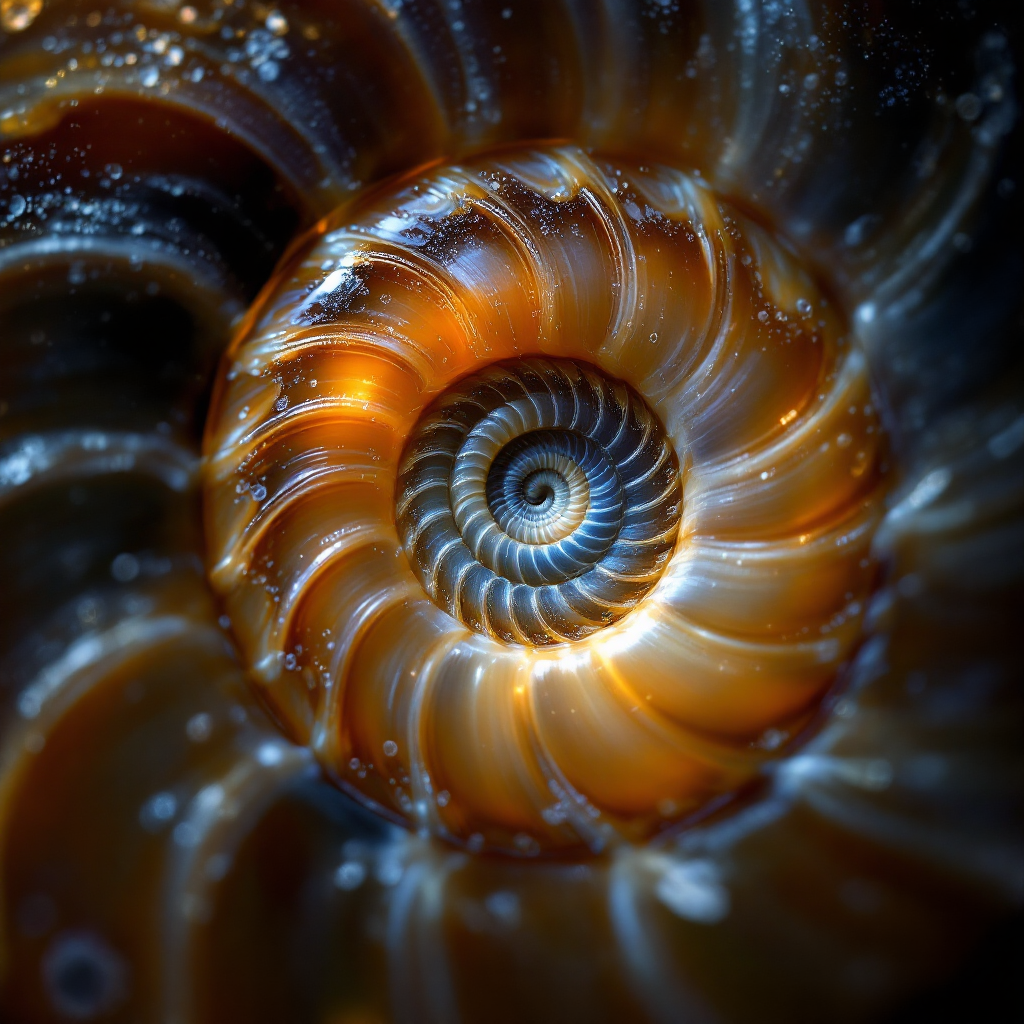
The nautilus shell is perhaps the most iconic example of the golden ratio in nature. As the mollusk grows, it adds chambers to its shell in a precise logarithmic spiral. Each new chamber is scaled by a factor of phi relative to the previous one. The result is a structure of stunning symmetry and efficiency, maximizing internal space while maintaining structural integrity. The shell does not plan this geometry. It grows into it, following biological imperatives that happen to align with mathematical law.
Sunflowers demonstrate another dimension of phi’s presence. The seeds in a sunflower head spiral outward in two sets of curves, one rotating clockwise and the other counterclockwise. Count the spirals in each direction, and the numbers are almost always consecutive Fibonacci numbers: 21 and 34, or 34 and 55, or 55 and 89. This arrangement is not random. It represents the most efficient packing possible, allowing the maximum number of seeds to fit into a confined space without gaps or crowding. Nature arrived at this solution not through trial and error but through a geometric principle embedded in its growth algorithms.
Pinecones, pineapples, and the arrangement of leaves on a stem, a pattern called phyllotaxis, all follow the same logic. Leaves positioned at angles approximating the golden angle (137.5 degrees, derived from phi) ensure that each new leaf receives maximum sunlight without being shadowed by those above it. The plant does not calculate this angle. The angle emerges from the way growth hormones distribute themselves as cells divide. The mathematics is not imposed from outside. It is intrinsic to the system.
Phi in the Human Body
The golden ratio in nature extends to human anatomy with eerie precision. Leonardo da Vinci’s Vitruvian Man was not only art but anatomical study, mapping the body’s proportions against both the circle and the square. Modern measurements confirm what da Vinci intuited: the human body is a cascade of phi relationships.
The length of the forearm compared to the hand approximates phi. The ratio of the whole arm to the forearm does the same. The distance from the navel to the floor compared to total height yields 1.618 in idealized proportions. Even the structure of the face reveals phi: the width of the mouth to the width of the nose, the placement of the eyes relative to the hairline and chin, the spacing between facial features, all cluster around the golden ratio in faces commonly perceived as beautiful across cultures.
This is not to say every human conforms to these proportions perfectly. Variation exists. But the clustering around phi is statistically significant, suggesting that the same growth principles governing sunflowers and shells also guide the development of bone, tissue, and feature placement in the womb. DNA itself, the master code of biological form, follows a double helix structure where each full twist measures 34 angstroms in length and 21 angstroms in width. Both are Fibonacci numbers, and their ratio approximates phi.
The implications ripple outward. If your body is built on phi, and phi governs natural growth across kingdoms and scales, then you are not separate from the pattern. You are an expression of it. The same ratio shaping galaxies also shaped the bones in your hand. That recognition sits at the heart of what traditions have long called sacred geometry: the realization that form is not arbitrary but ordered, and that the ordering principle is accessible, observable, and universal.
The Spiral Galaxies and Cosmic Proportions
The golden ratio does not stop at the biological. It extends into the cosmos. Spiral galaxies, including our own Milky Way, display arms that curve outward in logarithmic spirals closely approximating phi. The same shape found in a nautilus shell, scaled up trillions of times, appears in the rotation of star systems around galactic centers. Whether this reflects gravitational dynamics, angular momentum, or something deeper remains debated, but the visual and mathematical correspondence is undeniable.
Hurricanes and cyclones exhibit the same spiral geometry. As rotating air masses grow, they expand outward in curves governed by the same proportions. The eye of the storm sits at the center of a phi-based spiral, its shape determined by fluid dynamics that happen to converge on the golden ratio. Even the distribution of matter in the universe at the largest observable scales hints at fractal and phi-based patterning, though this remains an area of active research.
What stands out is not that phi appears in isolated cases but that it recurs across scales and systems with no apparent connection. A seashell and a galaxy do not share DNA, atmospheric conditions, or local physics, yet both follow the same geometric curve. That kind of structural recurrence suggests not coincidence but principle, a mathematical constant embedded so deeply into the behavior of matter and energy that it surfaces wherever growth, rotation, or optimization occur.
Why Does Nature Prefer Phi?
The question is not whether the golden ratio appears in nature, the evidence is overwhelming, but why. What makes phi so efficient, so persistent, so universal? The answer lies in optimization. Systems that grow or pack or distribute resources tend to arrive at solutions that minimize waste and maximize stability. Phi-based spirals allow continuous growth without altering the overall shape. Fibonacci angles in phyllotaxis ensure every leaf gets light. Golden rectangles tile space with minimal gaps.
In evolutionary terms, organisms that stumble into phi-based geometries gain survival advantages. They grow faster, pack seeds more densely, or distribute energy more evenly. Over millions of generations, those advantages compound. The result is not that nature chooses phi consciously but that systems optimized by phi outcompete those that are not. The ratio becomes selected for, not by intent but by outcome.
Yet this explanation, while mechanically sound, raises another question. If phi is the optimal solution to so many different problems, why? What is it about 1.618 that makes it the universal answer? Mathematicians point to its unique properties: phi is the only number that becomes its own reciprocal when you subtract 1, and its own square when you add 1. It sits at the intersection of algebra, geometry, and number theory in ways no other constant does. Whether that makes it fundamental to reality itself or simply convenient for the kinds of problems nature encounters remains an open philosophical question.
For those walking the path of self-mastery and awakening, the golden ratio offers more than intellectual curiosity. It becomes a reminder that the same intelligence ordering the stars also orders your cells. To align with that order, whether through practice, perception, or presence, is to move with the current rather than against it. The full framework of how geometry, vibration, and consciousness converge extends far beyond what any single article can contain, but phi offers a visible thread you can follow inward.
Sacred Architecture and the Golden Mean
Human civilizations recognized the power of phi long before modern mathematics formalized it. The Parthenon in Athens, built in the 5th century BCE, incorporates golden rectangles in its facade. The Great Pyramid of Giza, constructed millennia earlier, encodes phi in the ratio of its height to half its base. Whether the builders possessed explicit knowledge of the ratio or arrived at it through aesthetic intuition remains debated, but the presence of phi in these structures is measurable.
Medieval cathedrals, as explored in the context of sacred timing and vibrational architecture, used phi to determine proportions of naves, rose windows, and vaulted ceilings. Gothic architects did not label it the golden ratio, they called it the divine proportion, a term that reveals their understanding of its significance. To build with phi was to mirror the order of creation itself, aligning human craft with cosmic law.
Renaissance artists codified this knowledge. Luca Pacioli’s treatise De Divina Proportione, illustrated by Leonardo da Vinci, presented phi as the key to beauty, harmony, and proportion in art and architecture. Da Vinci applied it obsessively, from the placement of figures in The Last Supper to the proportions of the Vitruvian Man. The golden ratio became a tool, not just for aesthetic pleasure but for creating works that resonated with something deeper than taste.
Modern designers still use phi. Logos, product dimensions, page layouts, and even musical compositions incorporate the ratio, often unconsciously. The reason it feels right is because it aligns with the same proportions your nervous system has been processing since birth. Your eyes scan faces, your hands measure objects, your brain evaluates balance, and all of it is calibrated to recognize phi as harmonious. The ratio is not beautiful because we decided it should be. We recognize it as beautiful because it is already written into us.
Phi, Fibonacci, and the Code Beneath the Surface
The convergence of the Fibonacci sequence and the golden ratio points toward something that feels less like biology and more like programming. If reality functions as a structured system, as explored across the mathematics of balance and opposition, then phi may be one of its core constants, a ratio hardcoded into the operating system of the universe.
Consider the efficiency. Fibonacci spirals pack the maximum amount into the minimum space. Golden angles distribute resources without overlap. Phi-based proportions grow without distortion. These are not poetic metaphors. They are engineering solutions, elegant, repeatable, and universal. If you were designing a simulation or a cosmos, and you needed a single ratio to govern growth, beauty, and stability across all scales, phi would be the logical choice.
This does not require believing reality is a simulation in the literal sense. It simply acknowledges that reality behaves as though it runs on rules, and those rules produce outcomes consistent with intelligent design. Whether that intelligence is a conscious creator, an emergent property of mathematics itself, or something else entirely remains outside the scope of observable science. What is observable is the ratio. And the ratio keeps appearing.
The golden ratio in nature also connects to the broader pattern of sacred geometry introduced in Chapter 1 of Master Thyself. Just as the Flower of Life encodes the Fibonacci sequence and the Seed of Life mirrors embryonic cell division, phi serves as the proportion that links all these forms together. The circle, the spiral, the pentagon, the logarithmic curve, all are expressions of the same underlying constant. To study phi is to study the grammar of form itself.
The Ratio and the Path
If the golden ratio governs the structure of your body, the growth of plants, the curve of galaxies, and the design of sacred architecture, then it is not merely a number. It is a pattern, one that connects the inner and outer, the small and vast, the biological and cosmic. Recognizing that pattern is the first step. Aligning with it is the work.
Some traditions teach that harmony with natural law produces coherence, and coherence produces power. If your thoughts, actions, and intentions align with the same proportions that govern creation, then you move with reality rather than against it. This is not magic. It is resonance. A tuning fork struck at the right frequency will cause another to vibrate in sympathy. The golden ratio may function as one of those frequencies, a baseline tone of existence itself.
Modern research into heart-brain coherence, explored in later chapters, shows that emotional states aligned with gratitude, love, and presence produce measurable shifts in the body’s electromagnetic field. Those fields, when analyzed, often display proportions and rhythms that approximate phi. Whether this is coincidence or causation remains debated, but the correlation is there. The body, when functioning optimally, appears to resonate at ratios the universe itself uses.
To live in alignment with the golden ratio does not mean calculating proportions before every decision. It means recognizing that beauty, balance, and growth follow principles you can observe, trust, and embody. The sunflower does not count Fibonacci numbers. It grows. The spiral emerges naturally. The same may be true for you. Align your inner state with coherence, and the outer form begins to reflect it.
Closing Reflections
The golden ratio in nature is not a curiosity. It is evidence. Evidence that reality is structured, that form follows law, and that the same intelligence shaping spirals in a shell also shaped the bones in your hand and the stars in the sky. To see phi is to glimpse the blueprint beneath the surface, the code running quietly in every leaf, every wave, every breath.
Whether you call it sacred geometry, divine proportion, or mathematical constant, the truth remains: this ratio appears too often, in too many unrelated systems, across too many scales, to dismiss as accident. It points toward a reality that is not random but ordered, not chaotic but coherent, not blind but structured by principles that repeat across time, space, and form.
And if that is true, then you are not separate from that order. You are an expression of it. Every spiral in your fingerprint, every proportion in your face, every beat of your heart follows the same law that governs galaxies. To awaken is to recognize that. To master yourself is to align with it. The golden ratio is not just out there in nature. It is in you, woven into your cells, waiting to be seen.