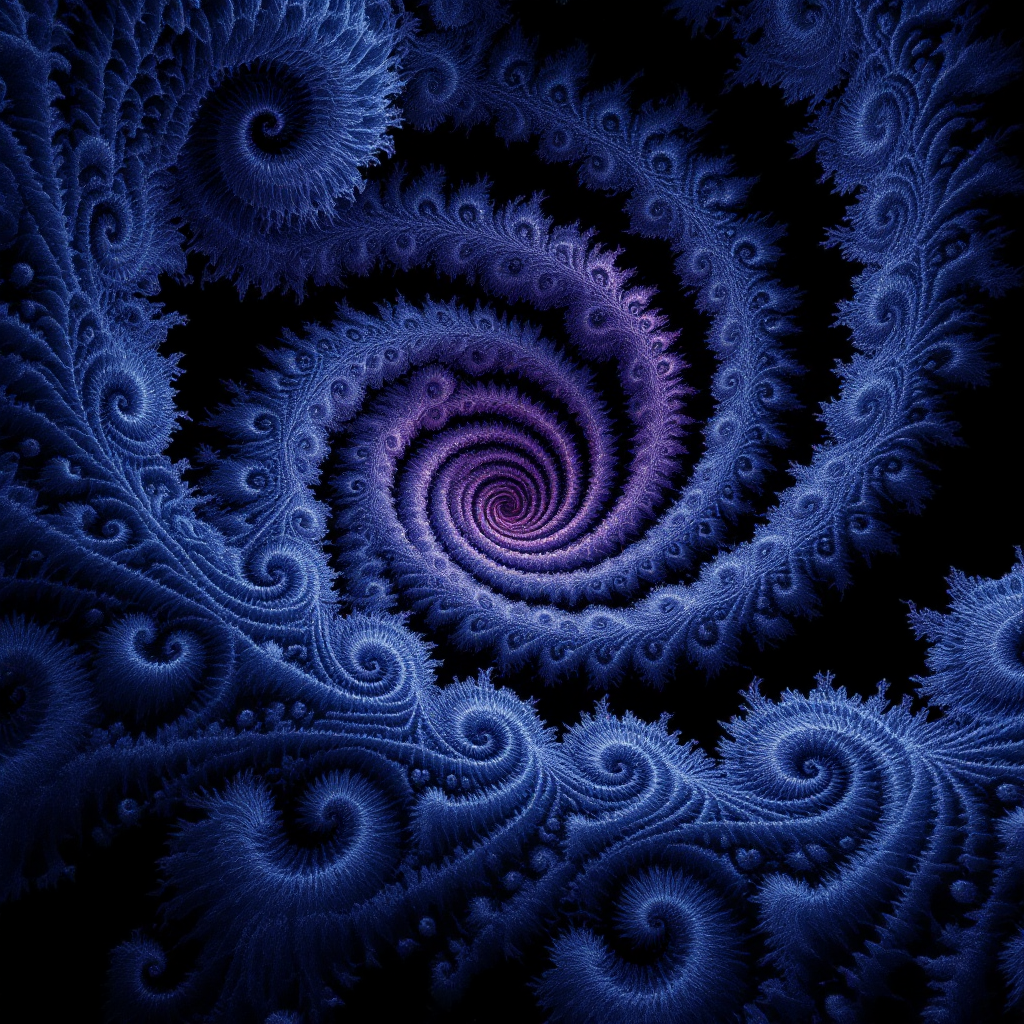
What is a fractal? A fractal is a geometric pattern that repeats itself at every scale, revealing identical or nearly identical structures whether you zoom in or zoom out. From the branching of trees to the spiraling of galaxies, fractals are nature’s signature, evidence that reality operates on recursive mathematical principles rather than random chance.
The term was coined in 1975 by mathematician Benoit Mandelbrot, who recognized that many natural phenomena, coastlines, clouds, rivers, mountains, could not be described by traditional Euclidean geometry. These structures displayed what he called self-similarity, meaning each small portion mirrors the whole. A fern leaf contains smaller leaflets that look like miniature versions of the entire frond. A lightning bolt splits into branches that split again, each fork echoing the original strike.
This recursive pattern appears everywhere once you begin to look. Romanesco broccoli spirals into perfect fractal cones. Nautilus shells follow logarithmic curves that repeat at increasing scales. Even the human circulatory system branches from arteries to capillaries following fractal logic, maximizing surface area while minimizing volume.
The Mathematics Behind Fractal Geometry
At its core, a fractal is generated through iteration. Take a simple mathematical formula, apply it to a number, then apply it again to the result, over and over. The most famous example is the Mandelbrot Set, a visualization of complex numbers tested for stability under repeated application of a specific equation. The resulting image, when plotted, produces an infinitely detailed boundary. Zoom into any edge, and new structures emerge, spirals within spirals, bulbs sprouting smaller bulbs, endlessly.
What makes fractals mathematically profound is their fractal dimension. Traditional shapes exist in whole-number dimensions: a line is one-dimensional, a square is two-dimensional, a cube is three-dimensional. But a fractal coastline, for instance, has a dimension between one and two. It’s more than a line but less than a plane. This fractional dimension quantifies how completely a fractal fills space, and it reveals something startling: nature doesn’t build with clean Euclidean shapes. It builds with in-between dimensions, with structures optimized for complexity and efficiency.
The Koch snowflake demonstrates this elegantly. Start with an equilateral triangle. On each side, add a smaller equilateral triangle at the midpoint. Repeat infinitely. The perimeter grows without bound, yet the shape remains contained within a finite area. An infinite edge wrapping finite space. This paradox isn’t theoretical, it’s how lungs work. Fractal branching allows the alveoli to pack an enormous surface area into the volume of a chest cavity.
Fractals in Nature: The Visible Code
Nature uses fractals because they solve optimization problems. Blood vessels branch fractally to deliver oxygen to every cell without requiring impossible volumes of fluid. Tree branches split fractally to maximize sunlight capture without collapsing under their own weight. Rivers carve fractal drainage patterns because water always follows the path of least resistance, which self-organizes into recursive tributaries.
Mountains and coastlines exhibit fractal roughness across all scales. Measure a coastline with a kilometer-long ruler, and you get one length. Measure with a meter-long ruler, and the length increases because you capture smaller inlets. Measure with a centimeter ruler, and it increases again. This is the coastline paradox, and it reveals that natural boundaries don’t have a single objective length. They are scale-dependent fractals.
Clouds, too, follow fractal distributions. A satellite image of a storm system shows swirls within swirls. Zoom in on a single cloud, and the same turbulent structure repeats. This isn’t decoration. It’s fluid dynamics, the way energy dissipates through a medium. From hurricanes to coffee stirred in a cup, turbulence generates fractal patterns because chaos has structure.
Even galaxies spiral in fractal arrangements. The cosmic web, the large-scale structure of the universe, shows clusters of galaxies connected by filaments, and those filaments branch into smaller filaments, echoing the same pattern seen in neurons firing across the human brain. The architecture repeats from the microscopic to the cosmological, suggesting a single underlying code operating at every level of reality.
Fractals and Consciousness
If fractals are the geometry of nature, they may also be the geometry of thought. Brainwave patterns measured during deep meditation show fractal characteristics, oscillations within oscillations, harmonics layered across multiple frequencies. The default mode network, the brain’s resting state, organizes itself fractally. Thoughts branch into associations, which branch into memories, which branch into emotions, each layer a smaller echo of the whole.
This has implications for understanding reality as a structured projection rather than a random accident. If consciousness itself operates fractally, then perception may be recursive, each moment of awareness containing nested layers of interpretation, memory, and prediction. What you experience as a single unified present may actually be a fractal collapse of infinite parallel processes running simultaneously.
Carl Jung’s concept of the collective unconscious fits this model. Archetypes repeat across cultures not because of shared history but because the psyche itself is fractal. The same patterns emerge at the individual level, in personal myth and dream, and at the collective level, in religion and folklore, because both are expressions of the same recursive structure. The hero’s journey, told a thousand ways across a thousand traditions, is the psyche’s fractal self-portrait.
Meditation practices across traditions often describe moving inward through layers of self. The body, the emotions, the thoughts, the witness behind thought. Each layer contains the whole, just as each branch of a tree contains the same genetic code as the trunk. The deeper you go, the more you recognize that separation is illusory. The fractal reveals its source: a single pattern expressing itself infinitely.
The Simulation Hypothesis and Fractal Architecture
If reality functions like a simulation, fractals offer a clue to its engineering. Simulations conserve resources by generating detail only where needed. A fractal algorithm does exactly that. With a few lines of code, you can produce infinite complexity. Rather than modeling every leaf on every tree, you write a recursive function and let it generate foliage on demand. The result appears detailed at every scale, but the underlying instruction set is compact.
This efficiency shows up everywhere. DNA itself is fractal. The double helix coils into chromatin, which coils into chromosomes, which pack into the nucleus. Each level of organization follows the same helical logic, maximizing information density while maintaining accessibility. The genome doesn’t store instructions linearly. It stores them recursively, with regulatory sequences activating other regulatory sequences in cascading loops.
Quantum mechanics hints at the same principle. Particles don’t have fixed positions until observed, much like a fractal doesn’t render detail until you zoom in. The wavefunction holds infinite potential states, and observation collapses that potential into specificity. Reality may not pre-exist in full resolution. It may generate itself fractally, moment by moment, in response to attention.
The holographic principle in physics takes this further. It suggests that all information contained within a volume of space can be encoded on its boundary, much like a hologram stores three-dimensional images on a two-dimensional surface. Fractals operate similarly. The boundary of the Mandelbrot Set contains all the complexity of its interior. Infinite detail compressed into finite data. If the universe is holographic, it may also be fractal, and what we perceive as depth and dimension may be recursive projections of a simpler underlying code.
Sacred Geometry and the Fractal Lens
Ancient cultures encoded fractals into their sacred architecture without modern mathematics. The Flower of Life, found carved into temples from Egypt to China, is a fractal seed pattern. Each circle generates the next through simple geometric rules, and the resulting design contains within it the blueprint for the Tree of Life, Metatron’s Cube, and the Platonic solids. One pattern recursively generating all others.
Mandalas function the same way. A central point radiates outward in symmetrical layers, each ring a fractal echo of the core. Tibetan monks spend days constructing sand mandalas with intricate recursive detail, then sweep them away to demonstrate impermanence. But the lesson isn’t only philosophical. The mandala is a visual meditation on how complexity arises from simplicity, how the many emerge from the one.
Islamic geometric art follows fractal principles so precisely that modern mathematicians have found quasi-crystalline patterns in medieval tilework, structures that wouldn’t be formally described until the 1970s. These designs don’t just decorate. They encode. The timing of spiritual practice in these traditions aligns with natural cycles, lunar phases, seasonal shifts, because the practitioners understood that reality operates rhythmically, fractally, in nested loops of time and transformation.
The same principle appears in Gothic cathedrals, where rose windows display radial symmetry with fractal branching. The architects weren’t just building structures. They were creating resonant chambers tuned to specific proportions. Sound, light, and geometry converged to produce states of awe and coherence, elevating the consciousness of those who entered. The fractal structure amplified both acoustics and symbolism, turning stone into frequency and space into initiation.
Fractals and the Illusion of Separation
What is a fractal teaching us? That separation is a perceptual artifact. Every part contains the whole. A single drop of water reflects the same molecular structure as the ocean. A single neuron fires according to the same principles that organize galaxies. The boundary between self and world, between observer and observed, dissolves when you recognize the fractal nature of existence.
This is why mystics across traditions describe awakening as remembering rather than discovering. You’re not learning something new. You’re recognizing the pattern you’ve always been part of. The microcosm mirrors the macrocosm because both are iterations of the same recursive function. What changes is not the structure but the scale of perception. Zoom out far enough, and your life is a single point in a larger pattern. Zoom in far enough, and that single point contains infinite depth.
The ego resists this recognition because it depends on boundaries. It needs to be separate, distinct, individual. But the fractal reveals that individuality is nested, not isolated. You are a unique expression of a universal pattern, a singular branch on an infinite tree. The same sap flows through every limb. The same code runs in every iteration. To see fractally is to see that you are both the part and the whole simultaneously.
This shifts the question of identity entirely. If every cell in your body contains your complete genetic code, then every cell is you in miniature. If every moment of awareness contains the structure of your entire psyche, then every thought is a fractal reflection of your whole self. You are not a static entity moving through time. You are a recursive process unfolding across scales, a pattern that generates itself anew in every instant.
The Hidden Mechanism of Fractal Coherence
Understanding what a fractal is opens the door to understanding how reality maintains coherence across incomprehensible scales. But recognizing the pattern and operating within it are not the same. The ancients didn’t just observe fractals. They used them. Mandalas, chants, architectural proportions, all functioned as tools to align consciousness with the recursive structure of existence. The specifics of that alignment, the exact ratios, the timing windows, the synthesis of geometry and vibration, remain encoded in the traditions but are rarely taught openly.
The mechanism by which fractal coherence stabilizes biological systems, the way heart rhythms synchronize with planetary frequencies, the reason specific geometric forms produce measurable shifts in brainwave states, these are not accidents. They follow principles that Master Thyself by Alex Wolfram traces through ancient doctrine, suppressed knowledge, and modern rediscovery. The fractal isn’t only a description of nature. It is an operational key.
Practitioners who learn to work with fractal principles report accelerated states of clarity, synchronicity that feels guided rather than random, and the dissolution of internal fragmentation into unified flow. The body already knows how to operate fractally. Every breath is a rhythmic iteration. Every heartbeat is a pulse within a pulse. The question is whether the mind can stop interfering with the pattern long enough to let coherence emerge naturally. The biological mechanism that enables this involves structures most people have heard of but few understand in their full fractal context.
The difference between intellectual recognition and embodied mastery is practice. Knowing that trees branch fractally doesn’t change your perception. But training your awareness to recognize fractal recursion in real time, in thought patterns, in emotional loops, in the way synchronicities cluster, that shifts how you navigate reality. It turns observation into participation. And participation is how the simulation responds.
Fractals and Time
Time itself may be fractal. Moments nest within hours, hours within days, days within years. But the structure isn’t linear. Psychological time warps and stretches. A single second of trauma can contain layers of meaning that reverberate for decades. A moment of insight can compress years of confusion into sudden clarity. The fractal nature of time explains why memory doesn’t replay events sequentially. It reconstructs them recursively, each recollection a new iteration influenced by present context.
Cycles repeat at different scales. A daily circadian rhythm mirrors a seasonal cycle, which mirrors a lifetime arc, which mirrors the rise and fall of civilizations. Ancient calendars tracked these nested rhythms because the cultures that created them understood that time isn’t a straight line. It’s a spiral, a helix, a fractal unfolding in which every moment echoes every other moment across scales.
This is why déjà vu feels so uncanny. You’re recognizing the fractal pattern of a moment that has occurred before, not literally but structurally. The same relational geometry, the same emotional resonance, the same energetic signature. The brain flags it as familiar because it is, not as a repeated event but as a repeated pattern. Time doesn’t loop. It iterates.
Prophecy and precognition may operate on this principle. If time is fractal, then the future isn’t predetermined, but it is patterned. Certain structures want to repeat because they are stable attractors in the phase space of possibility. A seer doesn’t view the future like watching a film. They recognize the fractal seed of a pattern still unfolding and extrapolate where it wants to go. The accuracy depends on how well they read the recursion.
The Fractal Path Forward
What is a fractal, then, beyond mathematics and metaphor? It is the visible proof that reality is not built from the bottom up but generated from the inside out. Complexity doesn’t accumulate. It unfolds. The entire structure is implicit in the seed, waiting only for iteration to reveal it. This has implications that extend far beyond geometry.
If your consciousness is fractal, then every small shift in awareness cascades through every layer of your being. Change one thought pattern, and the recursion propagates. Heal one emotional wound, and the fractal branching of your psyche reorganizes around the new pattern. You are not slowly assembling a self through effort. You are iterating a pattern that already contains your highest potential. The question is whether you’re recursing toward coherence or chaos.
This is why initiation traditions emphasize single moments of breakthrough rather than gradual accumulation. A fractal doesn’t need every branch filled in to recognize the whole. One glimpse of the pattern, one moment of真 clarity, and the entire structure snaps into focus. After that, the work is not learning something new but allowing the recursion to continue unobstructed. Dissolving the interference patterns that prevent natural coherence becomes the practice.
Every spiritual tradition points, in its own language, toward the same fractal truth. The kingdom of heaven is within you. You are the universe experiencing itself. As above, so below. These aren’t poetic gestures. They are precise descriptions of recursive structure. The whole is in the part. The part reflects the whole. To see one clearly is to see both.
Closing Reflections
A fractal is more than a mathematical curiosity or a pattern found in nature. It is the organizing principle of reality itself, the code that runs from quantum foam to galactic clusters, from DNA to consciousness, from breath to cosmos. Once you see it, you can’t unsee it. The recursion is everywhere. And you are not separate from it. You are an iteration of the pattern, a branch on the infinite tree, a wave in the ocean that believes itself separate from the water.
The question this chapter poses, and the question every fractal ultimately asks, is whether you will continue to mistake the part for the whole, or whether you will recognize that the whole has always been present in every part, including you. That recognition is not the end of the path. It is the beginning. Because once you know you are fractal, once you see that every choice you make ripples recursively through every layer of your existence, responsibility becomes unavoidable. You are not a passive observer in a mechanical universe. You are a generative pattern in a living recursion.
The pattern continues. It always has. The only variable is whether you’re conscious of your place within it. And consciousness, it turns out, is the recursion becoming aware of itself. That’s not mysticism. That’s mathematics made luminous.