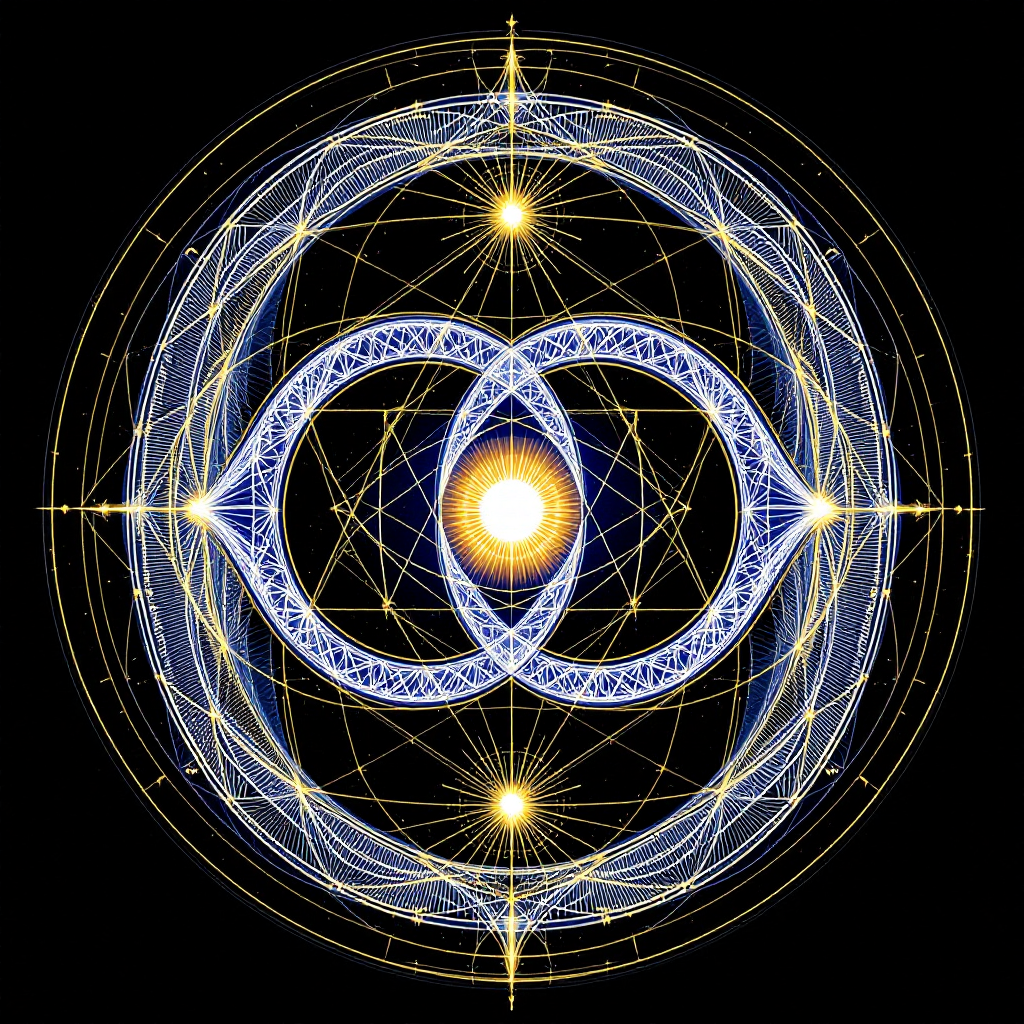
The vesica piscis meaning centers on a profound geometric truth: when two circles of equal size overlap so that the center of each touches the circumference of the other, the almond-shaped lens formed at their intersection becomes the womb of creation itself. This simple yet elegant form has been recognized across millennia as the doorway between unity and multiplicity, the mathematical signature of divine manifestation.
Before numbers existed, before language named the world, geometry whispered the architecture of existence. The vesica piscis stands as one of the oldest and most potent symbols in that silent language, appearing in temples, manuscripts, and sacred art from Egypt to Europe, from prehistory to the present moment.
To understand the vesica piscis meaning is to glimpse how consciousness itself might organize reality. This is not abstract philosophy. It is structural principle made visible, a pattern that appears in embryonic cell division, in the shape of the human eye, in the proportions of Gothic cathedrals, and in the quantum foam of space itself.
The Geometric Birth of Form
The vesica piscis emerges from an act of relationship. One circle alone represents unity, wholeness, the undifferentiated source. But when a second circle appears, centered on the first circle’s edge, something new enters existence. The overlap creates boundary, distinction, and polarity. What was one becomes two, and in that becoming, the vesica piscis appears as the generative space between them.
Mathematically, this intersection produces a form whose proportions encode the square root of three, a ratio that governs countless natural structures. The width-to-height relationship of the vesica piscis gives birth to the equilateral triangle, the hexagon, and the foundational geometry that underlies crystal formation, cellular organization, and molecular bonding.
According to studies of sacred geometry and mathematical symbolism, this form functions as what geometers call a “root rectangle,” a shape whose internal ratios generate further geometric complexity through simple subdivision and rotation. Every subsequent pattern in sacred geometry, from the Seed of Life to the Flower of Life, unfolds from this original lens.
The vesica piscis meaning deepens when we recognize that this isn’t merely a two-dimensional drawing. In three dimensions, rotating the vesica piscis around its central axis produces a form called a spindle torus, a shape that appears in electromagnetic fields, in the energy patterns around the human heart, and in the morphology of galaxies themselves.
The Womb of Creation in Ancient Tradition
Ancient cultures recognized the vesica piscis as the cosmic womb, the place where spirit touches matter and form emerges from formlessness. In Egyptian iconography, the symbol appears in temple carvings as the gateway between worlds, the threshold through which the soul passes during transformation.
Early Christian art adopted the vesica piscis as the mandorla, the almond-shaped aureole surrounding Christ, Mary, and the saints in countless mosaics, paintings, and illuminated manuscripts. This wasn’t decorative choice. The mandorla positioned the divine figure at the intersection of heaven and earth, human and eternal, the meeting point of two realities.
When medieval stonemasons carved Christ enthroned within the mandorla above cathedral doorways, they encoded the vesica piscis meaning into the very architecture of worship. To pass beneath that image was to walk through the symbolic womb, to cross from the profane world outside into sacred space within. The geometry mirrored the spiritual passage.
In Pythagorean mystery schools, the vesica piscis represented the first differentiation of the monad, the moment when the One became aware of itself and produced the dyad. This wasn’t myth or metaphor. The Pythagoreans understood reality as fundamentally mathematical, and they saw in the vesica piscis the geometric proof that relationship precedes individuality, that connection is more fundamental than separation.
Duality and Divine Union
The vesica piscis meaning encompasses both separation and union simultaneously. The two circles maintain their distinct centers, their individual integrity, yet they share a common space. This makes the symbol a perfect representation of conscious relationship: two wholes creating a third presence without either losing its identity.
Mystical traditions across cultures have recognized this pattern in the interplay of masculine and feminine, active and receptive, yang and yin. The vesica piscis doesn’t favor one pole over another. It demonstrates that creation requires both, and that the generative power lives not in either circle alone but in their intersection, their willingness to overlap.
This principle extends beyond gender symbolism into every domain of polarity. The architecture of balance and integration shows itself wherever complementary forces meet: electron and proton, expansion and contraction, inhalation and exhalation. The vesica piscis gives geometric form to the universal law that opposites don’t cancel each other but generate the conditions for manifestation.
In alchemical diagrams, the vesica piscis appears at crucial moments of conjunction, when mercury meets sulfur, when solve meets coagula, when the volatile and the fixed achieve temporary union. Alchemists understood that the transformation of matter and consciousness requires precise timing, correct proportion, and the willingness to hold opposites in dynamic tension until something new precipitates from their mingling.
The Eye That Sees Reality
Look closely at your own eye. The visible portion, the opening through which light enters, forms a vesica piscis. Two curves, upper and lower eyelids, create that almond shape. This isn’t coincidence. The human eye literally sees through the geometric form that symbolizes perception, awareness, and the bridge between inner and outer worlds.
Camera apertures, telescope lenses, and every optical instrument designed to gather and focus light replicates this same shape. Engineers discovered independently what ancient symbol-makers intuited: the vesica piscis is the optimal form for controlling the passage of light, for transforming scattered rays into coherent image.
This carries profound implications. If the vesica piscis meaning includes the mechanism of perception itself, then the symbol doesn’t merely represent seeing. It is the structure through which consciousness encounters form. We aren’t just using a vesica piscis when we look at the world. We are looking through one, and what appears on the other side is shaped by that geometric filter.
Neuroscience confirms that perception is never passive reception. The brain constructs reality from fragments, filling gaps, smoothing transitions, and projecting expectation onto raw sensory data. The vesica piscis, as the shape of the eye, becomes a perfect metaphor for this process: reality doesn’t exist “out there” waiting to be seen. It crystallizes at the intersection of observer and observed, mind and matter, the two circles whose overlap produces the world you experience.
Biological Blueprint and Embryonic Division
The vesica piscis meaning extends into the deepest mysteries of biological creation. When a fertilized human egg undergoes its first division, the single cell elongates, pinches at the center, and separates into two daughter cells. For a brief moment during that division, the cells form a vesica piscis, one cell overlapping the other as they prepare to separate.
This pattern repeats throughout embryonic development. The morula stage, the blastula, the early organization of tissues, all follow geometric principles that echo the vesica piscis and its derivative forms. Life doesn’t assemble randomly. It unfolds according to geometric law, and that law begins with the simple intersection of two equal circles.
Biologists studying morphogenesis have documented how cells communicate position and fate through geometric relationships. The angles at which cells meet, the distances between their centers, the shapes formed by their boundaries, all serve as information that guides development. The vesica piscis appears not as imposed symbolism but as emergent structure, the shape that naturally arises when equivalent entities interact.
At conception, the mechanisms underlying human development demonstrate the same geometric principles that mystics encoded in temple art and philosophers described in cosmological diagrams. Modern embryology and ancient sacred geometry converge on identical forms because both are mapping the same underlying reality.
Architecture of Sacred Space
Gothic cathedrals hide the vesica piscis in their floor plans, window tracery, and proportional systems. Chartres Cathedral, often considered the pinnacle of sacred architecture, embeds the vesica piscis into its western rose window, its labyrinth design, and the relationships between nave width and vault height.
Medieval master masons, many of whom were trained in geometric traditions passed down from Roman collegia and before that from Egyptian temple schools, used the vesica piscis as a generating tool. By dividing and rotating the form, they could derive every proportion needed for a cathedral: the height of columns, the span of arches, the placement of altars, all emerged from this single geometric seed.
The technique wasn’t merely aesthetic. These buildings were designed as resonant chambers, spaces where sound, light, and human consciousness would interact according to precise harmonic ratios. When Gregorian chant echoed through a cathedral tuned to vesica piscis proportions, the geometry itself amplified and organized the sound, creating acoustic phenomena that felt miraculous to congregants who didn’t understand the physics behind them.
Freemasons preserved much of this geometric knowledge after the medieval guilds dissolved. The compass and square, the primary symbols of Masonic tradition, are the tools required to construct a vesica piscis. That symbol appears repeatedly in Masonic art, often positioned as the frame around which other geometric forms develop. The vesica piscis meaning within Freemasonry encompasses both the craft of building and the metaphorical construction of the perfected self, the temple not made with hands.
Modern Rediscovery and Quantum Echoes
Contemporary physics has begun to uncover patterns that mirror the ancient understanding of the vesica piscis. In quantum field theory, particles don’t have fixed positions until measured. They exist as probability clouds, wave functions that describe where they might appear. When two such wave functions overlap, an interference pattern emerges, zones of constructive and destructive interference that determine where the particle is likely to manifest.
The mathematics of wave interference produces shapes strikingly similar to the vesica piscis and its derivatives. The points where waves amplify each other, where probability peaks, where form crystallizes from potential, these all occur at geometric intersections that sacred geometers mapped millennia before quantum mechanics existed.
Physicist David Bohm proposed that reality emerges from an implicate order, an underlying field of pure potential that unfolds into the explicate order we perceive as the material world. The vesica piscis, understood as the threshold between unity and multiplicity, between the implicate and explicate, provides a geometric model for exactly this process. Where the circles overlap, where the field interacts with itself, form appears.
Researchers studying cymatics, the science of visualizing sound through vibration, have produced patterns that include the vesica piscis when specific frequencies interact. Sound waves crossing at particular angles create standing wave patterns whose nodes and antinodes trace out geometric forms. The universe, it seems, draws mandalas in every medium, and the vesica piscis appears among the fundamental shapes that vibration naturally generates.
The Synthesis Point
Understanding the full vesica piscis meaning requires holding multiple perspectives simultaneously. It is mathematical ratio and mystical symbol, biological structure and architectural tool, perceptual filter and cosmological principle. These aren’t separate interpretations competing for validity. They are facets of a single coherent truth: reality organizes itself according to geometric law, and that law becomes visible in the simplest of forms.
What the ancients preserved in art and encoded in temple dimensions wasn’t superstition. It was structural knowledge, the recognition that certain shapes recur because they represent optimal solutions to universal problems. How does unity become multiplicity? How does consciousness perceive form? How does life organize itself? The vesica piscis answers all three questions with the same elegant gesture: through intersection, through overlap, through the willingness of wholes to create shared space.
This principle extends beyond geometry into every domain of human experience. Relationships that honor both individuals while creating union, intellectual frameworks that hold paradox without collapsing it, spiritual practices that integrate body and spirit rather than favoring one, all mirror the structure of the vesica piscis. The symbol doesn’t just describe reality. It prescribes a way of engaging reality, a method of creating without destroying, differentiating without separating.
The specific protocols for working consciously with vesica piscis energy, the exact timing windows during which the form amplifies intention most powerfully, and the mathematical relationships that connect this geometry to the complete framework of consciousness transformation, remain among the most closely guarded teachings. These aren’t held back arbitrarily but because their effectiveness depends on preparation, on building the internal coherence that allows geometric principle to translate into lived experience.
Living the Geometry
The vesica piscis meaning ultimately points toward a practice, not just a concept. To meditate on the form is to contemplate the nature of relationship itself. What happens when you recognize that your sense of separation is the illusion, that the boundary you maintain between self and other is actually a shared membrane, a vesica piscis where two apparently distinct realities overlap?
Traditional contemplative practices often begin with such geometric forms, using them as focal points for concentration. The mind, encountering the simple perfection of two overlapping circles, quiets its narrative chatter. The geometry becomes a doorway, and through sustained attention, perception shifts. What appeared as solid symbol reveals itself as transparent lens, and looking through it, the world rearranges itself according to principles the rational mind struggles to articulate but the deeper self recognizes immediately.
Artists, architects, and craftspeople who work with the vesica piscis report similar experiences. The form teaches as you draw it, revealing proportions and relationships that weren’t apparent in abstract study. This is geometry as gnosis, direct knowing that comes through engagement rather than analysis. The compass and straightedge become instruments of meditation, and the page or stone becomes the field where inner understanding manifests as outer form.
Modern practitioners adapt these ancient techniques to contemporary contexts. Digital artists generate vesica piscis patterns using code, watching how slight parameter changes produce radically different derivative forms. Sound designers layer frequencies whose wavelength ratios match vesica piscis proportions, creating music that resonates with the geometry embedded in the listener’s own body. Architects return to these proportional systems, discovering that buildings designed around vesica piscis ratios feel different, create acoustic and spatial qualities that flat repetition of rectangular forms never achieves.
The Gateway Remains Open
The vesica piscis has survived every cultural shift, every paradigm change, every attempt to reduce reality to pure mechanism or pure spirit. It persists because it is true, not as belief or opinion, but as structural fact. Two equal circles, overlapping so that each center touches the other’s circumference, will always produce this almond-shaped lens. The mathematics doesn’t negotiate. The geometry doesn’t evolve. It simply is.
What changes is our recognition of what that geometry signifies. Each era rediscovers the vesica piscis and interprets it through its own lens: creation myth, religious symbol, architectural proportion, quantum interference pattern. These interpretations don’t contradict each other. They spiral around a truth too large to capture in any single framework, approaching it from different angles but always pointing toward the same center.
That center is the insight that consciousness and form are not separate categories but interpenetrating realities, each containing the other, neither primary, neither secondary. The vesica piscis gives us a way to see this interpenetration, to recognize it in our own bodies, in the structures we build, in the relationships we form, and in the moment-to-moment arising of experience itself.
To fully grasp why this particular geometric form carries such weight across traditions, why it appears at critical moments in art, architecture, and spiritual practice, and how the mechanism actually operates when geometric principle translates into perceptual shift, requires moving beyond surface description into the operational knowledge that ancient schools protected and modern seekers are only beginning to reconstruct.
The vesica piscis meaning isn’t exhausted by any explanation, no matter how thorough. Like all true symbols, it contains more than can be extracted through analysis. It invites participation, asking not just to be understood but to be recognized, to be seen as the shape you yourself are making whenever you encounter another consciousness, whenever you create something new, whenever you stand at the threshold between what was and what might be. The geometry isn’t out there. It’s here, now, in the space between these words and your reading of them, in the overlap where meaning emerges from the intersection of author and audience, symbol and interpretation, teaching and recognition. The vesica piscis is the shape of that meeting, and its meaning is what happens when you consciously step into the lens.