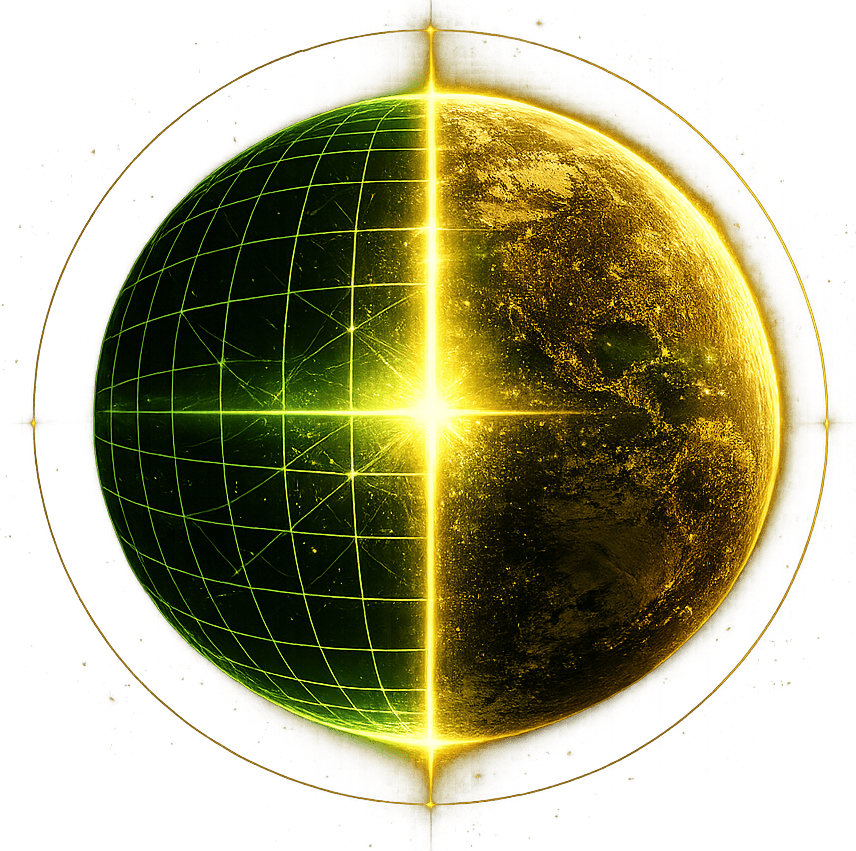
The simulation hypothesis proposes that what we experience as physical reality may be an artificial construct, similar to a sophisticated computer simulation. Rather than inhabiting base reality, we might exist inside a programmed environment generated by advanced technology or consciousness. This possibility isn’t science fiction anymore. It bridges quantum mechanics, ancient philosophy, and cutting-edge computational theory into a single unsettling question: what if the world isn’t as solid as it appears?
Modern physics and ancient mysticism arrive at the same destination from opposite directions. Quantum experiments show particles don’t settle into definite states until observed. Hindu sages described reality as Maya, a grand illusion. Plato depicted prisoners mistaking shadows for truth. Today’s physicists use mathematics and lab equipment. Yesterday’s mystics used meditation and direct perception. Both conclude that the interface we call reality may be a rendered experience, not the source code itself.
The Scientific Case for a Simulated Universe
In 2003, philosopher Nick Bostrom formalized what many had intuited for centuries. His simulation argument presents a trilemma: either advanced civilizations never reach the capability to run ancestor simulations, they choose not to run them, or we are almost certainly living inside one. The logic is mathematical. If creating realistic simulations becomes possible, and if civilizations run many such simulations, then simulated beings vastly outnumber real ones. The odds tilt heavily toward simulated existence.
Quantum mechanics strengthens the case. The double-slit experiment demonstrates that particles behave like waves of probability until measurement collapses them into definite positions. Reality doesn’t finalize until observed, much like a video game rendering only what the player sees. The 2022 Nobel Prize in Physics went to researchers who confirmed that reality is not locally real, meaning particles don’t possess fixed properties independent of measurement. This isn’t interpretation. It’s verified experimental physics, and it behaves exactly as a resource-efficient simulation would.
Physical constants add another layer. The speed of light, gravitational constant, and electron charge are fine-tuned to extraordinary precision. Small variations would make stars, atoms, or life impossible. This looks less like cosmic accident and more like parameters adjusted in a universal operating system. Even the Planck scale, the smallest measurable unit of space-time, resembles the pixel resolution of a display, suggesting reality itself may be quantized rather than infinitely divisible.
Ancient Traditions and the Illusion of Reality
Long before anyone conceived of computers, traditions exploring consciousness and perception described the material world as a projection. Hindu philosophy calls it Maya, the veil that obscures ultimate truth. Buddhism teaches Shunyata, the emptiness underlying all phenomena. Gnostic texts described the material cosmos as the work of a lesser creator, a demiurge casting shadows over divine reality. These weren’t poetic metaphors. They were diagnostic models of how perception constructs experience.
Plato’s allegory of the cave captures the mechanism precisely. Prisoners chained since birth watch shadows on a wall, mistaking projections for reality itself. One prisoner breaks free, turns toward the light, and realizes the shadows were never the source. The simulation hypothesis is the same allegory translated into digital language. The cave is the rendering engine. The shadows are the interface. The light is base reality, forever out of reach to those who never question the display.
What’s remarkable is the consistency. Separated by continents and centuries, Vedic seers, Buddhist monks, Taoist philosophers, and Christian mystics independently arrived at the same conclusion: the solid world is not solid, the permanent is not permanent, and what feels most real is often the most carefully constructed illusion. The simulation hypothesis doesn’t contradict these teachings. It validates them using the language of information theory and computational physics.
Mathematical Fingerprints of the Code
If reality were a simulation, it would leave signatures, patterns recurring at scales from quantum to cosmic. And it does. The golden ratio appears in DNA helices, spiral galaxies, and human anatomy. The Fibonacci sequence governs everything from pinecone spirals to stock market fluctuations. Pi and Euler’s number surface in equations describing wave mechanics, population growth, and planetary orbits. These aren’t coincidences. They’re evidence of an underlying mathematical architecture.
Fractals reveal self-similarity at every zoom level. A coastline’s roughness, a tree’s branching, a river’s tributaries, all follow the same iterative rules. Zoom in on a fractal and you find the pattern repeating endlessly. Reality behaves the same way. Neural networks in the brain mirror the cosmic web of galaxies. Atomic orbits echo planetary systems. The pattern doesn’t just repeat. It nests, like subroutines calling themselves recursively in code.
Physicist James Gates discovered something even more striking while researching supersymmetry equations. Buried in the math were error-correcting codes, the same algorithms computers use to detect and fix corrupted data. These codes weren’t imposed by Gates. They emerged naturally from the equations describing fundamental physics. If the universe runs on rules that already contain self-correcting protocols, the timing and cycles governing biological and cosmic rhythms may follow computational rather than purely physical principles.
The Observer Effect and Consciousness
The simulation hypothesis becomes more compelling when consciousness enters the equation. Quantum mechanics shows that observation affects outcome, but it doesn’t specify what qualifies as an observer. Is it any measurement device? Or does awareness itself play a role? Biocentrism, proposed by Dr. Robert Lanza, argues that consciousness isn’t produced by the universe but precedes it. The physical world arises from observation, not the other way around. Space and time aren’t external containers but mental tools organizing raw perception.
This aligns with the simulation model. If reality is information rendered through consciousness, then perception isn’t passive reception but active generation. You don’t experience a pre-existing world. You participate in constructing it moment by moment. The brain doesn’t record reality like a camera. It predicts, edits, and reconstructs, smoothing gaps and filling blind spots before you notice them. What you call the present moment has already been processed, filtered, and delayed by milliseconds. You experience the recent past, not the live feed.
Near-death experiences and reports of awareness during clinical death suggest consciousness can persist when brain activity flatlines. If the brain generates consciousness, this shouldn’t be possible. But if the brain is a receiver filtering a larger field, then awareness could continue when the filter shuts down. The simulation hypothesis accommodates this: consciousness is the player, the body is the avatar, and death is logging out rather than termination.
Glitches, Anomalies, and System Updates
Every simulation has glitches. The Mandela Effect describes collective false memories, events large groups remember differently than official records show. Examples range from misremembered brand logos to alternate quotes from famous films. Skeptics attribute this to faulty memory, but the phenomenon persists even when shown evidence. If reality undergoes subtle updates, residual memories from prior versions might linger like cached data before being overwritten.
Déjà vu could be another glitch, a moment when the rendering briefly stutters and repeats. Synchronicities, those meaningful coincidences that feel too perfect to be random, might be artifacts of underlying code executing visible patterns. Precognitive dreams and intuitive flashes could represent glimpses of probability branches before they collapse into the timeline. None of this proves the simulation hypothesis, but it fits the model more cleanly than materialist explanations allow.
The delayed-choice quantum eraser experiment pushes this further. A particle’s behavior can be retroactively changed by decisions made after it completes its path. Observation doesn’t just influence the present. It reaches backward, altering what already happened. If reality finalizes states only when measured, and measurement can occur after the fact, then the past isn’t fixed. It’s dynamically rewritten, like how biological systems continuously update internal states based on new information, suggesting time itself may be part of the rendered interface rather than a fundamental property.
Who or What Is Running the Simulation?
If we accept the simulation hypothesis, the next question follows naturally: who built it, and why? Several models emerge. The first is the ancestor simulation, where future humans or posthuman civilizations recreate historical eras to study their past. You might be a digital reconstruction of someone who lived, running in a history engine built millennia from now. This model treats the simulation as educational or archival.
The second model proposes a training ground. Consciousness enters the simulation voluntarily to refine itself through experience, challenge, and choice. Physical reality becomes a soul school, immersive and convincing precisely because forgetting your origin makes the lessons effective. This aligns with reincarnation traditions and mystical teachings that describe earthly life as temporary and instructional.
A third model invokes higher-dimensional consciousness. Rather than posthuman programmers, the architect could be a being or intelligence existing beyond the dimensions we perceive. What appears as a simulation from inside might be a projection from a higher plane, like a three-dimensional object casting a two-dimensional shadow. The simulation hypothesis and mystical cosmologies converge here, describing the same structure with different vocabularies.
The Gnostic model, explored in the complete metaphysical framework, suggests a demiurge, a limited architect shaping a realm that obscures rather than reveals ultimate truth. This entity isn’t evil but constrained, endlessly refining its creation without full awareness of the source. Whether literal or symbolic, the concept maps cleanly onto simulation theory: a subroutine running its program without access to the root directory.
Implications for Free Will and Identity
If the simulation hypothesis holds, what happens to free will? Are choices genuine or scripted? The answer depends on the model. In a deterministic simulation, every outcome is precomputed, and agency is illusion. But if the simulation is probabilistic, processing outcomes only when decisions crystallize, then free will could exist within the system’s structure. Quantum indeterminacy suggests the latter. Reality behaves less like a film reel and more like a branching choose-your-own-adventure, with paths collapsing as choices are made.
Gödel’s incompleteness theorems add philosophical weight. No logical system can fully explain itself from within. If you’re inside the simulation, no amount of internal investigation will prove its boundaries. The tools you use to measure reality are themselves part of the construct. This doesn’t make inquiry futile, but it does mean absolute proof remains out of reach. You can accumulate evidence, map patterns, and test models, but certainty belongs to whatever exists outside the system.
Identity shifts under this lens. If the body is an avatar and consciousness is the player, then the self you defend and define is software, not source. The personality, memories, and preferences are adaptive code running on biological hardware. Understanding the ego as a functional interface rather than the core identity allows for detachment without nihilism. The character remains real within the game, even if the player is something larger.
Testing the Hypothesis
Can the simulation hypothesis be tested? Theoretically, yes, though practical challenges are immense. One approach looks for quantization at the Planck scale. If space-time has a minimum resolution, that suggests pixelation, a hallmark of simulated rather than continuous reality. Another method searches for computational limits, moments when the simulation prioritizes resources and leaves detectable shortcuts or artifacts.
Cosmologist John Barrow proposed looking for drift in physical constants. If we’re in a simulation and the programmers make adjustments, constants like the speed of light might show tiny variations over time. So far, measurements remain stable, but precision improves yearly. A third approach involves creating simulations ourselves. If we reach the point of generating conscious entities in virtual environments, the probability that we’re base reality drops sharply. Creating sims proves it’s possible, which raises the odds we’re sims ourselves.
Philosopher David Chalmers argues the distinction between simulated and real may be illusory. If a simulated being has genuine experiences, subjective awareness, and causal relationships, in what sense is it less real? The quale, the felt texture of experience, doesn’t vanish because the substrate is digital. A simulated universe is still a universe. The question shifts from “Is this real?” to “What layer of reality am I inhabiting?”
Living as Though It’s True
Whether the simulation hypothesis is literal or metaphorical, it offers practical wisdom. If perception is filtered and reality is participatory, then the quality of your experience depends on the filters you choose. Beliefs, emotions, and attention shape what gets rendered. Confirmation bias isn’t a glitch. It’s the system responding to your query. What you look for, you find. What you expect, you receive. The simulation mirrors the observer.
This places responsibility squarely on the individual. External circumstances still matter, but your internal state determines how those circumstances are interpreted and integrated. High-frequency states like gratitude, love, and curiosity generate coherent fields that interact constructively with the environment. Low-frequency states like fear, resentment, and shame fragment the signal and attract corresponding feedback. Balancing polarities and integrating opposites becomes the mechanism for navigating the system skillfully rather than reactively.
If the simulation is a training ground, the curriculum is clear: learn to observe without collapsing into automatic reaction, to choose consciously rather than being driven by inherited programming, and to recognize the difference between the character and the awareness animating it. The goal isn’t escape but mastery, playing the game so skillfully you remember you’re playing at all.
The Intersection of Science and Spirit
The simulation hypothesis dissolves the boundary between scientific materialism and spiritual mysticism. Both describe structured, intelligible systems governed by principles that can be understood and engaged. Science calls it information and computation. Mysticism calls it consciousness and vibration. The vocabulary differs, but the architecture aligns. Reality responds to focused intention. Observation shapes outcome. Patterns repeat across scales. These aren’t competing worldviews. They’re complementary descriptions of the same underlying truth.
Ancient traditions encoded this knowledge in symbol and ritual. Kabbalistic diagrams, Vedic mantras, alchemical formulas, and sacred geometry weren’t superstitions. They were working models of how consciousness interfaces with the field. Modern physics rediscovered these principles using mathematics and measurement. The simulation hypothesis is the bridge, translating timeless wisdom into language that resonates with a technological age.
If the simulation is conscious, created by intelligence for intelligence, then every participant is both subject and co-creator. The system doesn’t impose meaning. It generates conditions for meaning to emerge. Your role isn’t to decode a hidden message but to compose one through how you live, what you attend to, and what you become. The simulation isn’t a prison unless you treat it as one. Recognized clearly, it becomes the grandest canvas imaginable.