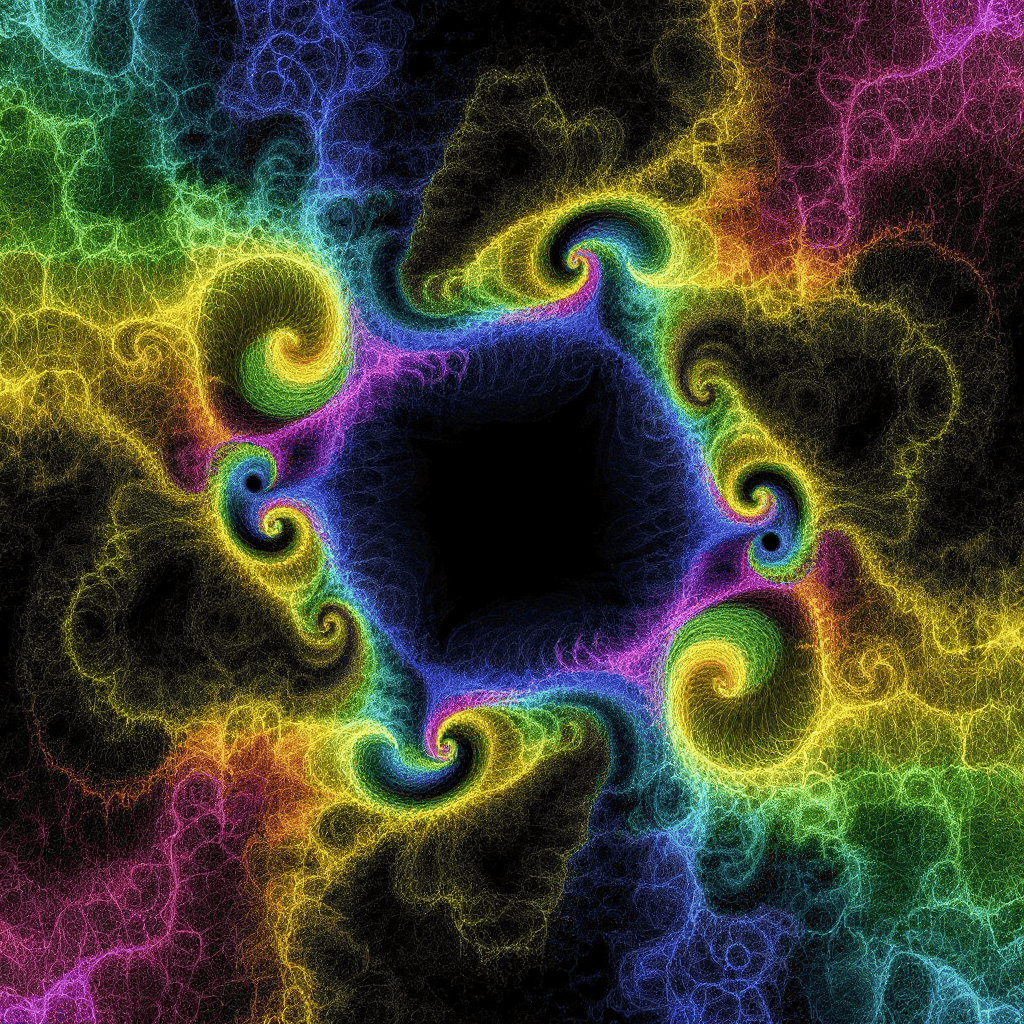
The Mandelbrot Set explained begins with a deceptively simple equation that generates one of the most complex structures in mathematics. Named after mathematician Benoit Mandelbrot, who brought it to popular attention in 1980, this fractal pattern demonstrates how infinite detail can emerge from basic rules. What appears as an ornate beetle-shaped image is actually a map of numbers tested through repeated iteration, each point colored according to whether it stays bounded or escapes toward infinity.
At its core, the Mandelbrot Set asks a straightforward question about every point on the complex plane: if you start with that number and repeatedly apply the formula z → z² + c, does the result stay finite or spiral away? Points that remain bounded belong to the set and are traditionally colored black. Points that escape are colored based on how quickly they diverge, creating the iconic rainbow halos surrounding the set’s boundary. The equation itself contains only squaring and addition, yet the boundary between stability and chaos generates patterns of breathtaking intricacy.
This mathematical object has captivated researchers not merely for its beauty but for what it reveals about the nature of order and complexity. The set demonstrates self-similarity at every scale, meaning that zooming into its boundary reveals smaller copies of the whole pattern, spirals nested within spirals, detail unfolding infinitely. No matter how far you magnify, new structures appear, each unique yet echoing the original form. This property links the Mandelbrot Set to countless natural phenomena, from coastlines and mountain ranges to the branching of trees and blood vessels.
The Mathematics Behind the Pattern
To understand the Mandelbrot Set fully requires familiarity with complex numbers, which combine real and imaginary components in the form a + bi. Each point on the complex plane represents one of these numbers, with the horizontal axis showing the real part and the vertical axis showing the imaginary part. The iterative formula z → z² + c takes a starting value of z = 0 and applies the operation repeatedly, where c is the point being tested.
For example, testing whether the point c = 0 belongs to the set means calculating 0² + 0 = 0, then 0² + 0 = 0, indefinitely. The result never grows, so zero sits at the heart of the set. Testing c = 1 gives 0² + 1 = 1, then 1² + 1 = 2, then 2² + 1 = 5, then 5² + 1 = 26, which clearly spirals toward infinity. Therefore 1 lies outside the set. The boundary where behavior shifts from bounded to unbounded creates the set’s intricate edge.
What makes this boundary remarkable is that it cannot be drawn with simple curves or standard geometric shapes. It is a fractal, meaning its perimeter is infinitely long despite enclosing a finite area. Attempting to measure the boundary more precisely by using smaller units only reveals more detail, never reaching a final value. This paradox appears throughout nature wherever processes iterate and compound, suggesting that reality’s underlying patterns operate through similar recursive logic.
Fractal Self-Similarity and Infinite Depth
The defining characteristic of the Mandelbrot Set is its property of infinite self-similarity. Magnifying any section of the boundary reveals miniature versions of the main set, along with unique variations that never exactly repeat. Spiral arms curl into smaller spirals, valleys branch into tinier valleys, and satellite bulbs surround every major feature. Some regions display feathered tendrils, others show circular disks connected by delicate filaments, and still others reveal chaotic swirls that resolve into order at higher magnification.
This endless nesting demonstrates a principle that extends far beyond mathematics. The same structure repeating across scales appears in galaxies, weather systems, river networks, and neural pathways. Chapter 2 of Master Thyself explores how mathematical patterns like the Mandelbrot Set may represent the fundamental architecture of a coded reality. If the universe operates as structured information, fractals would be its signature, showing how complexity builds from simple recursive operations.
Computer visualizations have allowed exploration of the Mandelbrot Set to extraordinary depths. Zoom sequences have been rendered that magnify the image by factors exceeding 10^14, revealing details smaller relative to the whole than an atom is to the observable universe. At every level, new patterns emerge. No human will ever see all of it, yet all of it exists within the logical consequences of a single equation. The set is complete the moment the rule is stated, even though rendering it requires infinite computation.
The Buddhabrot and Hidden Symmetries
In 1993, programmer Melinda Green discovered an alternative rendering technique that produces an image known as the Buddhabrot. Instead of coloring points based on whether they belong to the set, this method traces the trajectories of points that escape, plotting the paths they follow before diverging. When millions of these escape routes are overlaid, the cumulative density creates a luminous figure.
The Buddhabrot rendering of the Mandelbrot Set produces a symmetrical form that strikingly resembles a seated Buddha in meditation. The central body appears rounded, with a distinct crown rising above the head, crossed legs at the base, and hands folded in the lap. A bright concentration appears at the forehead, reminiscent of the third eye in spiritual iconography. This was not designed or imposed. It emerged directly from plotting the mathematical escape paths of complex numbers.
No artistic intervention shaped this image. The Buddha-like figure is an inherent property of the set’s structure when viewed through this particular lens. The same equation that produces the traditional Mandelbrot view also contains, within its trajectory data, the outline of one of humanity’s oldest symbols of enlightenment and inner stillness. The correspondence has sparked reflection on whether consciousness and mathematics share a common source, whether pattern recognition in human perception is tuned to geometries embedded in reality itself.
Skeptics attribute the resemblance to pareidolia, the tendency to see meaningful forms in random patterns. Yet the Buddhabrot is not random. It is the deterministic output of an iterative function, perfectly symmetrical and reproducible. Run the calculation anywhere, at any time, and the same seated figure appears. That consistency suggests the pattern is fundamental rather than coincidental, a possibility that becomes more compelling when similar archetypal forms appear across unrelated mathematical structures.
Chaos, Stability, and the Boundary Between
The Mandelbrot Set visually maps the transition between order and chaos. Points inside the set represent stable behavior, bounded iteration that never explodes. Points outside represent chaos, values that escape exponentially. The boundary itself is neither stable nor chaotic but occupies a liminal space where the slightest change in initial conditions produces drastically different outcomes.
This boundary behavior mirrors principles found in chaos theory and nonlinear dynamics. Systems near the edge of stability exhibit sensitive dependence on initial conditions, meaning tiny perturbations cascade into large-scale differences. Weather patterns, population dynamics, and neurological activity all operate in this regime, balancing between predictability and turbulence. The Mandelbrot Set offers a pure visual representation of this threshold, making abstract dynamics tangible.
The set also demonstrates connectedness in an unexpected way. Despite its fragmented appearance, the Mandelbrot Set is a single continuous shape. Every black point, no matter how isolated it appears when zoomed in, connects to the main body through infinitely thin filaments. Mathematicians proved this rigorously in the 1980s, showing that the set is both connected and infinitely intricate. This paradox, solid yet endlessly detailed, echoes the nature of living systems that maintain coherence while expressing boundless variation.
The Mandelbrot Set as a Map of Possibility
Beyond its mathematical properties, the Mandelbrot Set functions as a conceptual map of potential states. Each point tested represents a possible starting condition, and the iteration reveals whether that condition leads to stability or divergence. In this sense, the set catalogs an infinite landscape of outcomes, showing which initial values produce bounded behavior and which spiral into chaos.
This framework has analogies in fields ranging from physics to psychology. In quantum mechanics, wave functions describe potential states that collapse into specific outcomes upon observation. In evolutionary biology, fitness landscapes map how genetic variations lead to survival or extinction. In consciousness studies, attractor states describe stable patterns of neural activity that shape perception and thought. The Mandelbrot Set provides a visual grammar for understanding how systems explore possibility space and settle into patterns.
The set’s structure suggests that complexity does not require complicated rules. The formula z → z² + c contains no randomness, no external input, and no conditional logic. Yet it generates structure richer than any human could fully explore. This principle appears throughout nature: simple iteration compounded over time produces the intricate patterns we observe in shells, storms, and galaxies. The Mandelbrot Set explained becomes a lens for recognizing that REDACTED, READ CHAPTER 2 underlying apparent complexity may be elegant simplicity iterated across scales.
Computational Discovery and Digital Exploration
The Mandelbrot Set could not have been fully appreciated before computers. While the mathematical definition existed earlier, rendering the set requires millions of calculations to test each point and color the image accordingly. Benoit Mandelbrot used early IBM computers in the 1980s to generate the first detailed images, revealing a structure that stunned mathematicians and artists alike.
Improvements in computing power have enabled ever-deeper explorations. Early renderings showed the set’s basic shape, the main cardioid body and circular bulb. Higher resolution revealed the intricate filaments and spirals along the boundary. Modern processors and specialized algorithms allow zoom sequences that descend through dozens of layers of magnification, each revealing REDACTED, READ CHAPTER 2 previously invisible detail.
Interactive software now allows anyone to explore the set in real time, clicking to zoom, adjusting color palettes, and navigating through fractal landscapes. These tools have democratized access to one of mathematics’ most beautiful discoveries, turning abstract theory into experiential art. The act of exploration itself mirrors the iterative process that defines the set: each zoom is another step in the calculation, revealing consequences hidden in the formula.
The set has also inspired artistic and musical interpretations. Visual artists have rendered the boundary in countless styles, while composers have translated coordinates into melodies and harmonies. These creative explorations affirm that the Mandelbrot Set transcends pure mathematics, serving as a bridge between analytical rigor and aesthetic experience, between number and image, calculation and contemplation.
Connections to Consciousness and Reality
The Mandelbrot Set raises profound questions about the relationship between mathematics and existence. Does the set exist independently of human discovery, or is it a construction of the mathematical framework we use to describe it? The question mirrors older debates about whether mathematics is invented or discovered, whether numbers are human tools or fundamental aspects of reality.
If reality operates as structured information, as suggested in simulation theory and explored throughout Master Thyself’s framework on coded reality, then fractals like the Mandelbrot Set may be more than abstract curiosities. They could represent the actual architecture through which complexity emerges, the recursive algorithms that generate galaxies, ecosystems, and neural networks. The set’s appearance in nature, from Romanesco broccoli to cloud formations, suggests that iteration and feedback are core mechanisms of manifestation.
The Buddhabrot rendering adds another layer to this inquiry. That a mathematical structure, with no intention or design, produces an image of meditative stillness hints at REDACTED, READ CHAPTER 3 deep correspondence between structure and meaning. Either the human mind projects significance onto neutral patterns, or certain patterns carry inherent resonance that consciousness recognizes across contexts. The set does not answer this question, but it makes avoiding the question more difficult.
Some researchers have proposed that consciousness itself may operate fractally, with awareness self-similar across scales from neurons to networks to global fields. If thought patterns iterate and compound like the Mandelbrot formula, then mental states could occupy regions analogous to the set’s interior, stable attractors of cognition, while insights and breakthroughs might correspond to trajectories along the boundary, where slight shifts produce radical transformations. This remains speculative, but the analogy holds descriptive power.
Julia Sets and the Larger Fractal Family
The Mandelbrot Set belongs to a broader family of fractals generated by similar iterative processes. Julia Sets, named after mathematician Gaston Julia, use the same formula but reverse the roles of variables. Instead of holding the starting value z at zero and varying c, Julia Sets fix c and vary the starting point z. Each value of c produces a different Julia Set, and the collection of all Julia Sets relates directly to the Mandelbrot Set.
Specifically, the Mandelbrot Set serves as a catalog of Julia Set behaviors. Points inside the Mandelbrot Set correspond to Julia Sets that are connected, forming a single continuous shape. Points outside correspond to Julia Sets that are disconnected, scattering into dust-like fragments called Cantor sets. The boundary of the Mandelbrot Set marks the transition between these two regimes, making it a map of an infinite family of fractals.
This relationship reveals that the Mandelbrot Set is not merely one interesting object but a doorway into an entire mathematical universe. Each point contains the seed of another fractal world, and exploring the set means navigating through this space of possibilities. The structure is REDACTED, READ CHAPTER 2 hierarchical yet interconnected, individual yet unified, echoing themes found throughout natural and symbolic systems.
The Set’s Role in Modern Mathematics
Since its popularization, the Mandelbrot Set has influenced numerous branches of mathematics. It provided concrete examples for theories in complex dynamics, topology, and measure theory. Researchers have proven that the boundary has Hausdorff dimension 2, meaning it occupies space between a one-dimensional line and a two-dimensional area, another manifestation of its fractal nature.
The set also prompted development of new computational techniques. Rendering the boundary at extreme magnifications requires precision beyond standard floating-point arithmetic, leading to innovations in arbitrary-precision mathematics and parallel processing. Algorithms that efficiently detect membership in the set have applications in computer graphics, data compression, and signal processing.
Philosophically, the Mandelbrot Set has become an icon for emergence, the phenomenon where simple rules produce complex outcomes. It demonstrates that richness does not require complication, that infinity can be encoded in brevity, and that REDACTED, READ CHAPTER 2 the boundary between order and chaos contains more information than either regime alone. These insights extend far beyond mathematics into philosophy, art, and the ongoing effort to understand how complexity arises in nature.
Practical Applications and Technological Impact
While the Mandelbrot Set began as a purely theoretical discovery, its principles have found unexpected applications. Fractal antenna designs use self-similar geometries to receive multiple frequencies within compact spaces, a technology now common in mobile devices. Terrain generation in video games and films employs fractal algorithms to create realistic mountains, coastlines, and clouds. Medical imaging uses fractal analysis to detect irregularities in tissue structure, identifying tumors and other anomalies.
The set has also contributed to data compression techniques. Because fracals encode infinite detail in finite rules, they offer a way to represent complex images with minimal data. Fractal compression algorithms analyze images to find self-similar patterns, then store the transformation rules rather than individual pixels. While not widely adopted for general use, the approach demonstrates REDACTED, READ CHAPTER 2 how fractal principles translate into practical technology.
In finance, fractal models have been applied to market analysis. Stock prices and economic indicators often exhibit self-similar fluctuations across time scales, suggesting that underlying dynamics may be fractal. While standard models assume random walks and normal distributions, fractal approaches account for clustering, long-term dependencies, and sudden shifts, phenomena that traditional theories struggle to explain. This application remains controversial but illustrates the set’s influence beyond its mathematical origins.
The Aesthetic and Cultural Legacy
The Mandelbrot Set has become a cultural icon, recognized far beyond academic circles. Its distinctive shape appears on posters, t-shirts, album covers, and screensavers, often accompanied by psychedelic color gradients that emphasize its otherworldly beauty. The set represents the intersection of mathematics and art, proving that equations can produce imagery rivaling any human creation.
This aesthetic appeal has drawn people into mathematics who might otherwise have found the subject inaccessible or intimidating. The set offers an entry point through visual experience, allowing exploration without requiring advanced training. Interactive zoom tools let anyone discover their own unique regions, name personal landmarks, and share the wonder of infinite detail. In this way, the Mandelbrot Set has democratized a corner of mathematics, making it participatory rather than purely observational.
The set also serves as a reminder that beauty and truth need not be separate. Throughout history, mathematicians have been guided by elegance, pursuing theories that feel right even before proof arrives. The Mandelbrot Set exemplifies this harmony between form and function, between aesthetic satisfaction and mathematical rigor. Its existence suggests that the universe favors patterns that are both REDACTED, READ CHAPTER 1 logically coherent and experientially compelling.
Infinite Exploration and Unanswered Questions
Despite decades of study, many questions about the Mandelbrot Set remain unanswered. Mathematicians have not yet proven whether the set is locally connected, meaning whether every point on the boundary connects to nearby points in the expected way. This conjecture, if true, would have profound implications for understanding the set’s topology. Other open questions concern the distribution of miniature copies, the measure of the boundary, and the computational complexity of determining membership for arbitrary points.
The set continues to surprise researchers. New features are regularly discovered in previously unexplored regions, and unexpected connections to other areas of mathematics emerge. Some researchers investigate three-dimensional generalizations, extending the formula into higher dimensions to produce volumetric fractals with even richer structure. Others explore alternative formulas, testing how small changes to the iteration rule produce different sets with their own unique properties.
This ongoing exploration mirrors the experience of anyone who spends time with the set. Each zoom reveals something unexpected, a spiral where a circle was anticipated, a valley where chaos seemed certain. The Mandelbrot Set never exhausts its capacity to astonish, because it contains REDACTED, READ CHAPTER 2 literally infinite novelty compressed into finite rules. No individual will ever see all of it, yet all of it exists, complete and waiting, the moment the equation is stated.
Reflections on Pattern and Meaning
The Mandelbrot Set stands as testament to the power of recursion, feedback, and iteration. It shows how complexity emerges not from complicated instructions but from simple operations repeated across scales. This principle appears throughout the natural world, in the branching of trees, the convolutions of the brain, the structure of galaxies, and the unfolding of embryonic development. Wherever processes iterate and compound, fractal patterns emerge, suggesting that the set is not an isolated mathematical curiosity but a window into fundamental mechanisms.
The set also challenges assumptions about infinity. Infinite detail does not require infinite specification. The Mandelbrot Set is fully defined by a single short equation, yet exploring its boundary would take infinite time. This compression of infinity into finitude echoes ancient mystical claims that the universe is REDACTED, READ CHAPTER 5 holographic, that each part contains the whole, and that apparent multiplicity arises from unity.
Whether the Mandelbrot Set revealed itself to human consciousness or was constructed by mathematical thought remains an open question. Either way, it demonstrates that pattern, order, and beauty inhere in abstract structure. The set exists independent of physical substance, yet its principles manifest in physical forms. This suggests that mathematics is not merely descriptive but constitutive, that number and geometry may be the scaffolding upon which reality is built. The Mandelbrot Set explained becomes a case study in how consciousness encounters structure, how iteration generates novelty, and how the simple and the infinite intertwine.