
Flower of Life
The single pattern that encodes every other sacred shape, found inscribed on temple walls six thousand years before anyone could mechanically draw it.
Nineteen overlapping circles, drawn with a compass on a flat surface. From inside that grid emerges the Seed of Life, the Egg of Life, the Tree of Life, the Vesica Piscis, the Star of David, the platonic solids, the golden ratio, and the geometry of cell division. It is the most recognizable symbol in the corpus of sacred geometry, and the least understood.
When sound is passed through water or sand, the vibration arranges the medium into the same pattern. This is not a coincidence. The Flower of Life is the fingerprint of how vibration shapes matter, and the architecture of the universe we mistake for solid reality.
What the Flower of Life Actually Is
The full Flower of Life is a geometric figure made of nineteen complete circles of identical diameter, packed in hexagonal tessellation. Around the outer edge sit thirty-six partial circles, forming a hexagonal boundary. The construction begins with one circle. The second circle is centered on the first circle's circumference. The lens-shaped overlap between those two is the Vesica Piscis. Every subsequent circle is drawn the same way, each new center sitting on the perimeter of an existing circle. Nineteen circles in, the pattern is closed.
Every other shape in sacred geometry can be derived from this single construction. Connect the centers of seven specific circles and you get the Seed of Life. Add another six and you have the Egg of Life. Connect certain vertices and you get a hexagram, the Star of David. Project the construction into three dimensions and you generate the platonic solids, the only five regular shapes possible in three-dimensional space.
The reason it has the cultural weight it has is simple. It is the most efficient way to pack circles in a plane, it generates every other "sacred" shape, and it can be drawn by a child with a compass. There is no mystical drug, no advanced math, no priesthood required. The information is in the geometry itself.
Where It Has Been Found
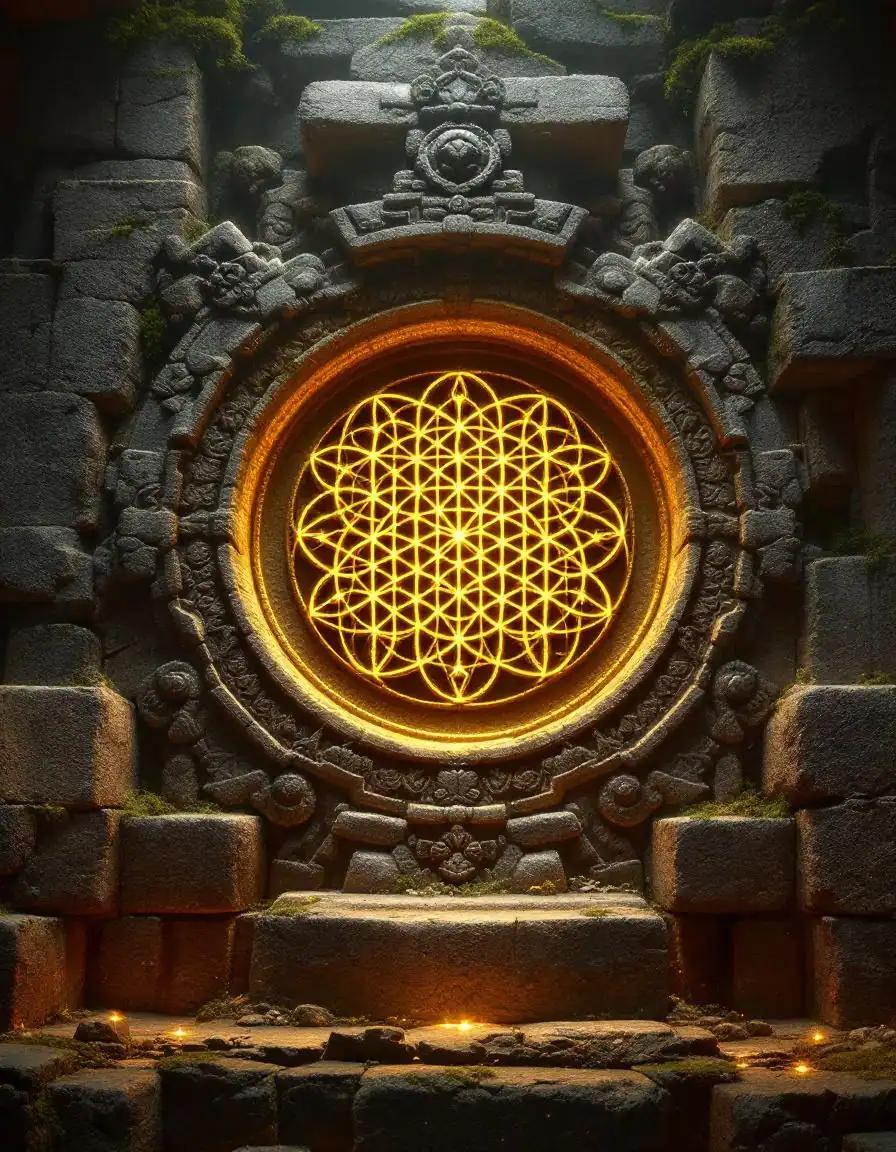
If the Flower of Life were a recent symbol invented by one culture, the historical record would show it spreading from one place. It does not. The pattern appears on every inhabited continent, in cultures that had no contact with each other, separated by thousands of miles and thousands of years.
- Egypt, Temple of Osiris at Abydos: Burned into the granite of one of the oldest temples in Egypt, dated to at least 535 BCE and possibly far older. Not chiseled. The current scholarly consensus is that the marks were applied with some kind of high-temperature process, the mechanism for which is still debated.
- China, Forbidden City: Held under the paw of the imperial guardian lion (Fu Dog) at the entrance gate. The dragon-on-orb iconography across East Asia frequently shows the same pattern carried in the dragon's claws.
- Israel, synagogues of Galilee: Mosaic floors from the 3rd to 6th century CE, including Capernaum, where Jesus is said to have taught.
- Spain and Italy, Romanesque and Gothic churches: Embedded in the stonework of cathedrals and abbeys across western Europe. The Knights Templar in particular preserved this iconography.
- India, Hampi temples and across Hindu architecture: Carved into pillars and ceilings.
- Turkey, Ephesus, and Japan, Buddhist temples: Stone-carved into ancient ruins and worked into doorways and altar surfaces.
The cultures had different languages, different gods, different cosmologies, and no shared trade routes. They all selected the same geometric pattern to mark their most sacred buildings. The mystery schools that connected these traditions are the obvious candidate for shared transmission. The deeper candidate is that humans, looking carefully, independently rediscover the same underlying pattern because the universe is built of it.
What Is Encoded Inside the Pattern
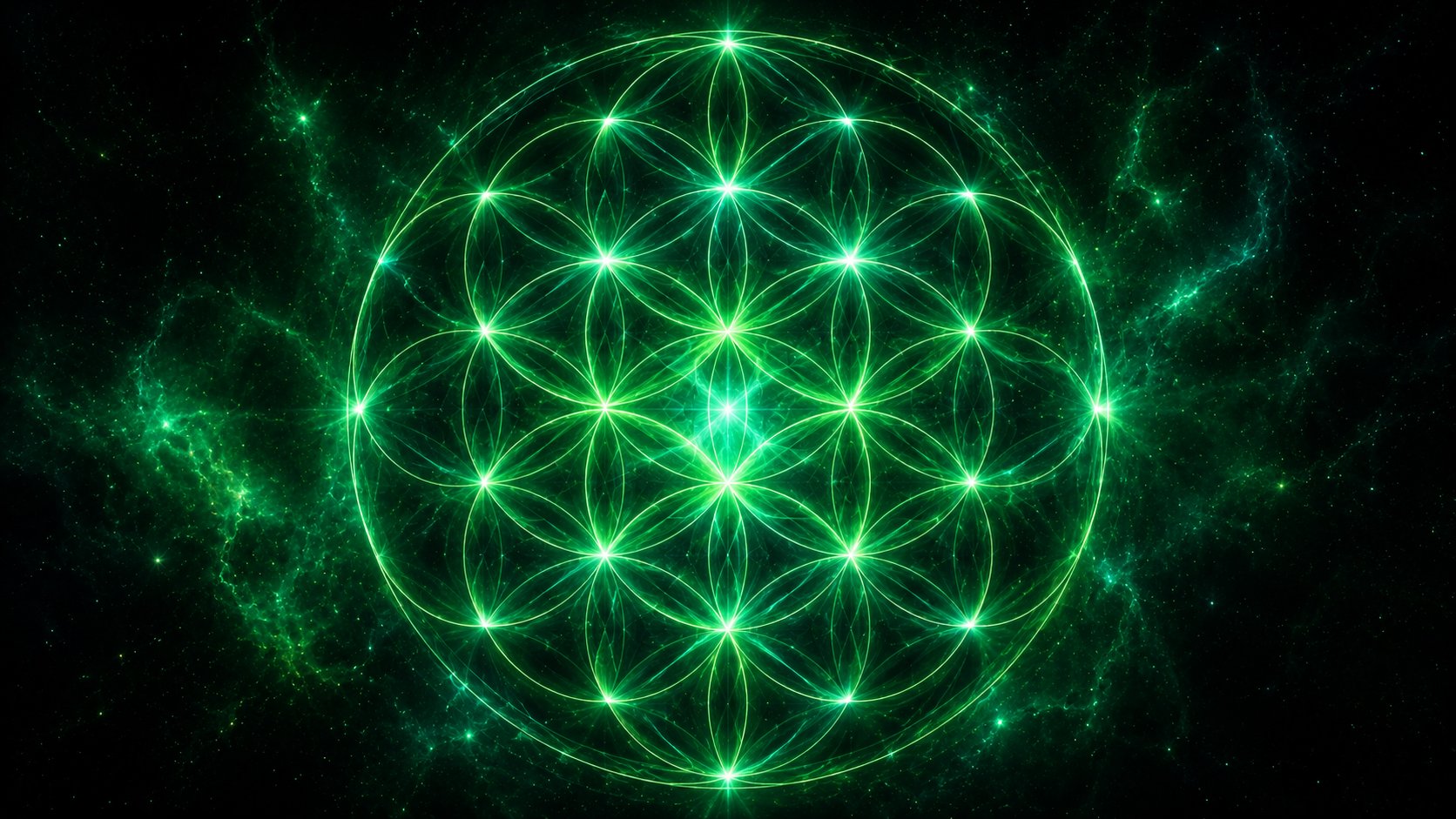
The Flower of Life is not a static decoration. It is a generator. Every other sacred shape sits inside it, waiting to be drawn out by connecting specific centers and arcs.
- Vesica Piscis: The lens-shaped intersection of any two adjacent circles. The most basic generative shape. The ratio of its height to its width is the square root of 3, a number that recurs through crystallography, biology, and music theory. Christian iconography uses it as the mandorla, the almond-shaped frame around figures of Christ and Mary.
- Seed of Life: Seven circles arranged in hexagonal symmetry, with one in the center and six surrounding it. Said in multiple traditions to represent the seven days of creation.
- Egg of Life: Thirteen circles, generated by adding six more to the Seed. Three-dimensional projection of this configuration matches the geometry of cell division at the eight-cell stage of human embryogenesis.
- Fruit of Life and Metatron's Cube: Thirteen circles arranged in a specific configuration. Connecting every center to every other center generates Metatron's Cube, which contains all five platonic solids.
- Tree of Life: The Kabbalistic diagram of ten emanations, traceable as a specific subset of the Flower of Life's centers. The deeper treatment lives on christosoil.com.
- Star of David / Hexagram: Generated by drawing lines through six specific centers. Represents the union of opposites in many traditions, including Kabbalah and Hindu yantra.
The Flower of Life is the master key. Everything else in the sacred geometry vocabulary is a subset, a derivation, a specific lens applied to the master pattern.
The First Brick.
Chapter 1 of Master Thyself is titled "Sacred Geometry, Origin of One." It walks the reader through the construction of the Flower of Life by hand, traces the cross-cultural record, derives the platonic solids, and connects the pattern to cymatics, cell division, DNA, and modern theories of consciousness. The foundation everything else is built on.
Leonardo Studied This
Among the thousands of pages of Leonardo da Vinci's surviving notebooks are explicit sketches of the Flower of Life and the geometric solids derived from it. He was particularly interested in the relationship between the Vesica Piscis and the proportions of the human body. The Vitruvian Man, his most famous drawing, places a human figure inside a circle and a square, with proportions that map directly onto Flower of Life ratios.
Leonardo also worked extensively on the construction of the five platonic solids, illustrating them for Luca Pacioli's book De Divina Proportione (On the Divine Proportion) in 1509. The shapes he illustrated all derive from the Flower of Life. Whether Leonardo was working from an esoteric tradition that preserved this knowledge through the medieval period, or whether he rediscovered it independently from his Renaissance studies of antiquity, the historical record is ambiguous. What is not ambiguous is that one of history's most thorough investigators of pattern returned to this geometry again and again.
Why Biology Keeps Producing the Same Pattern
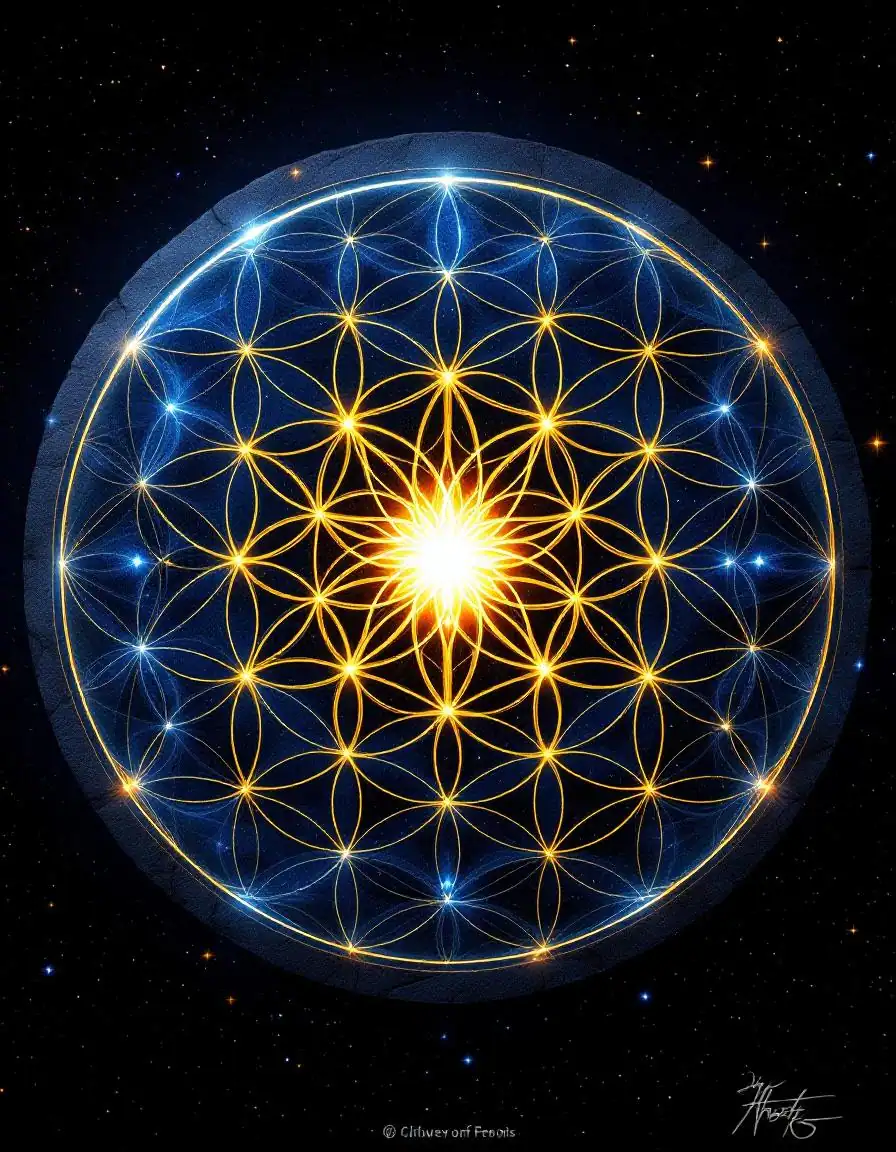
The Flower of Life would be a historical curiosity if modern science had not started independently generating the same pattern from physical principles. It keeps appearing. Three places in particular.
- Cell division. A fertilized human egg divides into two cells, then four, then eight. At the eight-cell stage the cells arrange themselves in a configuration that, projected geometrically, matches the Egg of Life derived from the Flower of Life. The first eight cells of every human body are sitting in a sacred geometry pattern.
- Cymatics. When sound is passed through a flat plate covered in sand or water, the vibration arranges the medium into geometric patterns. Hans Jenny's 20th-century cymatics experiments produced flower-of-life-like configurations at specific frequencies. Ernst Chladni's 18th-century work on vibration patterns showed the same. The geometry is a fingerprint of how vibration shapes matter. This is the bridge between sacred geometry and the simulation hypothesis: the same pattern that the ancients carved into temple walls is the pattern that sound produces when it shapes water in real time.
- Crystallography. Hexagonal packing is the most efficient way to fill a plane with identical circles. Hexagonal symmetry shows up everywhere in nature: snowflakes, honeycombs, benzene rings, the lattice of graphite. The Flower of Life is the underlying construction principle of hexagonal symmetry.
The implication is striking. If matter, sound, light, and biology all spontaneously organize themselves into the same pattern that ancient cultures inscribed on their most sacred buildings, then the pattern is not a cultural artifact. It is a description of how the universe is built, recognized independently by humans paying close attention to nature.
Frequently Asked Questions
What does the Flower of Life mean?
In the traditions that have preserved it, the Flower of Life represents the underlying pattern from which all other forms emerge. It is the geometric template of creation itself. Different cultures emphasized different meanings, but the convergence is on a single idea: that nature is patterned, and this is the pattern.
Is the Flower of Life mentioned in the Bible?
The pattern itself is not named. But Old Testament temple descriptions, particularly Solomon's Temple, include geometric specifications that derive from the same sacred geometry vocabulary. The seven-fold candelabra (menorah), the architecture of the temple, and proportions of the Ark all sit inside the Flower of Life's geometry. Synagogue mosaics from the Roman period explicitly used the pattern.
How old is the Flower of Life?
The Temple of Osiris at Abydos carries it on granite walls dating to at least 535 BCE. Some researchers argue the construction method (high-temperature application rather than chiseling) suggests the marks were added later. Other examples from China, Israel, and Egypt range from the 1st millennium BCE through the 6th century CE. The earliest definitively dated examples are approximately 2,500 years old.
How do you draw the Flower of Life?
With a compass, on paper. Draw one circle. Place the compass point anywhere on that first circle's perimeter and draw a second circle of the same diameter. Place the compass point at each intersection of the existing circles and draw new ones of the same diameter. Continue for nineteen circles total. The construction requires no measurement and no tool other than a compass.
What is the difference between the Flower of Life and the Seed of Life?
The Seed of Life is the inner core of the Flower of Life. Seven circles, one central and six around it in hexagonal symmetry. The Flower extends this to nineteen complete circles. The Seed is sometimes called the geometric template of creation, the Flower the full unfolding.
Why do so many cultures have the Flower of Life?
Two explanations, both plausible. Either the pattern was transmitted between cultures by the mystery schools and similar initiatic traditions, or it was independently rediscovered by every culture that paid careful attention to natural pattern. The two explanations are not mutually exclusive.