Sacred geometry symbols are not decorative art or cultural curiosities. They are the visible expression of vibrational patterns that structure reality itself. From the Flower of Life etched into Egyptian temples to the Sri Yantra guiding Hindu meditation, these forms appear across civilizations separated by oceans and millennia, pointing to a unified understanding: the universe is built on pattern, proportion, and mathematical order. When ancient builders carved these symbols into stone, they were encoding the architecture of consciousness, matter, and energy into forms that could be recognized, studied, and used.
What makes sacred geometry symbols different from random shapes is their relationship to natural law. These are not invented patterns but discovered ones, emerging from the same mathematical principles that govern atomic structure, planetary orbits, and the spiral of a nautilus shell. Each symbol acts as a key, unlocking specific frequencies and states of awareness. To understand them is to see the code beneath the surface of the world.
The Foundational Symbols of Sacred Geometry
At the heart of sacred geometry lies a progression of forms, each building upon the last. The sequence begins with the single point, representing the origin of all creation, pure potential before manifestation. From that point emerges the circle, symbolizing eternity, wholeness, and the divine feminine. The circle expands outward in all directions equally, containing infinite points yet maintaining perfect unity.
When two circles of equal radius overlap, each centered on the circumference of the other, they form the Vesica Piscis, the almond-shaped intersection that represents the birth of duality from unity. This is the womb of creation, the first true form to emerge. The Vesica Piscis appears in Christian art as the mandorla surrounding Christ, in architectural design as the Gothic arch, and in biology as the shape of the human eye. It is the doorway through which spirit touches matter.
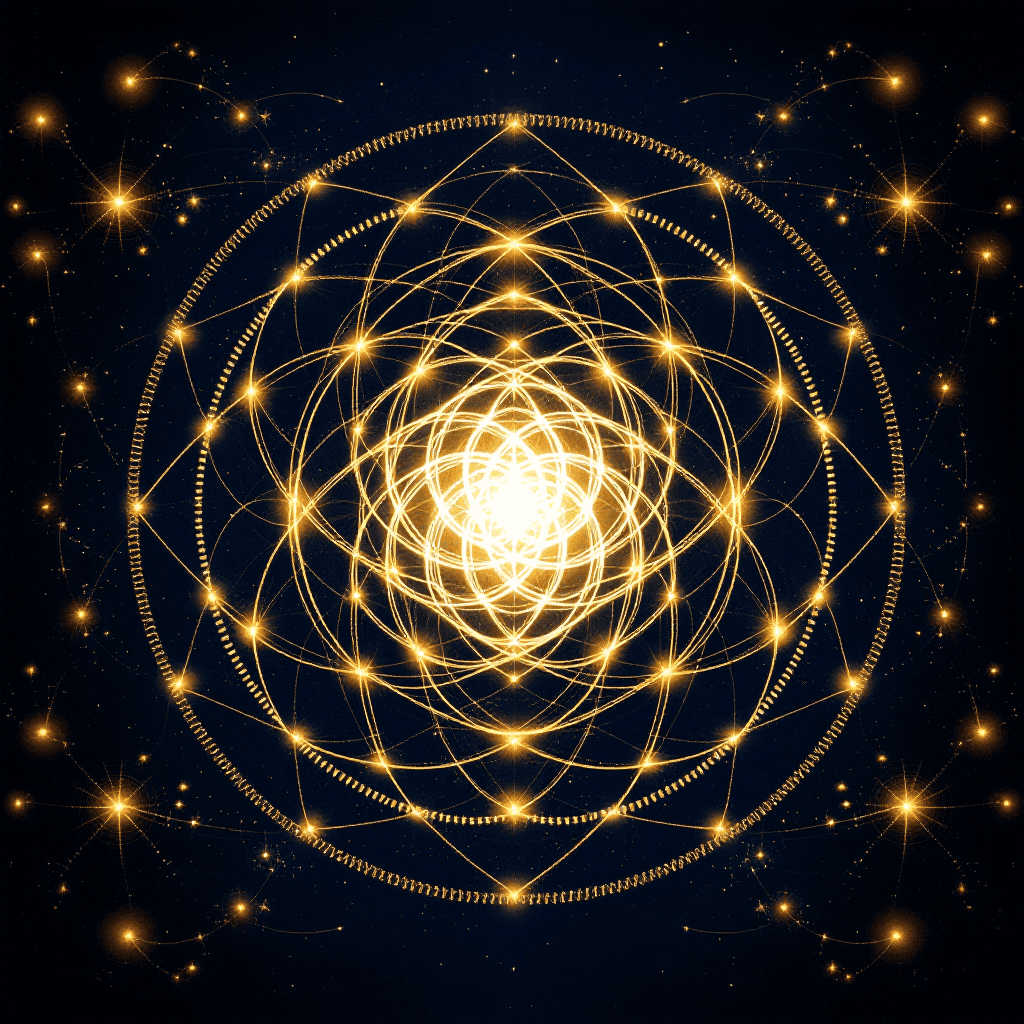
From the Vesica Piscis unfolds the Seed of Life, a pattern of seven interlocking circles formed by sequential rotation. This seven-fold structure mirrors the seven days of Genesis, the seven chakras of yogic tradition, and the seven-stage division of early embryonic cells. The Seed of Life is not metaphor but blueprint, showing how complexity emerges from simple repetition of a single rule.
Expanding the pattern further produces the Flower of Life, nineteen circles in perfect symmetry. This is perhaps the most widely recognized of all sacred geometry symbols, appearing in temples across Egypt, China, Japan, Turkey, and Europe. The Flower of Life contains within it every Platonic solid, the golden ratio, the Tree of Life, and Metatron’s Cube. It is the master pattern, the periodic table of sacred forms.
Metatron’s Cube and the Platonic Solids
Hidden within the Flower of Life is the Fruit of Life, thirteen circles representing the seed or essence of creation. Connect the centers of these circles with straight lines, and Metatron’s Cube emerges, a geometric matrix named after the archangel said to guard divine knowledge. Metatron’s Cube is significant because it contains all five Platonic solids, the only three-dimensional shapes where every face, edge, and angle is identical.
The Platonic solids, tetrahedron, cube, octahedron, dodecahedron, and icosahedron, were understood by ancient philosophers as the building blocks of reality. Plato associated each with a classical element: fire, earth, air, ether, and water. Modern science confirms their significance. Crystals grow according to these geometries. Viral capsids form icosahedral shells. The carbon-60 molecule, one of the strongest structures in nature, mirrors the truncated icosahedron.
What the ancients preserved in symbol, contemporary physics rediscovers in structure. The geometry was never symbolic alone. It was always functional, a map of how energy organizes itself into form. Understanding these patterns reveals the architecture beneath both matter and consciousness.
The Golden Ratio and Fibonacci Spiral
Among all proportions, one appears with such frequency across nature and sacred geometry symbols that it has been called divine. The golden ratio, approximately 1.618 and symbolized by the Greek letter phi, governs growth patterns in plants, the proportions of the human body, the spiral of galaxies, and the architecture of Gothic cathedrals. This ratio emerges naturally from the Fibonacci sequence, where each number is the sum of the two before it: 0, 1, 1, 2, 3, 5, 8, 13, 21, and onward.
As the Fibonacci sequence extends, the ratio between consecutive numbers approaches phi with increasing precision. This relationship manifests visually as the Fibonacci spiral, the logarithmic curve seen in nautilus shells, sunflower seed arrangements, hurricane formations, and the Milky Way itself. The spiral is not merely a shape but a process, showing how systems grow by repeating the same proportional expansion.
Sacred geometry symbols incorporating the golden ratio were not chosen for aesthetic appeal. They were recognized as resonant with the underlying mathematics of creation. When Leonardo da Vinci drew the Vitruvian Man, he was demonstrating that human anatomy follows the same proportional laws governing trees, shells, and stars. The body is a fractal expression of cosmic order.
The Sri Yantra and Geometric Meditation
While many sacred geometry symbols originated in the West, Eastern traditions developed their own sophisticated geometric languages. The Sri Yantra, central to Hindu Tantra, consists of nine interlocking triangles radiating from a central point, the bindu. Four triangles point upward, representing Shiva and the masculine principle. Five point downward, representing Shakti and the feminine. Their intersection creates forty-three smaller triangles, forming a mandala of extraordinary complexity.
The Sri Yantra is not decorative. It is a meditation instrument, a visual mantra designed to guide consciousness through layers of reality. Practitioners focus on the outer square gates, move inward through concentric lotus petals, and finally merge awareness into the bindu, the point of unity where all form dissolves. Each geometric layer corresponds to a specific state of consciousness, and the entire structure maps the journey from multiplicity back to source.
What makes the Sri Yantra remarkable is its mathematical precision. The angles and proportions required to construct it correctly are so exacting that even minor deviations destabilize the visual harmony. This suggests the form was not invented through trial and error but received or intuited, as though geometry itself dictated the design. Similar precision appears in mandalas across Tibetan Buddhism, each one a cosmogram encoding spiritual physics into visible form.
The Merkaba and Dimensional Geometry
Some sacred geometry symbols point beyond three dimensions into geometries the mind struggles to visualize. The Merkaba, derived from the Hebrew words for light, spirit, and body, consists of two interlocking tetrahedrons spinning in opposite directions. One points upward, the other downward, creating a three-dimensional Star of David.
Ancient traditions describe the Merkaba as the light-body vehicle, the geometric field surrounding every human being. When activated through specific breathing patterns and visualization techniques detailed in the complete framework, the Merkaba is said to enable dimensional travel and expanded states of awareness. Whether interpreted literally or symbolically, the form itself represents integration of opposites, masculine and feminine, spirit and matter, ascent and descent unified into a single spinning whole.
The Merkaba also appears in Kabbalistic diagrams and alchemical texts, often associated with transformation and ascension. Its geometric structure, two pyramids meeting at their bases, mirrors the hourglass, the double helix of DNA, and the toroidal energy fields documented by HeartMath research. Form follows function. The same geometries that organize matter at the atomic level reappear as symbols in mystical traditions.
The Vesica Piscis in Sacred Architecture
The Vesica Piscis, introduced earlier as the overlap of two circles, deserves deeper examination for its architectural significance. Medieval cathedral builders used this form as the foundation for Gothic arch design, creating structures that direct the eye and energy upward. The pointed arch is stronger than a rounded one, distributing weight more efficiently while creating the sense of aspiration that defines Gothic space.
But the Vesica Piscis carries symbolic weight beyond engineering. In Christian iconography, it frames Christ in glory, the mandorla representing the intersection of heaven and earth, the meeting point of divine and human. The same form appears in the design of church windows, doorways, and floor plans. Chartres Cathedral, Notre Dame, and dozens of others encode the Vesica Piscis into their proportions, making the entire building a three-dimensional expression of sacred geometry.
What the builders understood is that space itself can be tuned. When proportions align with natural harmonics, the structure resonates. Sound reverberates longer. Light filters through stained glass in calculated patterns. The nervous system of anyone entering the space entrains to the geometry, inducing states of awe, reverence, and expanded perception. Architecture becomes more than shelter. It becomes an instrument for shifting consciousness.
Sacred Symbols Across Cultures
The recurrence of sacred geometry symbols across unconnected civilizations points to something deeper than cultural exchange. The Flower of Life appears in Egyptian temples, Chinese guardian lion carvings, and medieval European manuscripts. The spiral shows up in Neolithic petroglyphs, Maori tattoos, and Celtic knotwork. The hexagon forms honeycomb cells, snowflake crystals, and the standing wave pattern at Saturn’s north pole.
These patterns were not transmitted through trade routes or conquest. They were discovered independently because they reflect universal principles. Geometry is not cultural. It is structural. The same mathematics that governs atomic bonding and galactic rotation also governs the forms humans recognize as sacred. What differs is the interpretation, the myths and meanings layered onto the patterns, but the underlying architecture remains constant.
This universality suggests that sacred geometry symbols function as a kind of cross-cultural language, a visual esperanto understood by consciousness itself. A mandala from Tibet and a rose window from France serve the same function despite different theological contexts. Both guide awareness inward through symmetry, repetition, and proportion. Both activate pattern recognition circuits in the brain, quieting linear thought and opening access to holistic perception.
Cymatics and the Sound of Geometry
One of the most striking validations of sacred geometry comes from cymatics, the study of visible sound. When sand, water, or other mediums are vibrated at specific frequencies, they spontaneously organize into geometric patterns. Low frequencies produce simple circles and lines. Higher frequencies generate hexagons, stars, mandalas, and forms strikingly similar to the Flower of Life.
What cymatics demonstrates is that geometry is not imposed on matter but emerges from vibration. Sound creates form. The patterns ancient cultures revered were not invented but observed, the visible expression of frequencies present in nature, temple acoustics, chanting, and perhaps the resonance of consciousness itself. When Hans Jenny coined the term cymatics in the 1960s, he was rediscovering what mystery schools had known for millennia: reality is structured vibration, and sacred geometry is its visible syntax.
This insight connects directly to creation myths across traditions. “In the beginning was the Word,” declares the Gospel of John. The Word, or Logos, is not speech but structured vibration, the frequency that organizes chaos into cosmos. Sacred geometry symbols are the Word made visible, the energetic blueprint that precedes and generates material form.
The Pentagram and Hexagram
Two symbols deserve attention for their dual nature, revered in antiquity yet later stigmatized or inverted. The pentagram, or five-pointed star, was sacred to the Pythagoreans who called it hugieia, meaning health. Its lines and angles encode the golden ratio at every intersection. When upright, the single point rising above represents spirit governing the four elements. The pentagram appears in early Christian symbolism as the five wounds of Christ and in alchemical texts as the quintessence, the fifth element unifying the others.
The hexagram, or six-pointed star, formed by two interlocking triangles, represents the union of opposites. One triangle points upward toward heaven, the other downward toward earth. Their intersection creates balance, the marriage of masculine and feminine, fire and water, spirit and matter. Known in antiquity as the Seal of Solomon, the hexagram was a symbol of wisdom and divine protection long before its later association with Judaism as the Star of David.
Both symbols were later inverted or rebranded, their meanings distorted to serve fear rather than understanding. The upside-down pentagram became associated with malevolence, the hexagram with occult danger. This inversion, turning symbols of order into signs of threat, is a pattern we explore more deeply elsewhere. What matters here is recognizing that the geometry itself remains neutral. The power lies in proportion and pattern, not in the mythology projected onto it.
Using Sacred Geometry as a Tool
Understanding sacred geometry symbols is one thing. Using them is another. These forms were never meant to be passively admired but actively engaged. Meditation on a mandala quiets the analytical mind and opens access to non-linear awareness. Wearing or displaying a Flower of Life pendant may act as a vibrational tuning fork, subtly aligning the body’s electromagnetic field with harmonic frequencies.
Some practitioners use sacred geometry in visualization practices, constructing forms mentally during meditation to stabilize focus and induce specific states. The Sri Yantra, when visualized with precision, is said to activate the third eye and align the chakras. The Merkaba, when spun mentally in coordination with breath, allegedly activates the light-body. Whether these effects are literal or psychological matters less than the fact that the practices produce measurable shifts in brainwave patterns, stress hormones, and reported states of consciousness.
Architecture offers another application. Designing living spaces according to golden ratio proportions, orienting structures along geomagnetic lines, and incorporating specific geometric motifs can create environments that support rather than fragment awareness. The ancients built temples as resonant chambers. Modern builders mostly ignore these principles, creating spaces optimized for function and profit but hostile to coherence. Reclaiming geometric design is not nostalgia but practical neuroscience, shaping environments that serve the nervous system rather than overload it.
The Hidden Layers of Symbolic Meaning
Every sacred geometry symbol operates on multiple levels simultaneously. The circle is eternity, yes, but also zero, the void, the ouroboros, and the sun. The triangle is trinity, pyramid, fire, and the delta symbol for change. The square represents earth, stability, the four directions, and the foundation. When these forms combine, as in the classic “squaring the circle” problem, they encode relationships between transcendence and manifestation, infinity and form.
Esoteric traditions layered meanings onto geometric forms the way programmers layer functions onto code. A rose window is simultaneously a cosmogram, a mandala, a sonic amplifier, and a light filter. The Great Pyramid encodes pi, phi, the speed of light, and the dimensions of Earth in its proportions. Whether by design or coincidence, the geometry serves multiple functions, aesthetic, structural, symbolic, and vibrational, all operating in parallel.
This multiplicity is intentional. Sacred geometry symbols were designed to work on whoever encountered them, regardless of intellectual understanding. A child sees beauty. A mathematician sees proportion. A mystic sees a map of consciousness. All three responses are valid because the geometry addresses multiple levels of perception simultaneously. Form communicates directly to the nervous system, bypassing language and belief.
Sacred Geometry and DNA Activation
One of the more controversial claims surrounding sacred geometry is its potential effect on genetic expression. Dr. Bruce Lipton’s research in epigenetics shows that environmental signals, including electromagnetic fields and vibrational input, can influence which genes activate or remain dormant. If the body is primarily water, and water responds to frequency as Masaru Emoto demonstrated, then exposure to harmonic geometric patterns may act as a signal, retuning cellular function at the molecular level.
Some researchers propose that the so-called “junk DNA,” the 98 percent of the genome that doesn’t code for proteins, may function as an antenna, receiving and interpreting vibrational information from the environment. In this model, sacred geometry symbols act as broadcast signals, activating dormant genetic potential when consciousness reaches sufficient coherence. The claim remains speculative, but the principle aligns with emerging understandings of biofields, biophotons, and the body as a resonant system.
Where Sacred Geometry Meets Modern Physics
Contemporary physics increasingly describes reality in terms that ancient geometers would recognize. String theory proposes that fundamental particles are vibrating loops, tiny geometric patterns oscillating in higher dimensions. The holographic principle suggests that three-dimensional space may be a projection of information encoded on a two-dimensional surface, much like the Platonic solids can be unfolded into flat nets. Quantum field theory describes particles as excitations in underlying fields, ripples in a geometric substrate.
What mystics encoded in symbol, physicists now model in equations. The convergence is not coincidental. Both approaches are mapping the same territory, one through direct perception and the other through measurement and mathematics. Sacred geometry symbols may represent humanity’s oldest attempt to visualize what scientists now call the quantum foam, the fluctuating geometric structure of space-time at the Planck scale.
If reality is fundamentally geometric, then studying these forms is not historical curiosity but practical physics. The forms are not relics. They are tools, keys to understanding how energy becomes matter, how consciousness interfaces with the field, and how pattern generates presence.
Closing Reflections
Sacred geometry symbols are maps written in a language older than words. They chart the territory where mathematics meets consciousness, where vibration becomes form, and where the invisible architecture of reality becomes briefly, beautifully visible. From the single point to the Flower of Life, from the Vesica Piscis to Metatron’s Cube, each symbol encodes principles that govern galaxies and atoms, cathedrals and cells.
These patterns were not invented by priests or philosophers. They were discovered, recognized in nature, replicated in stone, and preserved across millennia because they work. They resonate with something fundamental in both matter and mind. To study them is to remember what the modern world has largely forgotten: that the universe is not random chaos held together by chance, but ordered beauty structured by law.
Whether you approach sacred geometry as art, science, spirituality, or all three, the symbols themselves remain patient teachers. They ask nothing but attention. They offer everything: a glimpse behind the curtain, a sense of the code beneath the code, and the quiet recognition that you are not separate from the pattern. You are woven into it, built from it, and capable of reading it once you learn to see.
The geometry is still here, still speaking. The question is whether we remember how to listen.