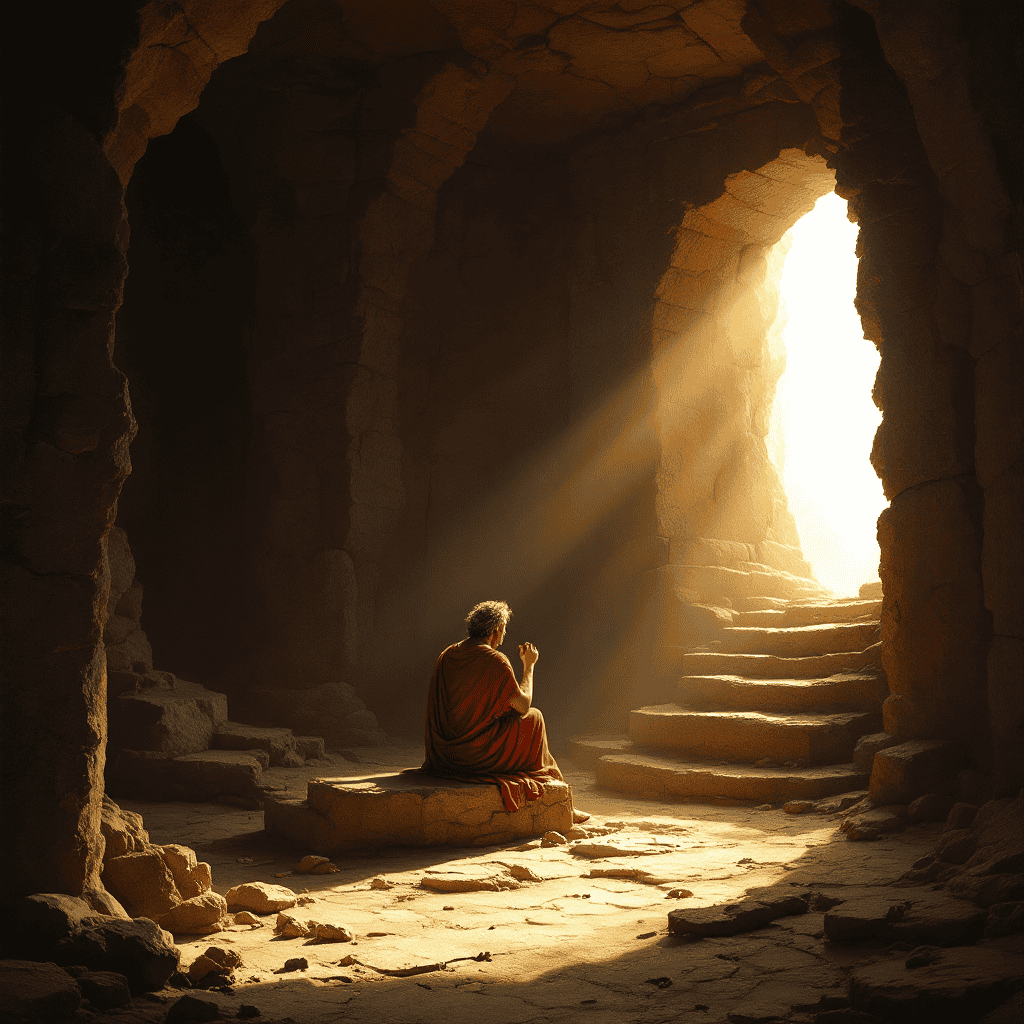
The allegory of the cave explained is one of philosophy’s most enduring images, a story that cuts through centuries to reveal something unsettling about perception itself. Written by Plato around 380 BCE in The Republic, this parable describes prisoners chained inside a cave since birth, their backs to the entrance, watching shadows flicker across a wall. To them, those shadows are reality. They have never seen the objects casting them, never turned toward the fire behind them, never glimpsed the sunlight beyond the cave’s mouth. The allegory asks a simple question with profound implications: what if everything you perceive is just a shadow, and the real world exists somewhere you have never looked?
The Structure of Plato’s Cave
Plato’s allegory unfolds in stages, each one a step toward recognizing illusion. The prisoners sit in darkness, bound so tightly they cannot turn their heads. Behind them burns a fire, and between the fire and the prisoners, unseen figures carry objects that cast shadows on the wall. The prisoners see only the shadows. They hear echoes and assume those sounds come from the shapes before them. Over time, they develop a complete understanding of their world: naming the shadows, predicting their movements, becoming experts in a reality that does not exist.
One prisoner breaks free. He turns toward the fire, and the light blinds him. At first, the pain is unbearable. The flickering flames reveal the objects he mistook for shadows, but his eyes have not adjusted. Confusion replaces certainty. He stumbles toward the cave’s entrance, where sunlight waits, and the intensity nearly drives him back into the dark. But he persists. Gradually, his vision clears. He sees trees, not their shadows. He sees the sun itself, the source of all light, and understands that everything he once believed was a projection.
When he returns to the cave to free the others, they mock him. His eyes, now accustomed to sunlight, struggle in the darkness. He stumbles. He cannot name the shadows as quickly as before. To the prisoners, he appears damaged, foolish, weakened by whatever lies beyond. Some threaten him. Others turn away. The allegory ends with a warning: those who escape the cave and return to liberate others often face hostility, even violence, from those still chained.
This structure maps directly onto the journey from ignorance to knowledge, from perception to truth. The shadows represent the sensory world, the objects behind the prisoners represent forms and abstractions, and the sun represents ultimate reality, what Plato called the Form of the Good. But the allegory is not merely epistemological. It is diagnostic. It suggests that most people live inside a cave of their own making, mistaking filtered images for the whole truth.
Perception as Interface, Not Reality
Modern neuroscience reaches the same conclusion Plato intuited. The brain does not record reality directly. It constructs a model, filtering billions of sensory inputs into a manageable stream. What you experience as the world is a simplified interface, optimized for survival, not accuracy. Perception itself is an active process, shaped by expectation, memory, and cognitive bias. The shadows on Plato’s wall are not metaphorical. They are the everyday mechanics of human awareness.
Cognitive scientist Donald Hoffman argues that natural selection favors perceptions that enhance survival, not those that reflect objective truth. His interface theory of perception demonstrates mathematically that organisms tuned to truth are outcompeted by those tuned to utility. In other words, evolution designed your senses to show you a useful rendering of reality, not reality itself. The desktop icons on a computer screen do not resemble the electrical circuits beneath them, yet they allow interaction. Your senses function the same way. You navigate a world of symbols, not the underlying code.
This is where the allegory of the cave explained becomes more than philosophy. It becomes biology. The prisoners are not morally deficient. They are operating exactly as their perceptual apparatus was designed. The chains are not external but neurological, built into the filtering mechanisms that compress raw data into coherent experience. To break free requires more than willpower. It requires recognizing that the filter exists in the first place.
The Fire, The Sun, and the Structure of Ascent
Plato’s allegory operates on a vertical axis. The cave represents the lowest level of awareness, where shadows dominate. The fire represents a partial illumination, revealing the objects that cast shadows but still relying on artificial light. The sun represents the highest truth, self-evident and self-sustaining, the source from which all else derives. This is not random imagery. It maps the philosopher’s journey from opinion to knowledge to wisdom.
The firelight stage is particularly important. Most people who begin questioning their assumptions stop here. They recognize that media narratives are constructed, that cultural conditioning shapes belief, that authority figures can be wrong. They see the objects behind the curtain and believe they have reached the truth. But firelight is still artificial. It reveals only what someone else has chosen to place in its glow. The sun, by contrast, illuminates everything without selection or bias. It represents direct apprehension of reality, unmediated by intermediary.
In mystical traditions, this same structure appears as initiation. The outer court, the inner hall, and the holy of holies. The body, the mind, and the spirit. The material, the intellectual, and the transcendent. Piercing the veil of constructed reality has always required moving through stages, each one preparing the seeker for what comes next. Plato encoded this into his allegory, knowing that the journey cannot be rushed. Eyes accustomed to darkness cannot bear sudden light without pain.
The Return and the Problem of Authority
The most unsettling part of the allegory is not the escape but the return. The freed prisoner, having seen the sun, descends back into the cave. His eyes no longer work in darkness. He stumbles. The other prisoners, who have spent their lives mastering shadow-prediction, see him as incompetent. They reject his testimony. Some interpret his struggle as proof that leaving the cave is dangerous. Others see him as a threat to the social order they have built around shared illusion.
Plato wrote this allegory during a time when Socrates, his teacher, had been executed by the Athenian state for corrupting the youth and questioning the gods. The freed prisoner who returns is Socrates. The prisoners who reject him are the citizens who voted for his death. The allegory is not abstract. It is a record of what happens when truth confronts consensus.
This pattern repeats across history. Galileo faced the Inquisition for claiming the Earth moved. Ignaz Semmelweis was ridiculed for suggesting doctors wash their hands. Whistleblowers are prosecuted, reformers are marginalized, and those who see beyond the accepted narrative are labeled conspiracy theorists, heretics, or lunatics. The cave is not only perceptual but social. It is maintained by collective agreement, and breaking that agreement is treated as a crime against the group.
Yet the allegory does not counsel resignation. It insists that the philosopher, having seen the sun, has a duty to return. Enlightenment without action is solipsism. The freed prisoner could remain outside, basking in truth, but Plato frames that as a failure. The journey is incomplete until others are freed. This introduces a paradox: how do you communicate a reality others cannot yet perceive? How do you describe sunlight to those who have only known shadows?
The Cave as Simulation
When the allegory of the cave explained meets modern metaphysics, something clicks. The prisoners are not passive. They are participants in a rendered environment, their attention locked onto a display that feels complete because they have never seen beyond it. The shadows are the interface. The cave is the system. The chains are the code that keeps perception locked in place. This is not metaphor. It is structural description.
Simulation theory proposes that what we experience as base reality may be a construct, a programmed environment running on principles we do not fully understand. Ancient traditions encoded timing, rhythm, and thresholds into their practices, suggesting they understood that reality operates on cycles and frequencies, not randomness. The allegory of the cave is one of the earliest recorded attempts to describe this. Plato did not have the language of computation, but he had the insight: what you see is not what is.
The freed prisoner’s journey mirrors the stages of awakening described across mystical systems. The first stage is disorientation. Beliefs collapse. The familiar becomes alien. The second stage is adjustment. New patterns emerge. What once seemed solid reveals itself as construct. The third stage is integration. The seeker learns to navigate both realities, moving between the cave and the sun without losing coherence. The biological mechanisms underlying this shift involve hormonal cascades, brainwave synchronization, and glandular activation, processes that align perception with higher-order patterns.
Plato’s sun functions as the ultimate source code. It is self-illuminating, requiring nothing outside itself to exist. Everything else derives from it. In computational terms, it is the base layer from which all simulations render. In theological terms, it is the uncreated light, the divine intelligence that generates form. In both frameworks, the allegory holds: most people experience only the output, never the origin.
Why the Prisoners Resist
The most psychologically accurate part of the allegory is the prisoners’ hostility. Cognitive dissonance is not abstract. When core beliefs are challenged, the brain treats it as a threat. fMRI studies show that regions associated with physical pain activate when deeply held assumptions are contradicted. To the prisoners, the freed man is not offering liberation. He is attacking their identity.
This is why awakening cannot be forced. The chains are not physical. They are perceptual and emotional. Breaking them requires the prisoner to choose discomfort over certainty, to endure the pain of adjustment, to accept that everything they once knew was incomplete. Most people will not make that choice unless the cave itself becomes unbearable. Only when the shadows stop making sense, when the predictions fail, when the consensus cracks, does the possibility of turning toward the fire become attractive.
Plato understood this. The allegory does not describe a rescue. It describes self-liberation. The freed prisoner breaks his own chains. No one can do it for him. The most the philosopher can offer is a demonstration, a witness that another way exists. Whether the prisoners turn or remain facing the wall is their decision. The full mechanism behind perceptual awakening requires more than intellectual acknowledgment. It requires embodied practice, sustained attention, and the willingness to sit with the discomfort of not knowing.
The Allegory Today
Every major shift in understanding begins with someone recognizing the shadows. The heliocentric model, germ theory, quantum mechanics, all started with individuals who questioned the consensus and endured ridicule. The allegory of the cave explained is not a relic of ancient philosophy. It is a manual for navigating epistemic transitions, moments when collective reality shifts beneath the surface and only some notice.
In the modern era, the cave has new walls. Algorithms curate what you see. Media frames what you believe is important. Education systems teach what is safe to know. The fire has been replaced by screens, but the principle remains. Most people experience a filtered reality, optimized for engagement, not truth. The shadows are more sophisticated now, but they are still shadows.
Breaking free requires the same courage it always has. You must turn away from the familiar, endure the discomfort of new light, and accept that most people will not follow. The systematic suppression of perception-expanding knowledge is not accidental. Systems that benefit from predictable behavior do not reward those who see beyond the script. The freed prisoner returns to hostility because the cave is not neutral. It is maintained.
Yet the allegory offers hope. The sun does not change. It remains accessible to anyone willing to turn toward it. The journey is individual, but the destination is universal. What Plato described as the Form of the Good, mystics called the divine, and physicists are now mapping as the structure underlying quantum fields, these are not separate truths. They are the same reality, described in different languages, pointing toward the same recognition: the world you see is not the world that is.
Closing Reflections
The allegory of the cave explained reveals a simple truth hidden in plain sight: perception is not reality. The shadows on the wall are convincing because they are all the prisoners have ever known. The firelight feels like truth because it reveals more than shadow. But only the sun, the unmediated source, offers clarity without distortion. Plato’s genius was not in inventing this insight but in preserving it through a story so vivid it could not be forgotten.
Every generation rediscovers the cave. The chains take new forms. The shadows grow more detailed. But the journey remains the same. Turn toward the light. Endure the pain of adjustment. Recognize that what you once called reality was a rendering, useful but incomplete. And when you return to the cave, whether others listen or not, you will have fulfilled the philosopher’s task: to witness that another way exists, and to extend the invitation.
The prisoners may mock you. They may threaten you. They may insist the shadows are all there is. But somewhere, one of them will turn. One will break their chains. One will begin the climb toward the sun. That is enough. The allegory does not promise mass awakening. It promises that the path is always open, and that those who walk it will see what the cave could never show them. The rest is choice.