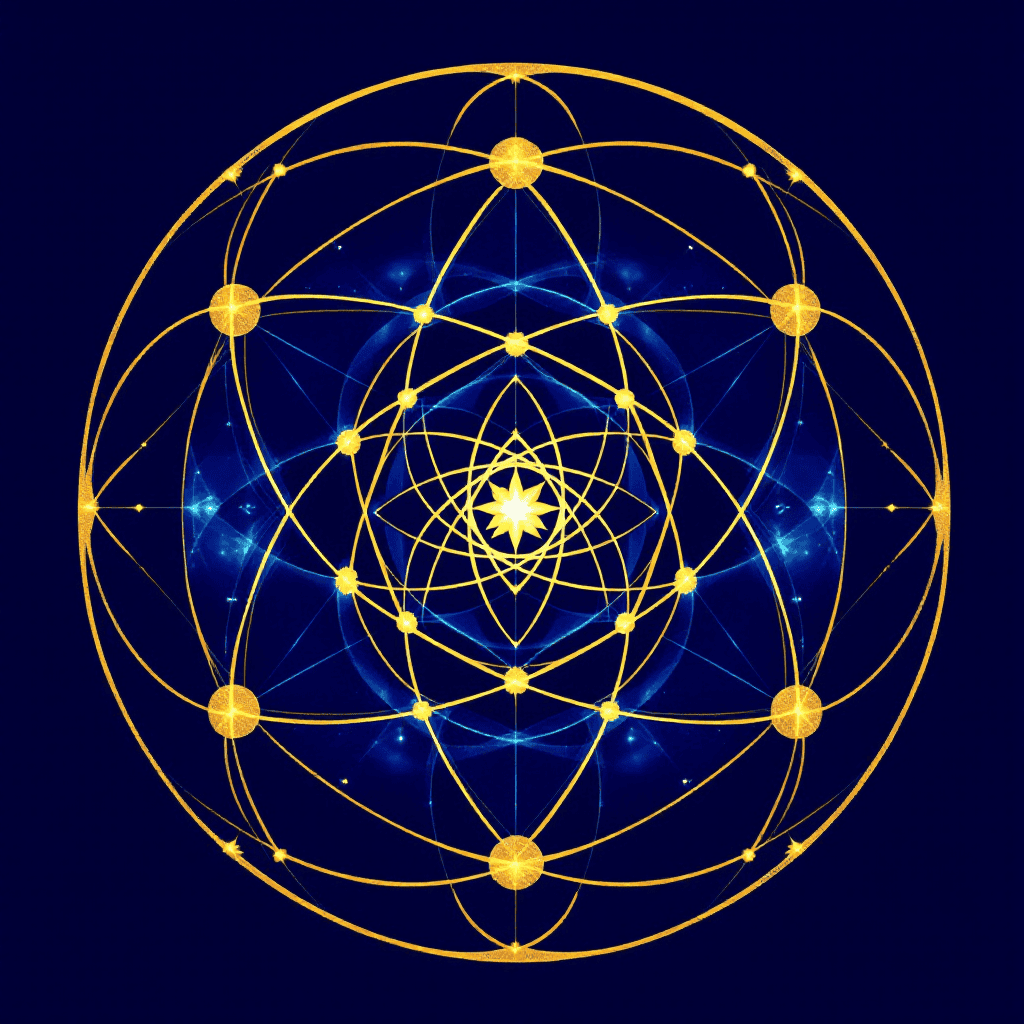
The seed of life is a sacred geometry pattern formed by seven interlocking circles arranged in perfect symmetry, a design that appears across ancient temples, mystical traditions, and the biological structures of life itself. This ancient symbol isn’t merely decorative art from forgotten cultures. It represents the fundamental architecture of creation, a geometric code that bridges mathematics, consciousness, and the physical world. When you understand the seed of life, you begin to see the hidden order beneath what most mistake for chaos.
Long before modern physics described reality as structured information, ancient civilizations carved this seven-circle pattern into stone. They recognized something profound: the seed of life encodes the same proportions found in cell division, planetary motion, and the harmonic ratios that govern sound and light. The pattern appears in Egyptian temples, Kabbalistic diagrams, and Buddhist mandalas, not because these cultures copied one another, but because they independently discovered the same underlying truth. Reality follows a blueprint, and the seed of life is one of its clearest expressions.
The Geometry Behind the Pattern
The seed of life begins with a single point, the primordial spark of awareness. From that center, the first circle expands outward, representing the initial boundary of being. When consciousness reflects upon itself, a second circle emerges, overlapping the first to form the vesica piscis, the almond-shaped intersection where unity meets duality. This is not abstract philosophy. It is sacred geometry’s fundamental operation, the moment one becomes two while remaining whole.
Six additional circles then radiate from the central point, each with its center placed precisely on the circumference of the original. The result is a flower-like configuration of seven circles, six surrounding one. This arrangement isn’t arbitrary. It reflects the most efficient packing of circles in two-dimensional space, the same mathematics that governs honeycomb construction, bubble formation, and the organization of cells in early embryonic development. The seed of life is nature’s answer to the question: how does unity express itself as multiplicity while maintaining coherence?
Every line, every intersection, every ratio within the seed of life pattern can be measured and verified. The structure contains within it the proportions that will later expand into the flower of life, the tree of life, and Metatron’s cube. These are not separate symbols but successive unfoldings of the same generative principle. The seed holds them all in potential, just as a biological seed contains the entire tree it will become.
Biblical Creation and the Seven Circles
The seven circles of the seed of life mirror the seven days of creation described in Genesis. This parallel is not coincidental. Each circle corresponds to a day, a stage in the unfolding of form from formlessness. Day one brings light, the first circle expanding from the point. Day two separates waters above and below, the second circle creating the vesica piscis that divides while connecting. Days three through six add circles in sequence, each building upon the last, until the pattern reaches completion.
On the seventh day, God rested. No new circle is added. Instead, the design turns inward, recognizing its own wholeness. The seed is complete, containing within it the blueprint of all creation. This is why the number seven recurs throughout scripture and mysticism: seven heavens, seven seals, seven chakras. The repetition isn’t symbolic decoration. It maps the actual stages through which consciousness structures reality, a process the ancients encoded in geometry because geometry transcends language.
Those who study the deeper patterns underlying reality recognize that creation narratives across cultures follow the same sequence. The Vedic tradition describes similar stages of manifestation. Kabbalistic texts trace the emanation of divine light through progressive spheres. The seed of life provides the visual map for what these traditions describe in words, showing how the many arise from the one through ordered expansion.
Embryonic Development and Biological Mirroring
The most striking validation of the seed of life pattern appears in human embryology. When a fertilized egg begins dividing, it follows the exact sequence the symbol depicts. One cell becomes two, forming the vesica piscis shape. Two becomes four, then eight. By the eight-cell stage, the embryo mirrors the egg of life configuration, a three-dimensional expression of the seed pattern. This is not metaphor. Under a microscope, the earliest stages of human development literally trace the same geometry that ancient mystics carved into temple walls thousands of years ago.
The cells arrange themselves in this pattern because it represents the most stable, efficient configuration for biological growth. The same mathematics that produces the seed of life also governs crystal formation, soap bubble clustering, and the arrangement of seeds in a sunflower. Nature uses this template repeatedly because it works. It optimizes space, maintains structural integrity, and allows for maximum connectivity between parts while preserving the coherence of the whole.
This biological correspondence suggests that the ancients understood something modern science is only beginning to rediscover: life itself is structured vibration taking geometric form. The seed of life isn’t imposed on reality from outside. It emerges from within as the natural expression of ordered growth. REDACTED, READ CHAPTER 1 Every cell division that builds your body recapitulates the same pattern that structures galaxies.
Mathematical Properties and Harmonic Ratios
When you analyze the seed of life mathematically, deeper patterns emerge. The distance from the center point to the circumference of the outer circles relates to the distance between adjacent circles through precise ratios. These ratios aren’t arbitrary measurements. They correspond to harmonic intervals in music, the same proportions Pythagoras identified when he discovered that pleasing sounds arise from simple numerical relationships.
The seed of life contains the golden ratio phi within its proportions, though this becomes more explicit in its expansion into the flower of life. It also encodes the vesica piscis, whose ratio of length to width approximates the square root of three. This same ratio appears in the construction of Gothic cathedrals, in the dimensions of the Ark of the Covenant as described in Exodus, and in the proportional systems used by Renaissance artists. The pattern serves as a key that unlocks multiple domains simultaneously: sound, space, proportion, and growth.
Those studying the fundamental polarities that structure existence recognize the seed of life as the point where unity first divides without fragmenting. The vesica piscis at its heart represents the generative tension between opposites, the creative friction that allows form to emerge from void. Every subsequent circle adds another dimension of polarity while maintaining the central coherence. This is how consciousness expands: not by shattering into pieces, but by differentiating while remaining whole.
Ancient Temple Carvings and Cross-Cultural Presence
The seed of life appears carved into stone at some of humanity’s oldest sacred sites. In Egypt, variations of the pattern are found at the Temple of Osiris in Abydos, etched with precision into granite columns. Some researchers date these carvings to the original temple construction, suggesting knowledge of this geometry extends back thousands of years. The pattern also appears in Assyrian palaces, on Buddhist stupas, in Celtic illuminated manuscripts, and within Islamic geometric art.
This widespread presence across unconnected cultures points to independent discovery rather than cultural transmission. The seed of life isn’t the intellectual property of any single civilization. It is a natural pattern, visible to anyone who looks carefully at how circles intersect and multiply. Ancient architects, mystics, and mathematicians across continents all arrived at the same form because they were mapping the same underlying structure: the geometry of creation itself.
Many temples built on this geometry were designed as resonant chambers, spaces where sound, proportion, and intention could amplify consciousness. REDACTED, READ CHAPTER 1 The stones themselves were positioned according to geometric principles that modern materialist archaeology often overlooks. When you stand in these spaces, you’re not merely visiting ruins. You’re entering a crystallized thought-form, a physical mandala built to scale.
Relationship to the Flower of Life
The seed of life serves as the foundation for the flower of life, the more complex nineteen-circle pattern recognized across mystical traditions. The flower expands the seed by continuing the same generative process: placing new circles with centers on the intersections of existing circles. Where the seed stops at seven circles, the flower continues outward, layer upon layer, until a complete tessellation emerges.
This relationship between seed and flower mirrors the relationship between potential and manifestation. The seed contains everything the flower will become, just as an acorn contains the entire oak. Nothing is added in the expansion except more of the same pattern, repeating at increasing scales. This is fractal geometry in action, self-similarity across dimensions. The principle that structures the seed also structures the flower, which structures the fruit of life, which structures Metatron’s cube, which contains all five Platonic solids.
Understanding the timing and inner mechanisms that activate dormant potential requires recognizing these nested patterns. Just as the seed precedes the flower, certain preparatory states must be achieved before deeper geometric understanding becomes experientially accessible. The symbol can be drawn at any time. The comprehension it encodes requires alignment. REDACTED, READ CHAPTER 13
The Seed as Meditation Tool
Beyond its mathematical and historical significance, the seed of life functions as a contemplative tool. Gazing at the pattern, tracing its circles with focused attention, or visualizing it during meditation can quiet mental noise and induce states of coherence. The symmetry itself acts as an anchor, a fixed point around which scattered awareness can reorganize itself. This is not superstition. Neuroscience confirms that symmetrical, balanced visual patterns activate specific neural networks associated with calm and focused attention.
Many practitioners report that sustained focus on the seed of life produces a sense of expansion, as though the boundaries of individual consciousness temporarily dissolve. This may be because the pattern mirrors the structure consciousness itself takes when observing its own nature. Looking at the seed is like watching the mind watch itself, a recursion that can trigger insight. REDACTED, READ CHAPTER 1
The practice isn’t passive observation. It involves allowing the geometry to organize your attention, to pull focus away from discursive thought and toward pure pattern recognition. In this state, the symbol becomes a portal, not to another place, but to a different quality of awareness. The seven circles stop being lines on a page and start revealing the principle they encode: that unity can differentiate without losing itself, that creation is not fragmentation but ordered expansion.
Cymatic Patterns and Sound Visualization
When sound frequencies are applied to a vibrating medium, particles arrange themselves into geometric patterns. This phenomenon, called cymatics, produces forms that often resemble sacred geometry symbols including the seed of life. Specific frequencies generate six-fold symmetry, circles radiating from a center point, and vesica piscis intersections. The visual similarity between cymatic patterns and ancient sacred geometry suggests these symbols weren’t invented but observed, natural forms that emerge when vibration structures matter.
This connects directly to the principle that reality itself may be vibration taking visible form. If sound can organize sand into geometric patterns, and if those patterns match the templates ancient mystics carved into temples, then sacred geometry may be the literal architecture of creation. The seed of life doesn’t symbolize how reality is structured. It shows you the structure directly, the way a blueprint shows the framework of a building before construction begins.
Researchers exploring the biological fluids and glandular secretions that respond to frequency have noted that geometric visualization paired with specific tones can influence physiological states. The mechanism isn’t fully mapped in mainstream science, but the correlations are documented. Geometry isn’t passive information. When engaged consciously, it acts as a tuning fork for the nervous system, aligning scattered energy into coherence. REDACTED, READ CHAPTER 6
Practical Applications in Modern Context
Understanding the seed of life has practical implications beyond historical curiosity. The pattern can be used as a design template for spaces meant to support focus, healing, or contemplation. Architects and designers who incorporate these proportions report that people feel more at ease in such environments, though they often can’t articulate why. The geometry works below conscious awareness, organizing space in a way that resonates with the body’s own structure.
The symbol also serves as a reminder that complexity arises from simplicity through repetition of a single principle. Every challenge you face, every system you build, every relationship you navigate can be understood through the same lens: start with a clear center, expand in balanced stages, maintain symmetry, and allow each new layer to build upon what came before. The seed of life isn’t just ancient wisdom. It’s an operating manual for how ordered growth happens at any scale.
For those walking the path of self-mastery outlined in the complete framework, the seed represents the first stage of awakening: recognizing that what appears chaotic is actually structured, that what seems random follows law, and that the pattern shaping galaxies also shapes the thoughts arising in your mind right now. Once you see the blueprint, you can’t unsee it. And once you recognize the code, you begin to understand your role in its unfolding.
The Seed and the Tree of Life
The Kabbalistic tree of life, with its ten spheres and twenty-two connecting paths, can be overlaid directly onto the seed of life pattern. The spheres correspond to specific circle intersections, and the paths trace lines already present in the geometry. This overlay demonstrates that the tree isn’t a separate system but an elaboration of the seed, adding dimension and meaning to the underlying structure.
Each sphere on the tree represents a stage of emanation, a level at which divine energy takes form. The seed of life provides the spatial map for this descent. The central circle corresponds to the middle pillar, the vertical axis through which energy ascends and descends. The surrounding six circles map to the outer pillars, the polarities of force and form. REDACTED, READ CHAPTER 20
This integration shows how different mystical systems point to the same underlying architecture. The Kabbalists didn’t invent the tree. They described what the geometry was already showing: that consciousness descends through stages, that each stage has specific qualities, and that the path back up requires understanding the map. The seed of life is that map in its simplest form, the outline before the details are filled in.
Why This Pattern Persists
The seed of life has survived millennia of cultural upheaval, religious reformation, and scientific materialism because it encodes something verifiable. You can test its proportions, observe its biological correlates, trace its mathematical relationships, and experience its effects on consciousness. Unlike purely symbolic systems that depend on belief, sacred geometry demonstrates itself. The pattern either generates the proportions it claims to generate, or it doesn’t. The circles either intersect according to harmonic ratios, or they don’t.
This empirical foundation is why the symbol transcends any single tradition. Christians, Jews, Muslims, Hindus, Buddhists, and secular scientists can all study the same pattern and extract valid insights from their respective frameworks. The seed doesn’t require conversion to a particular doctrine. It requires only the willingness to observe carefully and think clearly. When you do, the same conclusions emerge: reality is ordered, consciousness participates in that order, and geometry is the visible language through which order expresses itself.
What the ancients understood and modern culture has largely forgotten is that symbols aren’t arbitrary. The most powerful ones, the ones that persist across centuries, do so because they map something real. The seed of life maps the transition from unity to multiplicity, the moment when the one becomes many while remaining coherent. This isn’t mythology. It’s the fundamental operation of existence, visible in embryos, audible in music, present in architecture, and encoded in the structure of thought itself. REDACTED, READ CHAPTER 2
Closing Reflection
The seed of life is not a relic of primitive thinking. It is a precise diagram of how consciousness structures reality, how the one becomes many, and how order emerges from potential. Seven circles arranged in perfect symmetry contain within them the blueprint for biological growth, architectural proportion, musical harmony, and spiritual ascent. This is why the pattern appears across every continent and every era. It wasn’t transmitted through trade routes or conquest. It was discovered, independently, by every culture that looked closely enough at the way form arises from void.
When you understand the seed, you begin to see the same principle operating everywhere: in the division of cells, in the structure of snowflakes, in the proportions of your own body, in the way ideas unfold from a single insight. Reality isn’t random. It follows a template. And that template, in its simplest expression, is the seed of life. The pattern that began creation is still generating it now, in every breath, every heartbeat, every thought arising in awareness. You aren’t separate from this geometry. You are its living expression, the seed recognizing itself in the mirror of form.