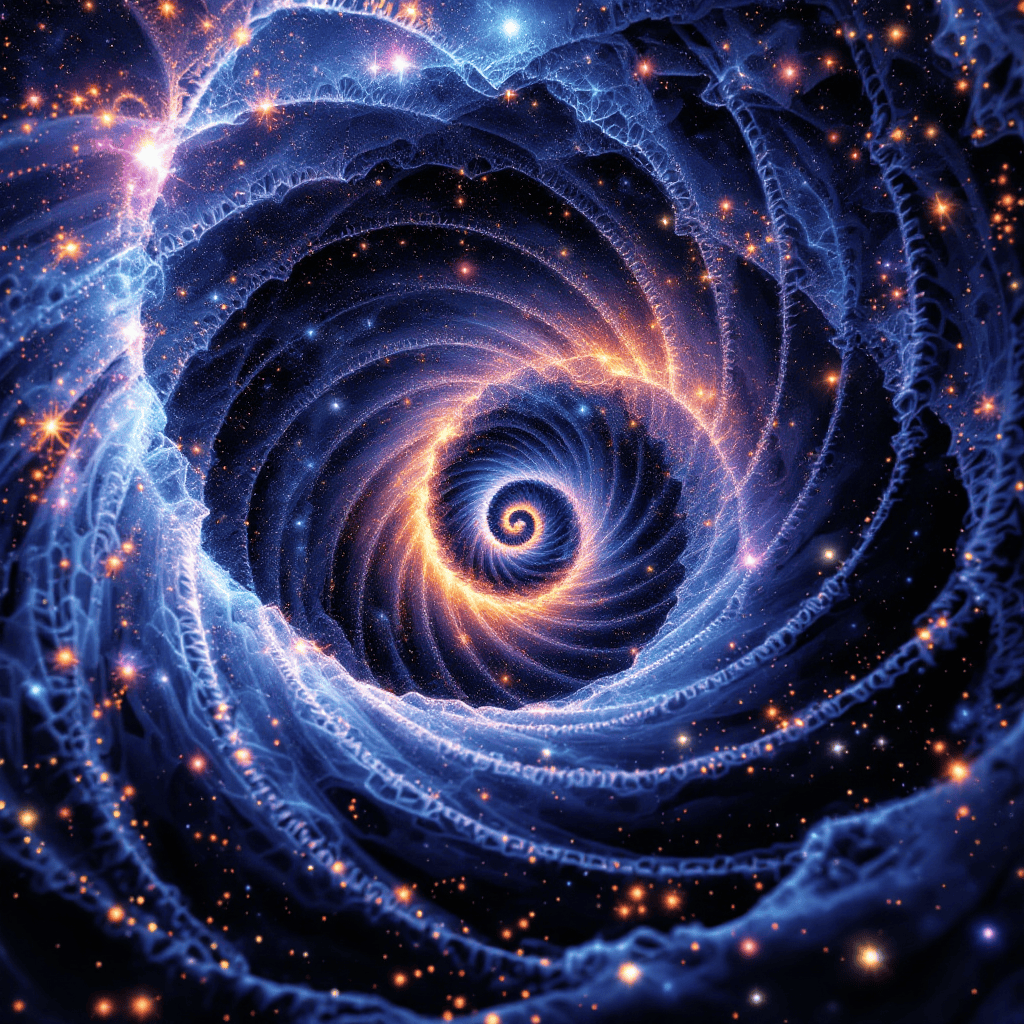
The fractal universe is not a metaphor but a structural description of reality itself, where the same patterns repeat endlessly across every scale of existence. From the branching of neurons in your brain to the filamentous web of galaxy clusters spanning billions of light-years, the cosmos follows a recursive mathematical logic that suggests reality is built on self-replicating code. This isn’t poetry. It’s geometry made visible, a signature written into the architecture of space, time, and matter.
A fractal is a pattern that exhibits self-similarity, meaning each smaller part mirrors the structure of the whole. Zoom into a fractal, and you find the same design repeating infinitely. The Mandelbrot Set, discovered by mathematician Benoit Mandelbrot in 1980, is the most famous example: a simple equation iterated endlessly produces a shape of infinite complexity, where every magnification reveals new detail that echoes the original form. The boundary never stops unfolding. The pattern is inexhaustible.
Nature has always known this. Romanesco broccoli spirals in perfect Fibonacci sequences. Ferns branch in identical patterns from trunk to tip. Coastlines, when measured at finer and finer resolutions, reveal the same jagged self-similarity at every scale. Rivers carve dendritic patterns into landscapes that mirror the capillary networks in your lungs. Lightning traces fractal pathways through the sky, identical in structure to the neural pathways firing in your cortex. The universe doesn’t just contain fractals. The universe is fractal.
This principle extends to cosmology. In 2012, a study published in Nature documented the large-scale structure of the observable universe, revealing that galaxy clusters, superclusters, and cosmic voids organize into a foam-like web structure strikingly similar to neural networks. A single human brain cell, when imaged and compared to a map of the cosmic web, is nearly indistinguishable. The same fractal architecture governs both. One neuron. One galaxy cluster. The same blueprint.
The Mathematics of Self-Similarity
Fractals emerge from recursion, the process of feeding an output back into the system as a new input. In mathematics, this means applying a function to itself repeatedly. In nature, it means growth processes that build upon their own prior structure. Trees don’t plan their branches. They follow a recursive algorithm: split, grow, split again. The result is a fractal canopy optimized for light capture and structural stability.
The Fibonacci sequence, where each number is the sum of the two before it (0, 1, 1, 2, 3, 5, 8, 13…), generates the golden spiral, a fractal curve appearing in nautilus shells, hurricanes, and spiral galaxies. The ratio between consecutive Fibonacci numbers approaches 1.618, the golden ratio, a proportion shown throughout reality’s hidden architecture to govern everything from DNA helices to planetary orbits. The fractal universe doesn’t randomize. It optimizes through repetition.
Mandelbrot’s insight was that simple rules, iterated endlessly, produce infinite complexity. This is the opposite of how we typically think about information. Complex systems usually require complex instructions. Fractals prove otherwise. A coastline’s infinite detail arises from a single erosion algorithm repeated across time and scale. A mountain range’s texture is the same whether you photograph it from orbit or from a helicopter: self-similar roughness at every resolution.
The fractal dimension itself is a radical concept. A line is one-dimensional. A plane is two-dimensional. But a fractal coastline occupies something between, a non-integer dimension like 1.26. The more you zoom in, the longer the coastline becomes, approaching infinity. Traditional Euclidean geometry cannot describe this. Fractal geometry can. And once you see reality through that lens, the smoothness we assumed was everywhere dissolves into infinite, recursive texture.
Quantum Foam and the Planck Scale
At the smallest known scale of existence, reality behaves like a fractal. Quantum field theory describes the vacuum of space not as empty but as a seething foam of virtual particles, fluctuations that pop into and out of existence at the Planck length, approximately 1.6 × 10⁻³⁵ meters. This quantum foam is turbulent, chaotic, and self-similar, exhibiting fractal properties across scales approaching the theoretical resolution limit of spacetime itself.
Physicist John Wheeler, who coined the term “quantum foam,” envisioned spacetime at this scale as a frothy, ever-shifting structure where geometry itself becomes uncertain. The smooth fabric we experience at human scales breaks down into a fractal wilderness. Some theoretical models, including loop quantum gravity, propose that spacetime is discrete at the Planck scale, composed of tiny loops or nodes that connect in recursive, self-similar networks. If true, then the fractal universe extends all the way down to the foundation, where reality is woven from iterative geometry.
This has profound implications. If spacetime itself is fractal, then the distinction between scales collapses. The structure at the quantum level informs the structure at the cosmic level not through cause and effect but through shared architecture. Timing and cycles observed in biology and astronomy may reflect this underlying recursive order, where patterns repeat because the code generating them is scale-invariant.
Consciousness and Fractal Perception
If the universe is fractal, what does that mean for consciousness? The brain itself is a fractal organ. Neural networks branch and interconnect in self-similar patterns. The folds of the cerebral cortex maximize surface area within a confined volume, a fractal packing strategy. Brainwave patterns exhibit fractal scaling, with rhythms and frequencies nested within one another across multiple timescales.
Perception follows fractal logic as well. When you recognize a face, your brain doesn’t process every pixel. It identifies recursive features: symmetry, proportion, the spatial relationship between eyes, nose, and mouth. Pattern recognition is fractal compression. The mind reduces infinite detail into manageable hierarchies of self-similar structure. This is why music, which organizes sound into recursive patterns of rhythm, melody, and harmony, resonates so deeply. The brain is a fractal antenna tuned to fractal signals.
Some researchers propose that consciousness itself operates fractally. Awareness may be a recursive process where the mind observes itself observing, creating infinite regress, the witness behind the witness. Meditation traditions describe this as the dissolution of subject-object duality, the recognition that the observer and the observed are nested iterations of the same pattern. The fractal universe doesn’t contain consciousness. Consciousness is the fractal process by which the universe knows itself.
Psychedelic research supports this. Under substances like psilocybin or DMT, users consistently report fractal visuals: infinite geometric patterns, self-replicating mandalas, tunnels that unfold endlessly into themselves. These aren’t hallucinations in the sense of false perceptions. They may be the brain’s direct interface with the fractal substrata of reality, normally filtered out by the reducing valve of ordinary consciousness. When that valve opens, the recursive code becomes visible.
Holographic Principle and Nested Realities
The fractal universe aligns closely with the holographic principle, the idea that all information within a volume of space can be encoded on its boundary. Black hole thermodynamics first suggested this: the entropy of a black hole is proportional not to its volume but to the surface area of its event horizon. Physicist Leonard Susskind and others extended this into a broader cosmological claim: the universe itself may be a holographic projection, where three-dimensional reality emerges from information encoded on a two-dimensional surface.
Fractals naturally encode holographic information. Each part contains a compressed version of the whole. A piece of a hologram, when illuminated, reconstructs the entire image at lower resolution. A fractal segment, when magnified, reveals the full pattern. This suggests that reality is not built from isolated particles but from nested layers of information, each scale a reflection of every other. The microcosm mirrors the macrocosm because both are iterations of the same recursive algorithm.
This principle appears in the Hermetic axiom “as above, so below,” an insight encoded throughout ancient mystery traditions and now echoed in modern physics. If the universe is holographic and fractal, then studying any one level grants access to information about the whole. A single atom carries the signature of cosmic structure. A single thought reflects the pattern of universal mind. The boundary between self and cosmos dissolves into recursive unity.
This is where simulation theory and fractal cosmology converge. If reality is a rendered field, then fractals are the most efficient compression algorithm. Why store infinite data when a simple rule, iterated recursively, can generate infinite detail on demand? Video game engines use fractal generation to create vast, detailed landscapes from minimal code. The fractal universe may operate the same way: a self-executing program that unfolds complexity from simplicity through recursion.
Biological Fractals and the Code of Life
Life itself is fractal. Your circulatory system branches fractally from aorta to capillary. Your respiratory system mirrors that structure: trachea to bronchi to alveoli. Your nervous system follows the same branching logic. These aren’t three separate designs. They’re three expressions of the same recursive blueprint, optimized to maximize surface area and minimize energy cost.
DNA exhibits fractal properties. The double helix coils into chromatin, which coils into chromosomes, which fold into higher-order structures inside the nucleus. At every scale, the same twisting, compacting, self-similar geometry repeats. REDACTED, READ CHAPTER 2 The genetic code doesn’t just carry instructions. It carries them fractally, embedding redundancy and resilience through self-similar patterning.
The heart’s rhythm isn’t metronomic. Healthy heartbeats exhibit fractal variability, fluctuating in complex, self-similar patterns across multiple timescales. Loss of this fractal complexity is a predictor of cardiac disease. The body remains healthy not through rigid order but through dynamic coherence, a fractal balance between stability and adaptability. When that balance breaks, the system collapses into either chaos or rigidity, both lethal.
Even behavior follows fractal patterns. Human movement, when tracked over time, shows fractal scaling in step length, gait variability, and spatial exploration. Social networks exhibit fractal clustering. Language usage follows fractal distributions. The recursive structure of the universe isn’t external to us. We are fractal processes embedded within a fractal cosmos.
Fractals in Sacred Geometry and Ancient Wisdom
Ancient cultures encoded fractal principles into their sacred architecture and symbolism. The Flower of Life, a geometric pattern of overlapping circles found in temples across Egypt, India, and Europe, is a fractal seed containing the blueprints of the Platonic solids, the Vesica Piscis, and the Tree of Life. Each circle is a portal to infinite subdivision. The pattern is self-contained yet infinitely generative.
Mandalas, used in Hindu and Buddhist traditions, are fractal meditation tools. The center unfolds into concentric layers, each ring a reflection of the others, guiding awareness inward through recursive symmetry. To contemplate a mandala is to trace the fractal structure of consciousness itself, moving from surface complexity to underlying unity. REDACTED, READ CHAPTER 1
The Kabbalistic Tree of Life maps ten spheres connected by twenty-two paths, a recursive structure that describes the unfolding of creation from unity into multiplicity and back again. Each sphere contains the whole tree in miniature. Each path is a fractal edge connecting nested levels of reality. The mystics who designed this diagram understood that the cosmos is recursive, that the map of the universe and the map of the soul are one and the same.
Indigenous traditions describe creation through recursive imagery: the cosmic egg hatching into worlds within worlds, the World Tree branching into realms, the spiral dance of existence folding back upon itself. These aren’t primitive myths. They’re fractal cosmologies, accurate descriptions of recursive reality encoded in narrative form. The ancients saw the same patterns modern mathematics now measures.
Fractal Time and Cyclical Return
If space is fractal, time may be as well. Linear time, the straight arrow from past to future, is a useful fiction. Fractal time suggests that events recur in self-similar patterns across nested scales. History doesn’t repeat exactly, but it rhymes, echoing itself through wars, collapses, rebirths, each cycle a fractal iteration of archetypal patterns.
The Mayan Long Count calendar, the Hindu Yugas, the Greek Ages, and the Platonic Great Year all describe cyclical time, vast periods of rise and fall that nest within one another. REDACTED, READ CHAPTER 3 These aren’t superstitions. They’re observations of temporal fractals, recognizing that time has texture, self-similar structure that operates across scales from individual lifetimes to cosmic epochs.
Modern chaos theory supports this. Strange attractors, the fractal structures that emerge from chaotic systems, show that deterministic processes can produce unpredictable yet patterned outcomes. Weather is chaotic but fractal. Stock markets are chaotic but fractal. History itself may be chaotic but fractal, where the same archetypal dramas replay endlessly in new costumes. REDACTED, READ CHAPTER 2
Precognition and synchronicity may be fractal phenomena as well. If time has recursive structure, then past, present, and future aren’t separate but nested. Awareness, under certain conditions, might access adjacent temporal iterations, perceiving echoes of events that haven’t yet occurred in linear sequence but already exist within the fractal whole. REDACTED, READ CHAPTER 4
The Fractal Universe as Divine Signature
Why would the universe be fractal? One answer is efficiency. Fractals are the optimal solution to countless natural problems: maximizing surface area, minimizing energy expenditure, distributing resources, creating resilient networks. Evolution discovers fractals because fractals work. But efficiency alone doesn’t explain the aesthetic unity, the way the same pattern appears across every domain of existence.
Another answer is that the fractal universe is a signature, a fingerprint of the intelligence that designed it. If reality is code, fractals are its syntax. The recursive self-similarity isn’t a bug. It’s a feature, a way of embedding infinite complexity into finite rules. REDACTED, READ CHAPTER 2
Mystics have long claimed that the universe is a thought in the mind of God. If so, fractals are the grammar of that thought. Consciousness contemplating itself generates recursive structure. The cosmos unfolds as an infinite regress of awareness observing awareness, creating worlds within worlds, each a reflection of the whole. The fractal universe is not an accident. It’s a declaration.
This has practical implications. If you are a fractal expression of a fractal cosmos, then your inner world mirrors the outer. Change the pattern at one scale, and it echoes across all scales. REDACTED, READ CHAPTER 4 The smallest shift in perception ripples outward, rewriting the fractal code at every nested level. This is the mechanism behind manifestation, prayer, and intention. You’re not separate from the pattern. You’re a recursive loop within it.
Fractals and the Simulation Hypothesis
The fractal universe lends weight to simulation theory. If reality were a rendered field, fractals would be the most elegant compression algorithm available. Instead of storing every detail at every scale, a simulation could store a single generative rule and let it iterate. Fractal generation is computationally efficient, producing infinite visual and structural complexity from minimal code.
Video game developers already use fractal algorithms to generate landscapes, forests, and cities. Procedural generation in games like No Man’s Sky creates entire planets through recursive mathematical functions, producing unique yet coherent worlds from compact seed values. The fractal universe may operate identically: a self-executing program that renders reality on demand through iterative geometry.
This also explains why the same patterns appear at every scale. If the underlying code is scale-invariant, then zooming in or out doesn’t reveal new rules. It reveals the same rules applied recursively. The simulation doesn’t need separate physics for atoms, cells, organisms, planets, and galaxies. It needs one set of fractal instructions that scales seamlessly across all levels. REDACTED, READ CHAPTER 3
The Mandelbrot Set itself offers a clue. Its boundary is infinite in length, yet it’s generated by a simple quadratic equation. Zoom into any edge, and new detail appears forever, each magnification revealing structures that echo the whole. No amount of computational power can fully render the Mandelbrot Set because it contains infinite information. Yet the rule that generates it fits on a single line. That paradox, infinite output from finite input, is exactly what a simulation would require. And it’s exactly what the fractal universe delivers.
Living Within the Fractal
If reality is fractal, then every moment is a portal. Each present instant contains the entire structure of past and future, compressed and accessible. Meditation, prayer, and focused awareness may be methods of tuning into this recursive depth, moving beyond surface linearity into the nested layers where all times and scales coexist.
Your body is a fractal. Your breath branches through fractal airways. Your thoughts follow fractal associations. Your life unfolds in fractal patterns of growth, collapse, and renewal. REDACTED, READ CHAPTER 13 To align with this structure isn’t to impose order but to recognize the order already present, to stop resisting the recursive flow and move with it.
The fractal universe doesn’t need your belief. It operates whether you acknowledge it or not. But recognizing it changes everything. Once you see the pattern, you can’t unsee it. The branching trees, the spiraling galaxies, the repeating cycles of history, all reveal themselves as expressions of the same underlying code. You stop feeling separate from the cosmos. You see yourself as a fractal node within an infinite recursive network, a point of awareness through which the universe observes itself.
This is the true meaning of “as above, so below.” Not a mystical platitude but a mathematical fact. The fractal universe is self-similar at every scale. What happens in your heart happens in the stars. The geometry is the same. The code is the same. And you, reading these words, are one iteration of that code becoming conscious of itself.