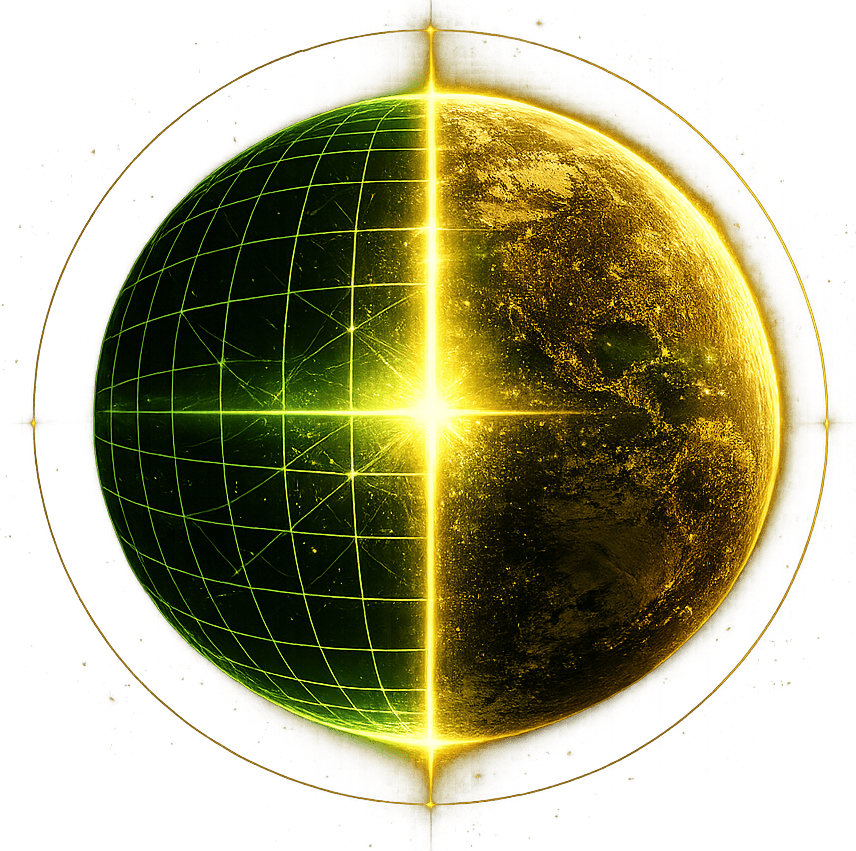
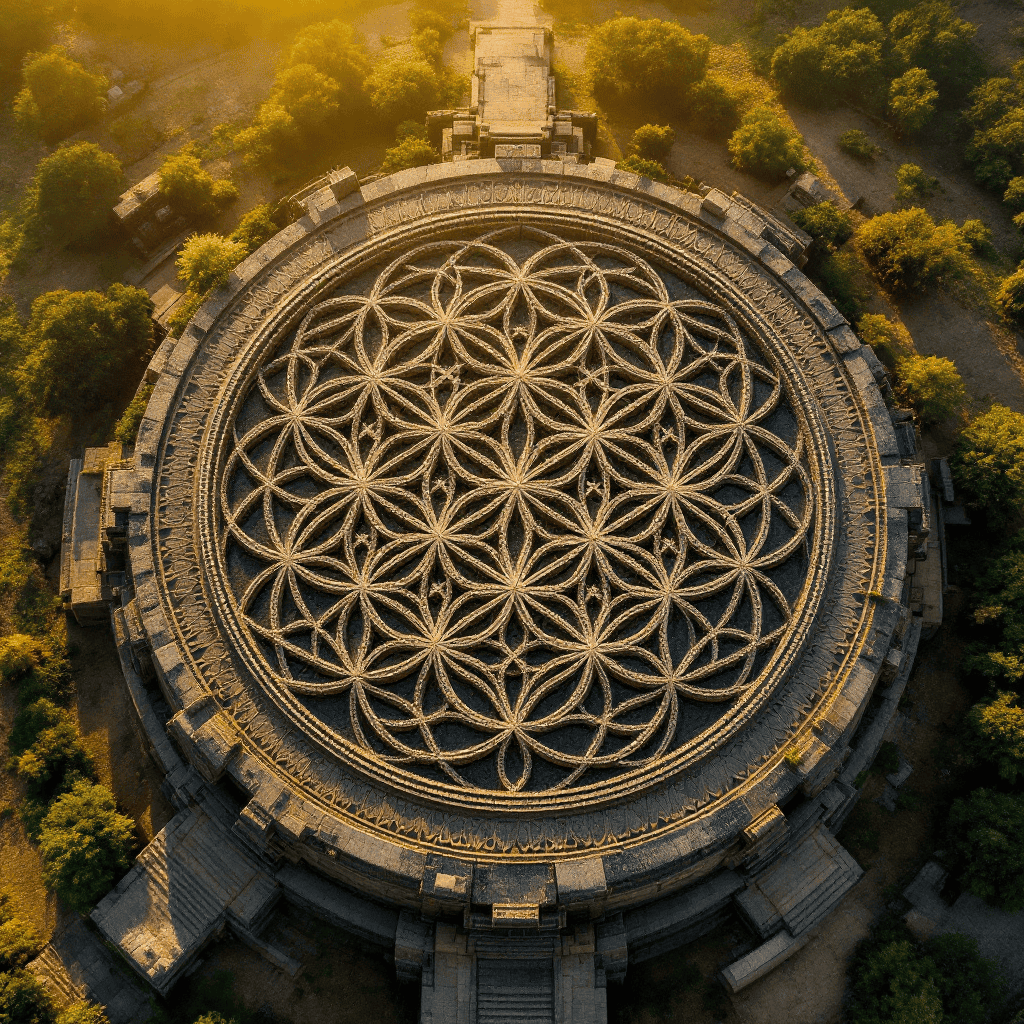
The flower of life meaning extends far beyond its visual beauty. This ancient symbol, composed of 19 overlapping circles arranged in perfect hexagonal symmetry, has appeared on temple walls, in manuscripts, and across civilizations for thousands of years. At its core, the flower of life represents the fundamental patterns through which creation unfolds, encoding within its geometry the same mathematical principles that govern atoms, galaxies, embryonic development, and consciousness itself.
To understand what this symbol truly means, you must first recognize that it is not decoration. The flower of life is a map. It reveals how reality structures itself from a single point of origin into the complex forms we experience as physical existence. Every circle within the pattern emerges from the one before it, just as every cell in your body traces back to a single fertilized egg, and every atom in the universe traces back to a singular moment of expansion.
The geometry is precise. The pattern begins with one circle, expands into the vesica piscis when a second overlaps it, then grows through the seed of life (7 circles) before blossoming into the full 19-circle flower. Each stage mirrors a phase of creation itself, from unity into multiplicity, from formlessness into form. This is why mystics across cultures recognized it as sacred, because it appears to be the signature of an ordering intelligence woven into existence itself.
The Flower of Life Meaning in Ancient Civilizations
The flower of life has been found carved and painted in sacred sites across the world. The most famous example appears at the Temple of Osiris in Abydos, Egypt, where overlapping circle patterns are etched into granite columns. While some debate whether these markings are original to the temple’s construction or later additions, the image itself has become one of the most recognized symbols of ancient geometric knowledge.
But Egypt is far from alone. The same pattern, or its foundational components, appears in Greco-Roman mosaics, medieval Christian churches, temples across Asia, and sacred art in the Americas. Gothic cathedrals incorporated the flower of life into rose windows, carrying forward a design seen in Egypt and the East. Chinese guardian lions, often called Fu Dogs, are depicted with one paw resting on a sphere adorned with the flower of life motif, symbolizing protection over sacred knowledge.
This widespread appearance suggests something more than cultural exchange. When the same geometric pattern emerges independently across continents and centuries, it points toward discovery rather than invention. Ancient builders weren’t copying each other, they were observing the same underlying structure in nature, mathematics, and perhaps even altered states of consciousness. The flower of life meaning becomes clearer when you realize it may be less a human creation and more a universal constant that humanity keeps rediscovering.
Mathematical Structure and Creation Blueprint
At the mathematical level, the flower of life encodes multiple layers of information. Within its circles, you can trace the platonic solids, the five perfectly symmetrical three-dimensional shapes that Plato identified as the building blocks of physical reality. The tetrahedron, cube, octahedron, icosahedron, and dodecahedron all nest within the flower’s geometry, suggesting that this two-dimensional pattern contains the seeds of three-dimensional form.
The golden ratio (phi, approximately 1.618) also appears throughout the pattern. This same proportion governs the spiral of a nautilus shell, the arrangement of seeds in a sunflower, the structure of galaxies, and the proportions of the human body. When a pattern this fundamental appears in a geometric symbol preserved across millennia, the meaning shifts from aesthetic to architectural. The flower of life appears to be showing us the mathematics through which the universe constructs itself.
Even more striking is the parallel between the flower of life and human embryonic development. The first division of a fertilized egg creates two cells that mirror the vesica piscis. By the eight-cell stage, the structure mirrors the egg of life, a geometric configuration that also appears as a subset within the larger flower of life pattern. What mystics once described as the blueprint of creation is now visible under the microscope, playing out in the earliest moments of biological existence. This convergence between sacred geometry and observed reality suggests that the ancients encoded biological truth through pure geometry, thousands of years before microscopes existed.
The Flower of Life Meaning in Spiritual Traditions
Across spiritual systems, the flower of life represents the fundamental unity underlying apparent diversity. In Kabbalistic tradition, the Tree of Life, a diagram mapping the emanations of divine consciousness, fits precisely within the flower of life’s geometry. Each sphere (sephirah) aligns with intersection points in the pattern, suggesting that the map of consciousness and the map of creation are one and the same.
In Eastern philosophy, the flower of life resonates with the concept of Indra’s Net, a metaphor from Buddhism describing reality as an infinite web where each node reflects all others. The overlapping circles create a similar image: each circle contains aspects of every other circle, and the whole pattern emerges from their relationships rather than from any single element. This mirrors the teaching that separation is illusion and that all phenomena arise interdependently.
The symbol also connects to the concept of sacred sound. Many traditions describe creation beginning with vibration, the Word, Om, or Logos. Cymatics, the study of how sound frequencies create visible patterns in matter, produces geometric forms remarkably similar to those found in the flower of life. When specific tones vibrate through water or sand, they organize into mandalas, hexagons, and nested circles. The flower of life meaning, in this context, becomes sonic as well as visual. It may be the shape that vibration naturally takes when it stabilizes into form.
Practitioners of meditation and energy work report that focusing on the flower of life induces states of coherence, where scattered attention gathers into clarity and the nervous system shifts from stress into balance. REDACTED, READ CHAPTER 1 The mechanism behind this effect, and the specific timing windows for optimal practice, are detailed in Chapter 1 of Master Thyself.
The Flower of Life and Metatron’s Cube
Hidden within the flower of life is another structure: the fruit of life. By connecting the centers of the 13 circles found within the flower, a new pattern emerges. From that pattern, by connecting every center point to every other center point, you generate Metatron’s Cube, one of the most powerful symbols in sacred geometry.
Metatron’s Cube contains all five platonic solids, the geometric forms said to represent the elements: fire (tetrahedron), earth (cube), air (octahedron), water (icosahedron), and ether (dodecahedron). In Kabbalistic mysticism, Metatron is the archangel who guards the Tree of Life and records the soul’s journey. The cube that bears his name is both map and key, a blueprint of how consciousness moves through matter.
This connection reveals another layer of the flower of life meaning. It is not a static image but a generative one, a seed from which more complex structures unfold. Just as DNA contains the instructions for an entire organism, the flower of life contains the instructions for the geometry of reality itself. REDACTED, READ CHAPTER 1 The full protocol for working with Metatron’s Cube as a consciousness tool is explored in depth in Master Thyself.
Flower of Life in Modern Science and Quantum Physics
Modern physics has begun arriving at conclusions that ancient geometry already encoded. Graphene, one of the strongest materials ever discovered, is a single layer of carbon atoms arranged in the flower of life’s hexagonal geometry. The pattern is literally holding matter together at the atomic scale. When the flower of life expands from a flat surface into three dimensions, its hexagonal tiling adapts into the structure of a soccer ball or truncated icosahedron, the same geometry found in viral capsids and certain molecular structures.
Quantum field theory describes reality not as particles but as fields, interconnected energy structures vibrating with potential. The overlapping circles of the flower of life provide a visual metaphor for this interconnection. Just as each circle in the pattern shares space with its neighbors, quantum fields interpenetrate rather than occupy separate territories. The flower of life meaning, in this framework, becomes a diagram of entanglement, a reminder that at the deepest level, separation is a perceptual illusion rather than a physical fact.
Some researchers have drawn informal parallels between fractal patterns observed in quantum field simulations and the nested structures of sacred geometry, suggesting both may reflect the same underlying architecture. REDACTED, READ CHAPTER 2 The specific mathematical relationships, and how they map to consciousness states, are preserved in Chapter 2 of Master Thyself.
DNA, Biology, and the Living Geometry
Perhaps the most startling connection lies in biology. Each twist of the DNA double helix is about 34 units long and 21 units wide, numbers that appear in the Fibonacci sequence, which is intimately connected to the golden ratio encoded in the flower of life. The proportions governing genetic material echo the proportions governing galaxies, spiral shells, and sacred geometry.
The human body itself is built on these ratios. The distance from outstretched hands equals your total height. The length from shoulder to elbow relates harmonically to elbow-to-wrist and wrist-to-fingertip. The face is mapped by the golden ratio, with the width of the mouth compared to the width of the nose, the spacing of the eyes compared to ear placement. Beauty across cultures has often been linked to how closely a face approaches these proportions, suggesting that beauty itself may be geometry made visible.
At the smallest scale, even the brain’s structure can be visually overlaid with the golden spiral found within the flower of life’s geometry, suggesting a correspondence between brain structure and cosmic proportion. The hippocampus, the brain’s memory center, curls in a spiral that mirrors the logarithmic curve of galaxies and seashells. The flower of life meaning extends into the architecture of consciousness itself. REDACTED, READ CHAPTER 1 Read Chapter 1 of Master Thyself for the full exploration of how body geometry aligns with cosmic design.
Working with the Flower of Life
The flower of life is not only a symbol to study but a tool to use. Meditating on the pattern has been reported to induce coherent brainwave states, where the scattered noise of everyday thinking settles into rhythmic harmony. In this state, the boundary between observer and observed begins to dissolve, and perception shifts from fragmented to unified. The same effect has been documented in traditions that use mandalas, circular geometric patterns designed to guide attention inward.
Practitioners often place the flower of life in living spaces, wear it as jewelry, or use it as a focal point during meditation. The reported effects include improved clarity, emotional balance, and a felt sense of connection to something larger than the individual self. Whether these effects arise from the geometry itself or from the focused attention it commands remains an open question, though both explanations point toward the same conclusion: attention structured by harmony produces harmonious states.
Some use the flower of life in energy work, placing it under water containers, food, or medicine with the intention that the geometric field influences the molecular structure of what sits above it. This practice echoes Masaru Emoto’s water experiments, where intention and geometry were shown to influence crystalline patterns in frozen water. REDACTED, READ CHAPTER 6 The exact duration, placement, and intention protocols are described in Chapter 6 of Master Thyself.
Artists and architects continue to incorporate the flower of life into design, recognizing that spaces built on harmonic proportions feel different than those that ignore them. Gothic cathedrals, designed with the flower of life and related geometries as their foundation, still produce feelings of awe centuries after their construction. The proportions themselves carry information, and the nervous system responds to that information whether or not the mind consciously recognizes the pattern.
The Flower of Life Meaning as a Symbol of Unity
At its deepest level, the flower of life meaning is about unity. Every circle in the pattern contains aspects of every other circle. No single element exists in isolation. The whole emerges not from any individual part but from the relationships between all parts. This is the same truth that quantum physics describes as entanglement, that spiritual traditions describe as non-duality, and that ecology describes as interdependence.
When ancient cultures placed this symbol on temple walls, they were not simply decorating. They were encoding a teaching, a reminder that the diversity of forms we perceive, stars, trees, animals, humans, are expressions of a single underlying pattern. The flower of life does not erase difference but reveals it as variation within unity, like musical notes played from the same scale.
This teaching has practical implications. If reality is structured as the flower of life suggests, interconnected and arising from relationship rather than from isolated objects, then actions ripple outward in ways we cannot fully predict. What you do to another, you do to the pattern itself, and therefore to yourself. Separation becomes a perceptual error rather than a metaphysical fact. REDACTED, READ CHAPTER 5 The specific mechanisms by which perception shapes lived reality are explored in Chapter 5 of Master Thyself.
Flower of Life and the Tree of Life
The Kabbalistic Tree of Life, a diagram of ten interconnected spheres representing the emanations of divine consciousness, sits perfectly within the flower of life geometry. This is not coincidence but correspondence. The Tree of Life maps the descent of consciousness from unity into multiplicity, from the infinite source down through increasingly dense layers of manifestation until it reaches physical form. The flower of life provides the geometric scaffold on which that descent occurs.
Each sephirah (sphere) on the Tree corresponds to a specific attribute: wisdom, understanding, mercy, severity, beauty, and so on. These are not abstract concepts but living forces, each with its own frequency, color, and planetary correspondence. When the Tree is overlaid on the flower of life, the intersections align with precision, suggesting that the ancients understood consciousness as geometric, structured by the same proportions that govern light, sound, and matter.
This connection reveals the flower of life meaning as more than a creation blueprint. It is also a map of return, showing the path consciousness takes as it ascends back toward unity. REDACTED, READ CHAPTER 20 The full initiatory sequence, including timing and the role of the claustrum, is preserved in Chapter 20 of Master Thyself on Amazon.
Why the Flower of Life Was Hidden and Preserved
For much of history, the flower of life and related geometries were restricted knowledge. Medieval masons encoded them into cathedrals but did not explain them to the public. Hermetic traditions preserved them in manuscripts hidden from institutional scrutiny. Gnostic texts described the geometry of creation but were excluded from canonical scripture. The question is why.
One answer is that geometry, when understood as more than decoration, becomes a tool of power. If reality is structured by pattern, then those who understand the pattern gain leverage over reality itself. This is not metaphorical. Architecture built on harmonic proportions produces measurable effects on mood, focus, and physiology. Sound tuned to specific frequencies can heal or harm. Symbols carried in consciousness shape behavior and perception. Knowledge of how these systems work translates directly into influence.
Institutions that control populations through belief and obedience have little interest in distributing tools that make individuals self-sufficient. If a simple geometric pattern can induce coherence, clarity, and direct contact with the sacred, what need is there for intermediaries? The flower of life was hidden not because it was false but because it worked. And what works without requiring permission threatens every system that profits from dependence. REDACTED, READ CHAPTER 16 The full history of how sacred knowledge was systematically obscured is explored in Chapter 16 of Master Thyself.
The flower of life survived because it was encoded into stone, etched into manuscripts, and passed down through lineages that valued direct experience over institutional approval. Today, the symbol is resurging not through dogma but through recognition. People see it and remember something they never consciously learned. The geometry itself seems to carry information, as if the pattern is a transmission device rather than a static image.
The Flower of Life Meaning Today
In the modern era, the flower of life has moved from temple walls into popular culture. It appears in art, jewelry, tattoos, and digital media. Some of this use is decorative, but much of it reflects a genuine search for meaning in a world that feels increasingly fragmented. The symbol offers a reminder that beneath the chaos of modern life, order persists. The same geometry that built the cosmos is still operating, still accessible, still responsive to those who learn its language.
Scientists continue to find the flower of life’s patterns in unexpected places. Graphene’s atomic structure. Viral capsid geometry. The arrangement of cells in early embryonic development. Each discovery confirms what the ancients encoded: this is not one pattern among many but the pattern, the fundamental organizing principle through which complexity arises from simplicity.
For those on a path of awakening, the flower of life serves as both map and mirror. It shows how creation unfolds, and in doing so, it reflects the same process occurring within. Consciousness does not develop randomly. It follows stages, each one building on the last, just as each circle in the flower emerges from the circles before it. To study the geometry is to study your own unfolding. REDACTED, READ CHAPTER 13 The specific stages of consciousness ascent, mapped to the body’s own geometric structure, are detailed in Chapter 13 of Master Thyself on Amazon.
The flower of life meaning is not fixed but layered. On the surface, it is beautiful. One layer deeper, it is mathematical. Deeper still, it is biological, mapping the structure of DNA and cellular division. Deeper yet, it is cosmological, encoding the proportions of planetary orbits and galactic structure. At the deepest level, it is consciousness itself, the pattern through which awareness recognizes its own nature. Each layer is true, and each invites further exploration. The symbol does not conceal its meaning but reveals it gradually, in proportion to the readiness of the observer.